Thales Alenia Space Multi-Purpose Habitation (MPH)
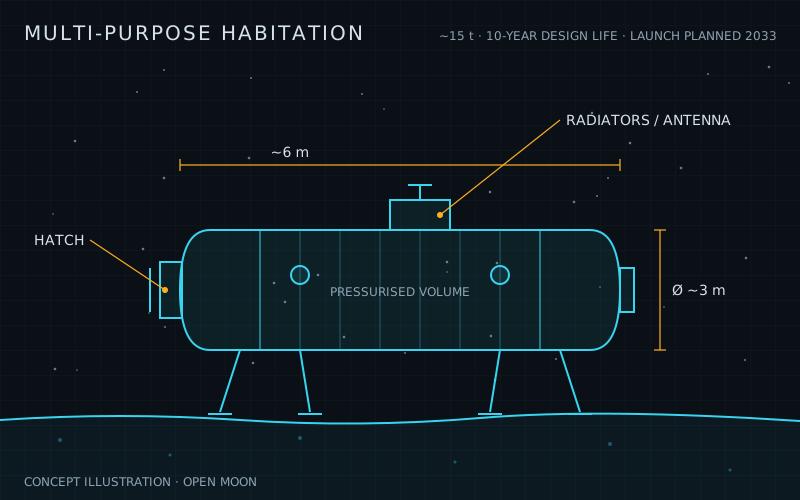
Preliminary design contract with ASI (Jul 2025); ~15 t, ~3 m × 6 m, 10-yr life; launch planned 2033
What it is
The Multi-Purpose Habitation (MPH) module is a rigid, pressurised habitat for the lunar surface. The Italian Space Agency (ASI) leads it, and Thales Alenia Space in Turin is the prime contractor. Thales Alenia Space calls it the first dedicated habitation asset on the Moon. It is planned to launch from NASA’s Kennedy Space Center in 2033 and is designed for at least 10 years of operation. Thales Alenia Space also builds pressurised modules for Gateway: ESPRIT and I-HAB for ESA, and HALO for Northrop Grumman (Thales Alenia Space).
The project grew out of a June 2022 ASI–NASA agreement that gave ASI the preliminary design of the module (European Spaceflight). NASA’s Element Initiation Review finished in October 2023 (Thales Alenia Space). ASI’s Mission Definition Review followed in July 2024 (Media INAF). A NASA Mission Concept Review board approved the next phase in September 2024 (European Spaceflight). In July 2025 ASI signed a two-year preliminary design contract with Thales Alenia Space, working with Altec (Thales Alenia Space).
In March 2026 NASA paused Gateway to focus on a surface base, and Italy signed a Statement of Intent with NASA that names habitation modules as part of its contribution. On 19 May 2026 a NASA board completed a combined System Definition and System Requirements Review, clearing the way to a Preliminary Design Review in 2027 (European Spaceflight). In September 2026 NASA Administrator Jared Isaacman said Italy is committing over $5 billion to the habitat and will get two astronaut seats on the surface. The module is expected to be ready in 2032 (European Spaceflight).
Why Open Moon uses it
The MPH is the reference habitat for milestone M08, “First habitat and crewed sorties”. It is the place where crews live during the first 14–30-day stays while they commission power, ISRU and mobility systems. Its mass of about 15 t matches what NASA says the cargo versions of the crewed landers can deliver: about 15 t. NASA plans to award delivery of a lunar surface habitat no earlier than FY2033 (NASA). That fits NASA’s Moon Base Phase Three (2032 onward), when habitats are assembled into a permanent outpost (NASA).
It is the only lunar surface habitat with a funded design contract and NASA review milestones behind it. Without it, M08 would rely on concepts such as NASA’s own Surface Habitat study (NASA), or on inflatable modules not yet designed for the Moon. Crewed sorties would then slip, and so would the later milestones that depend on people being on site.
How it works
The MPH is a cylinder about 3 m wide and 6 m long. It sits on wheels so it can be positioned precisely and serve crews at different sites (European Spaceflight). Between crews it runs science experiments on its own (European Spaceflight). Because it stays on the surface for good, it needs its own power generation and storage, thermal and environmental control, and communications. The design mixes heritage hardware with new technology (IAC-24 paper). Early work focuses on the big hazards: thermal swings, dust, radiation, micrometeoroids and low gravity (Thales Alenia Space). Altec in Turin will run ground control (Media INAF).
| Specification | Value |
|---|---|
| Size | ~3 m wide × 6 m long |
| Mass | ~15 t |
| Crew | 2 (more for short emergencies) |
| Use | 1 mission a year, 7–30 days |
| Design life | ≥10 years |
| Mobility | Wheels |
| Launch | 2033, Kennedy Space Center |
Sources: Thales Alenia Space, European Spaceflight. Pressurised volume, power level, life support design and shielding thickness have not been published.
Limitations and open issues
- Early design stage. The Preliminary Design Review is not due until 2027 (European Spaceflight). No flight hardware exists, and the 2033 launch leaves little margin.
- Small crew. It is sized for two astronauts on one 7–30-day mission a year (European Spaceflight). NASA’s Surface Habitat concept was for up to four crew for 30–60 days (NASA).
- Design may change. Wheeled mobility could be revisited as NASA moves to a more fixed Moon Base layout (European Spaceflight).
- Hard environment. Dust on mechanisms, lunar gravity effects and the cold lunar night are new problems compared with orbital modules (IAC-24 paper).
- Depends on a heavy lander. Delivery needs a ~15 t cargo lander that has not flown yet (NASA).
- Funding not fully formalised. The $5 billion figure comes from a speech, and in September 2026 a new agreement on Italy’s MPH contribution was still to be signed (European Spaceflight).
| Alternative | How it compares | Status |
|---|---|---|
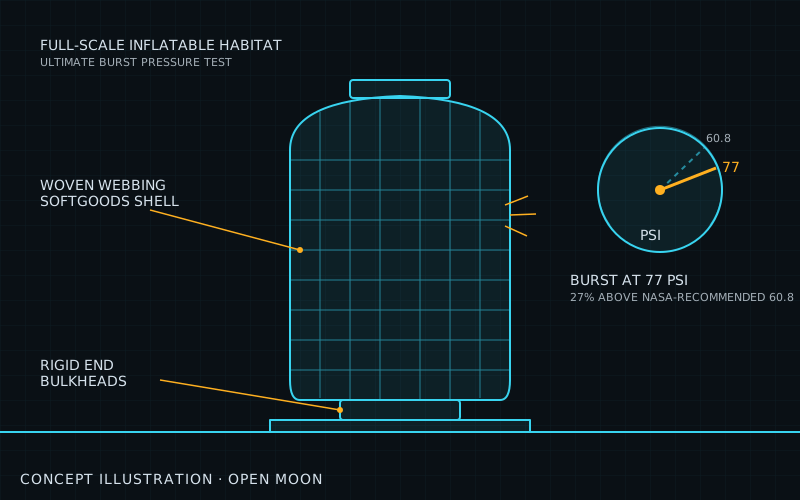
| Sierra Space LIFE inflatable habitat | A softgoods module that packs small for launch and expands to a much larger volume. It gives more room per kilogram than a rigid can, but it has no lunar-surface design or mobility yet and is aimed first at low Earth orbit. | Full-scale burst test reached 77 psi, 27% above NASA's recommended 60.8 psi (Jan 2024); planned for Orbital Reef in LEO |
| NASA Surface Habitat (Artemis Base Camp concept) | NASA's own fixed habitat concept for up to four crew for 30-60 days. It fits a four-person landing crew better than the two-crew MPH, but it is a study concept with no build contract. | Concept only (NASA paper, 2022) |
| JAXA/Toyota pressurised rover (Lunar Cruiser) | A mobile habitat and laboratory for two astronauts for up to 30 days, with about a 10-year life. Similar crew size and stay length to the MPH, but much smaller living space and designed to drive, not to be a base. | NASA-Japan agreement signed Apr 2024; delivery planned no earlier than FY2032 |
| ICON Project Olympus (built from regolith) | Builds structures from local lunar material instead of landing a 15 t module. It could give thick shielding cheaply, but it is a construction system, not a pressurised, life-supported habitat. | $57.2M NASA SBIR Phase III contract (Nov 2022); no lunar hardware flown |
- official Thales Alenia Space: contract with ASI to develop the first human outpost on the lunar surface (MPH) (Jul 2025)
- official Thales Alenia Space: Lunar Multi-Purpose Habitat activities officially underway (Nov 2023)
- paper Illiano et al. (ASI, Thales Alenia Space Italia, NASA), IAC-24: International development for lunar surface habitation (Oct 2024)
- official NASA HLS IAC 2026 presentation: cargo landers (~15 t) and lunar surface habitat delivery NET FY2033 (Oct 2026)
- official NASA Moon Base: Phases (2026)
- official Kessler et al., NASA: Artemis Deep Space Habitation: Enabling a Sustained Human Presence on the Moon and Beyond (2022)
- wiki Wikipedia: Artemis program (surface habitat and MPH) (2026)
- press Media INAF (ASI editorial): Mission Definition Review of the MPH module completed (Jul 2024)
- press European Spaceflight: NASA greenlights next phase of Italian lunar habitat project (Sep 2024)
- press European Spaceflight: ASI awards new lunar habitat contract to Thales Alenia Space (Jul 2025)
- press European Spaceflight: Italy's lunar habitat clears NASA System Requirements Review (May 2026)
- press European Spaceflight: Italy to spend over $5 billion to send two astronauts to the Moon (Sep 2026)
Summary
| System | Habitation and life support |
| Phase | 2 |
| Milestones | M08 |
| Readiness | TRL 5 / 9 |
| Plan status | ready to use |
Sources
- European Spaceflight: ASI awards new lunar habitat contract to Thales Alenia Space (MPH: 3 m × 6 m, ~15 t, 2 crew, 7–30 days a year) (status and facts)
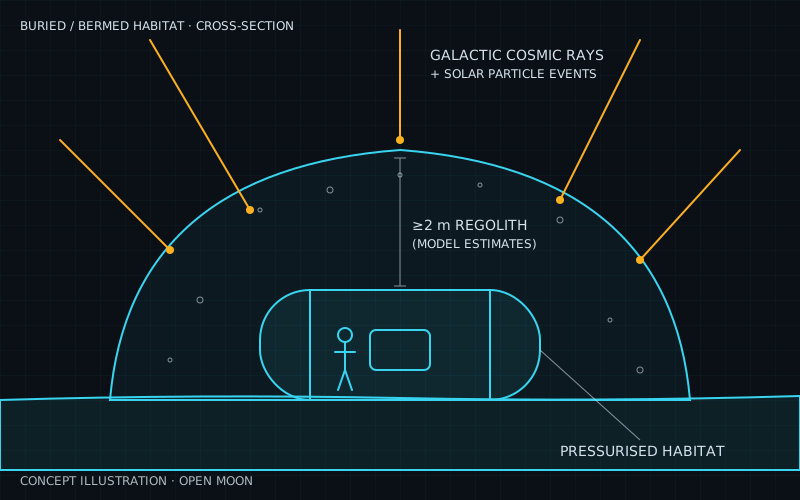
- Reference for the illustration
More sources are on each milestone page that uses this technology.