Regolith radiation shielding
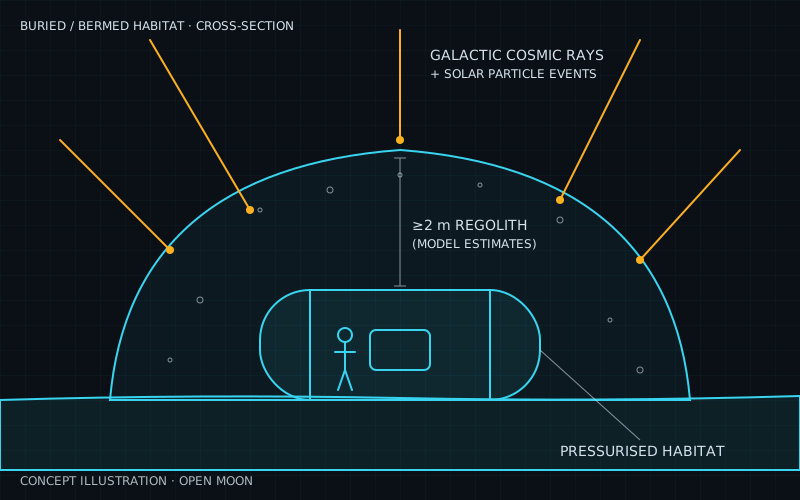
No single NASA design value; models suggest ≥2 m
What it is
Regolith radiation shielding means piling the Moon’s own loose soil over a habitat so that the soil absorbs incoming radiation. Regolith is the layer of crushed rock and dust that covers the lunar surface. It is already there, so it does not have to be launched from Earth. That is the main appeal.
The idea is old. A 1988 study for the Universities Space Research Association compared eight ways to shield a lunar base with soil and chose a module partly buried in the ground. Later NASA concepts include ARMOR, an arch-shaped jacket filled with a 3 m shell of unprocessed regolith. In 2013 ESA and Foster + Partners studied 3D-printing regolith walls over an inflatable dome and printed a 1.5 tonne demonstration block from simulant.
No regolith shield has been built on the Moon. Work so far is modelling and lab testing. There is no single NASA design value for how thick it should be, and NASA says sizing shields thicker than 100 g/cm² is not yet possible because of large physics uncertainty.
Why Open Moon uses it
The lunar surface is harsh. China’s Chang’e-4 lander measured an average dose equivalent of 1,369 µSv per day. NASA’s career limit is 600 mSv for every astronaut. Without shielding, a year on the surface would use most of a career.
Milestone M09 (permanent crew presence) depends on this. Four crew live on the surface in six-month rotations. Shipping that much shielding mass from Earth would be very costly. A 2024 IAC study found regolith-only shielding cost competitive, because launch mass drives settlement cost.
The same study, using NASA’s OLTARIS tool, found about 150 mSv per 180-day mission behind 2 m of regolith and about 100 mSv behind 3 m. Open Moon therefore sets 2 m as a minimum and 3 m as a target. Without it, crews would need short stays or shielding shipped from Earth.
How it works
Galactic cosmic rays are fast, heavy charged particles. When they hit matter, they lose energy and break apart into lighter particles. Regolith shields about as well as aluminium per unit of mass. Solar particle events are mostly lower-energy protons, which are shielded much more easily.
Thin shields can make things worse. Fragments from the shield itself can be more penetrating, so “some shielding is worse than none at all.” The IAC study found dose actually rises up to about 1 m of regolith, then falls. That is why the design uses metres, not centimetres. NASA advises not adding mass beyond 20 g/cm² unless the concept adds metres of shielding, such as a buried habitat.
Designers check a layout with OLTARIS, NASA’s web tool that combines environment models, particle transport and human body models with a ray-trace of the habitat.
| Item | Value | Source |
|---|---|---|
| Unshielded surface dose | 1,369 µSv/day | Chang’e-4 |
| NASA career limit | 600 mSv | NASA OCHMO |
| Dose peak with depth | ~1 m regolith | IAC-24 |
| Dose at 2 m, 180 days | ~150 mSv | IAC-24 |
| Dose at 3 m, 180 days | ~100 mSv | IAC-24 |
| ARMOR shell thickness | 3 m | NASA NTRS |
Limitations and open issues
- Thick-shield physics is uncertain. NASA calls for dose-depth measurements beyond 100 g/cm² and proposes stacking regolith over detectors on the Moon to measure it.
- One study sets the numbers. The 2 m and 3 m figures come from a student conference abstract. They exclude outdoor work and other shielding materials.
- No design requirement yet. NASA has not released radiation design requirements for lunar surface habitats.
- Construction is unproven. Bagging, piling or printing metres of regolith around a module has only been done as concepts and Earth demos, such as ESA’s printed block. ESA also flagged dust control as needing more study.
- Solar storms still need a plan. NASA suggests a storm shelter or wearable protection for large solar particle events, and dose outside the berm during surface work is not covered by the burial.
- Excavation mass and time. The tonnes moved and machine hours needed for a full burial are not published for a specific design.
| Alternative | How it compares | Status |
|---|---|---|
| Hydrogen-rich shields (polyethylene, water walls) | Hydrogen-rich materials stop particles better per kilogram than regolith and make fewer harmful fragments, and stored water or supplies can double as a storm shelter. But they must be shipped from Earth or made from scarce local water, so they suit a small shelter better than a whole buried habitat. | Polyethylene and water walls are studied by NASA for storm shelters; no surface habitat uses them yet. |
| Regolith mixed with polyethylene or water | Blending some polymer or water into regolith improves shielding while cutting how much polymer must come from Earth. It adds processing and some imported mass compared with plain piled regolith. | Lab tests with simulants on proton and neutron beams (2011); small gains measured, about 6% with 2 wt% water. |
| Lava tubes | A natural roof of many metres of rock and regolith gives shielding with no digging or piling. But the base must go where a usable tube is, and no lunar tube has been explored on the ground. | Modelled as radiation-safe in a 2002 NASA-linked analysis; no tube entered or surveyed in situ. |
| Wearable shielding (AstroRad vest) | A vest protects the most sensitive organs during a solar storm with far less mass than a buried habitat. It does little against galactic cosmic rays and is not meant to be worn all the time. | Flown on a phantom in Orion on Artemis I (2022) in DLR's MARE experiment. |
- paper Savage, IAC-24 abstract: Radiation shielding for long-term lunar settlements with regolith and other ISRU options (Oct 2024)
- paper Zhang et al., Science Advances: First measurements of the radiation dose on the lunar surface (Chang'e-4) (Sep 2020)
- official NASA OCHMO: Radiation protection technical brief (600 mSv career limit) (Mar 2023)
- official NASA (NTRS): NASEM presentation on space radiation gaps and lunar dose-depth measurements (Jul 2025)
- official Clowdsley, NASA Langley: Protecting astronauts from space radiation on the lunar surface (LSIC talk) (Feb 2021)
- data NASA OLTARIS: On-Line Tool for the Assessment of Radiation in Space (accessed Nov 2026)
- official Giersch, NASA NTRS: ARMOR archway for radiation and micrometeorite resistance (3 m regolith shell) (Dec 2012)
- official Bell et al., NASA NTRS: Radiation protective structure alternatives for habitats of a lunar base (1988)
- paper Miller et al., NASA NTRS: Radiation transport properties of regolith-epoxy materials (Feb 2003)
- paper De Angelis et al., NASA NTRS: Lunar lava tube radiation safety analysis (Dec 2002)
- paper Johnson et al., NASA NTRS: Radiation shielding of lunar regolith/polyethylene composites and regolith/water mixtures (2011)
- official DLR: MARE, the Matroshka AstroRad Radiation Experiment on Artemis I (accessed Nov 2026)
- official ESA: Building a lunar base with 3D printing (Jan 2013)
- wiki Lunar regolith, Wikipedia (accessed Nov 2026)
Summary
| System | Habitation and life support |
| Phase | 3 |
| Milestones | M09 |
| Readiness | TRL 4 / 9 |
| Plan status | needs development |
Sources
- IAC-24 abstract: regolith shielding depth (OLTARIS) (status and facts)
- Reference for the illustration
More sources are on each milestone page that uses this technology.