Sierra Space LIFE inflatable
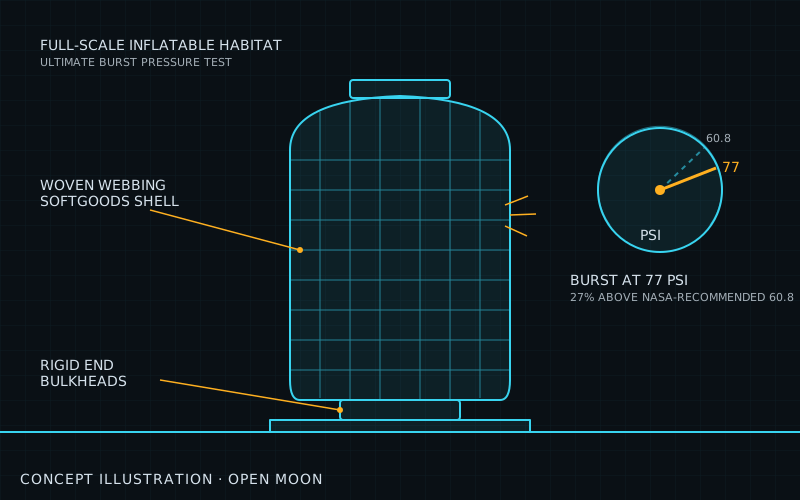
Full-scale burst test reached 77 psi before bursting (reported Jan 2024), 27% above NASA's recommended 60.8 psi
What it is
LIFE (Large Integrated Flexible Environment) is an inflatable habitat module built by Sierra Space. Its walls are “softgoods”: sewn and woven fabrics, mainly Vectran, that become a rigid structure once pressurised (Sierra Space). The module launches folded inside a standard 5 m rocket fairing and inflates to the size of a three-storey building (Sierra Space). The softgoods partner is ILC Dover. The idea traces back to NASA’s TransHab, an inflatable module of the late 1990s that Congress cancelled in 2000 (Wikipedia).
The first product, LIFE 285, has 285 m³ of volume, a 9 m diameter and a 6 m length. It is meant to sleep four astronauts (Sierra Space). Sierra Space has run burst and creep tests on five sub-scale units since 2022 (Sierra Space). It has burst two full-scale units, in December 2023 (77 psi) and June 2024 (74 psi) (Sierra Space). NASA’s Marshall Space Flight Center supported the full-scale tests under a reimbursable Space Act Agreement (Sierra Space; TechCrunch).
LIFE has not flown. Sierra Space plans a stand-alone “pathfinder” mission before the end of the decade (Sierra Space), supported by a NASA Space Act Agreement (Sierra Space). LIFE was also meant to be part of the Orbital Reef station with Blue Origin. In November 2026, Blue Origin said it was leaving Orbital Reef to focus on the Moon (Wikipedia).
Why Open Moon uses it
Open Moon lists LIFE as the alternative expandable habitat for M08, First habitat and crewed sorties. The baseline in M08 is one rigid, roughly 15 t module. An inflatable is the main way to get much more living space per launch later. Sierra Space says its modules give more than five times the volume of the fairing they fly in (Sierra Space). Sierra Space also says LIFE could be deployed on the Moon and Mars (Sierra Space blog). Under NASA’s NextSTEP-2 habitat program, it is assessing how well LIFE extends to the Moon and Mars (Sierra Space).
Without an inflatable, the base grows only by landing more rigid modules. Each one gives far less volume per tonne launched. A base of four or more people would need many more cargo landings.
How it works
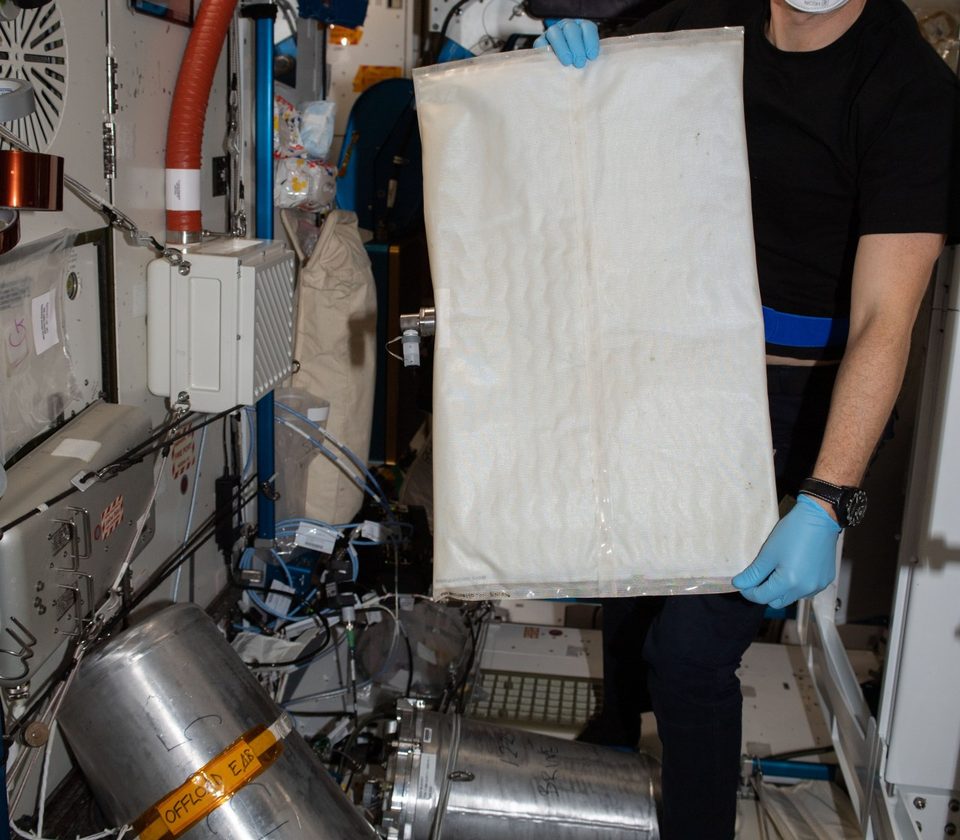
The load-bearing part is the restraint layer: a woven shell of Vectran straps and other high-strength fabrics that holds the air pressure (Sierra Space). Separate layers are planned for airtightness (the atmospheric barrier) and for protection against micrometeoroids and orbital debris. Sierra Space described these layers as at an early stage of development in January 2024 (same source). Metal plates can be built into the fabric to hold windows, robotic arms or antennas. The second full-scale test used two 4 ft by 4 ft steel plates in place of windows (Sierra Space).
Soft structures need a safety factor of four under NASA guidelines. A full-size module working at 15.2 psi must therefore hold at least 60.8 psi before it bursts (Sierra Space). Fabric also slowly stretches under constant load (“creep”). A one-third-scale creep test lasted over 150 hours against NASA’s 100-hour target (Sierra Space). From a month-long creep test in 2023, Sierra Space predicts a shell life far beyond 60 years. That figure is a 15-year design life times the safety factor of four (Sierra Space).
| Item | Value | Source |
|---|---|---|
| LIFE 285 volume / diameter / length | 285 m³ / 9 m / 6 m | Sierra Space |
| Launch fairing | 5 m | Sierra Space |
| Crew sleeping capacity | 4 | Sierra Space |
| Max operating pressure | 15.2 psi | Sierra Space |
| Required burst pressure (4×) | 60.8 psi | same |
| Full-scale bursts | 77 psi (Dec 2023), 74 psi (Jun 2024) | Sierra Space |
| One-third-scale bursts | 192 psi and 204 psi vs 182.4 psi required (2022) | Sierra Space |
| Larger planned sizes | 500 m³ (5 m fairing), 1,400 m³ (7 m), 5,000 m³ (9 m) | Sierra Space |
| Module mass | Not published | — |
Limitations and open issues
- Never flown. All tests so far are ground burst and creep tests of the pressure shell. The only expandable module flown to a station is the much smaller BEAM (16 m³), on the ISS since 2016 (Wikipedia).
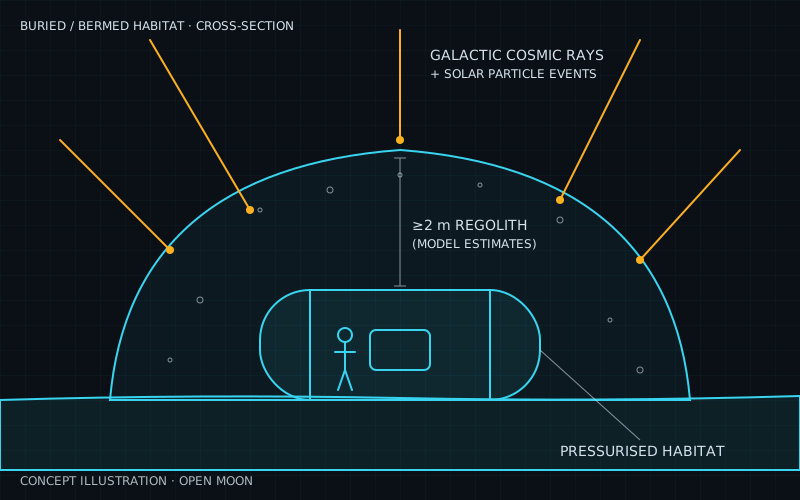
- Designed for orbit, not the Moon. Sierra Space has published no lunar surface design. There are no published details on floors, landing loads, dust, thermal cycling or regolith shielding over the shell.
- Other layers unproven. The airtight barrier and debris-protection layers were at an early stage in 2024 (Sierra Space).
- Certification not finished. NASA certification of the primary structure for human use still needs more tests (Sierra Space).
- Mass and cost not public. Neither has been published, so Open Moon cannot yet compare it fairly with rigid modules.
- Programme risk. Blue Origin’s exit from Orbital Reef in November 2026 removes one planned customer (Wikipedia). The pathfinder launch date is not fixed.
- Company claims. Most performance figures come from Sierra Space press releases rather than independent NASA reports.
| Alternative | How it compares | Status |
|---|---|---|
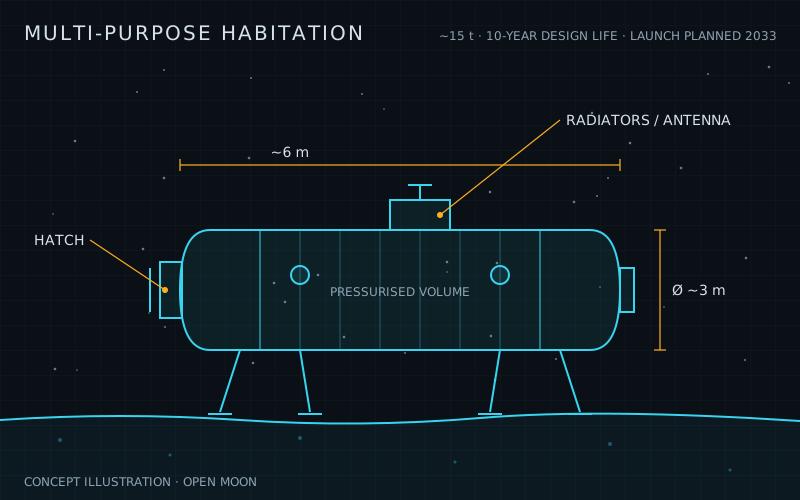
| Thales Alenia Space Multi-Purpose Habitation (MPH) | A rigid metal surface module instead of a fabric one. It is far smaller (about 3 m by 6 m) but uses well-understood pressure-vessel engineering and is designed for the lunar surface from the start, whereas LIFE has only been designed and tested for orbit. | Preliminary design contract from the Italian Space Agency (Jul 2025); launch planned for 2033 |
| Bigelow Expandable Activity Module (BEAM) | A small expandable module (16 m³) that has actually flown. It proves soft-shell modules can hold pressure in space for years, but it is far smaller than LIFE and its maker, Bigelow Aerospace, stopped operating in 2020. | Attached to the ISS since 2016 and still used for storage; owned by NASA |
| ICON Project Olympus (3D-printed regolith structures) | Builds walls from local lunar soil instead of launching a shell. This saves launch mass and gives thick shielding, but needs working printing robots on the surface and a separate airtight liner. | NASA SBIR Phase III contract of $57.2 million (2022) for landing pads, blast shields and roads |
| Lunar lava tubes | Natural caves could give radiation and meteoroid shelter with no construction, and an inflatable could be placed inside one. They are hard to reach and still barely explored. | Candidate sites identified from orbit; no surface exploration yet |
- official Sierra Space: LIFE inflatable space station product page (sizes, test history) (Nov 2026)
- official Sierra Space: first full-scale Ultimate Burst Pressure test reaches 77 psi (Jan 2024)
- official Sierra Space: second full-scale burst test reaches 74 psi (Jul 2024)
- official Sierra Space: first one-third-scale burst test (192 psi) under NASA NextSTEP-2 (Sep 2022)
- official Sierra Space: second sub-scale burst test (204 psi) (Dec 2022)
- official Sierra Space: sub-scale creep test lasts over 150 hours (Jan 2023)
- official Sierra Space: month-long creep test and new NASA Marshall Space Act Agreement (Mar 2023)
- official Sierra Space blog: LIFE habitat for orbit, the Moon and Mars (Apr 2022)
- press TechCrunch: Sierra Space's inflatable habitat blows up as planned (Jan 2024)
- wiki Wikipedia: Large Integrated Flexible Environment (Apr 2026)
- wiki Wikipedia: Orbital Reef (Nov 2026)
- wiki Wikipedia: Bigelow Expandable Activity Module (BEAM) (2026)
- wiki Wikipedia: TransHab, NASA's 1990s inflatable module (2026)
Summary
| System | Habitation and life support |
| Phase | 2 |
| Milestones | M08 |
| Readiness | TRL 5 / 9 |
| Plan status | ready to use |
Sources
- TechCrunch: Sierra Space's inflatable habitat blows up as planned (status and facts)
- Reference for the illustration
More sources are on each milestone page that uses this technology.