SpaceX Starship HLS / cargo
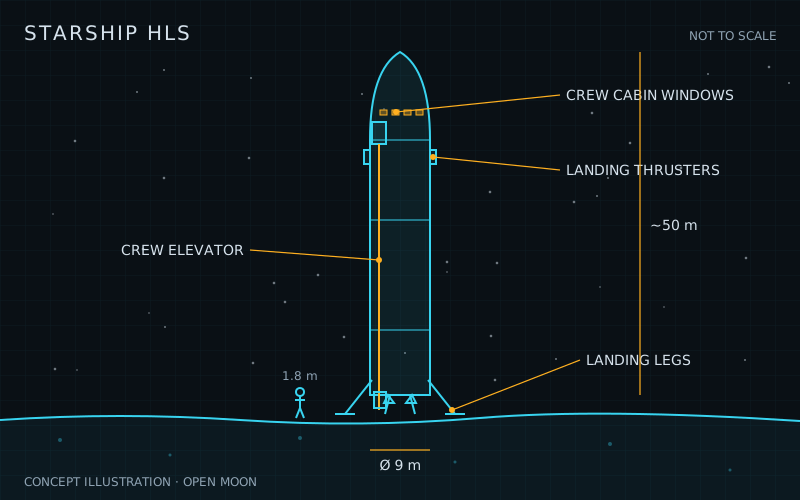
Starship reached orbit on flights 14 and 15 (2026); ship caught by the tower after flight 15
What it is
Starship HLS is the lunar version of SpaceX’s Starship upper stage. It is one of NASA’s two Human Landing Systems for Artemis. It stands about 52 m (171 ft) tall, uses six Raptor engines burning liquid methane and liquid oxygen, and is the second stage of the Super Heavy rocket. It is 9 m wide, carries 2 to 4 crew, and has no heat shield or fins because it never returns to Earth.
NASA chose SpaceX in 2021. The Option A contract was worth about $3 billion and Option B about $1 billion, for a total of about $4.3 billion; by December 2025 it had grown by about $253 million. The OIG found the Artemis III lander delayed by at least two years. NASA then changed the plan. Artemis III (2027) is now an Earth-orbit docking test with a Version 3 Starship test article, and Artemis IV (2028) is the first crewed landing.
Flight testing is moving fast. Flight 14 (28 September 2026) reached orbit despite losing one engine. On Flight 15 (13 November 2026) the ship spent more than 22 hours in orbit and was then caught by the tower, the first catch of a Starship upper stage from orbit. NASA also plans a cargo variant. It says the cargo versions of both crew landers will deliver about 15 t (33,000 lb) to the surface.
Why Open Moon uses it
Open Moon needs one heavy lander for its largest items: habitats, the fission reactor and large ISRU plants. Starship cargo is one of two candidates for the “heavy cargo” class in milestone M02 (transport). The habitat in M08 and later propellant work in M11 depend on that class. NASA already intends to give SpaceX the job of landing JAXA’s pressurized rover no earlier than FY2032. That makes Starship one of the first landers likely to carry a large payload to the Moon.
It is also a possible crew ride. Starship HLS has an elevator that moves crew and cargo between the cabin and the surface.
Without a heavy lander, every habitat and power unit would have to be split into pieces of about 3 t or less for landers like Blue Moon Mark 1. That means more landings, more assembly on the surface and more ways to fail.
How it works
A Starship lander cannot reach the Moon on one tank. SpaceX first launches a depot ship to low Earth orbit. Then more than 10 tanker flights fill it, one every 6 days, starting more than 200 days before crew launch. The lander docks with the depot and refuels, then flies to lunar orbit. There it can wait up to 100 days. Near the surface it uses thrusters on the mid-body, not the main Raptors, to limit plume damage.
| Item | Value |
|---|---|
| Height | 52 m (171 ft) |
| Diameter | 9 m |
| Engines | 6 Raptor (methane / oxygen) |
| Crew | 2 to 4 |
| Cargo to surface (NASA, cargo variant) | ~15 t |
| Tanker flights per mission | more than 10 (OIG) |
| Loiter in lunar orbit | up to 100 days |
| Crew/cargo access | Elevator |
The Wikipedia infobox lists 100 t to the surface. NASA has not published that figure, so Open Moon plans on NASA’s 15 t.
Limitations and open issues
- Refuelling is unproven. Moving cryogenic propellant between two spacecraft has never been done. Only a tank-to-tank transfer inside one ship (Flight 3, March 2024) has flown. The ship-to-ship test slipped from March 2025 and is now listed as no earlier than Q1 2027.
- Launch cadence. The OIG notes SpaceX has not shown the required 12 to 24 day pad turnaround needed for the tanker campaign.
- Schedule. NASA’s own plan puts the first tanker flight and the uncrewed landing demo in late 2027 to early 2028. The OIG said each failed test flight costs an estimated 1 to 3 months.
- Cargo variant details. No public cargo deck size, unloading method or price per landing has been published.
- Tall lander. Cargo sits many metres above the ground. Open Moon needs the elevator or a surface crane to unload it.
- Plume effects. A large lander landing near base hardware will throw regolith; NASA is still testing plume-surface interaction.
- Booster recovery. On Flight 15 the booster’s tower catch was called off and it was lost in the Gulf, so rapid reuse is still being proven.
| Alternative | How it compares | Status |
|---|---|---|
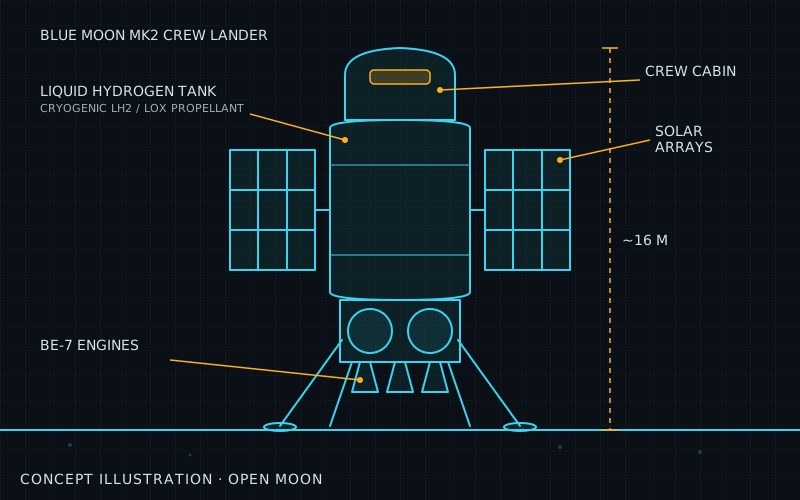
| Blue Origin Blue Moon Mk2 (cargo variant) | The other NASA crew lander, burning hydrogen and oxygen and launched inside a New Glenn fairing. NASA rates its cargo variant in the same ~15 t class. It gives Open Moon a second heavy supplier, but it also depends on in-space cryogenic refuelling and is further from flight than Starship. | In development under a ~$3.1B NASA contract; OIG expects its uncrewed demo in February 2029 |
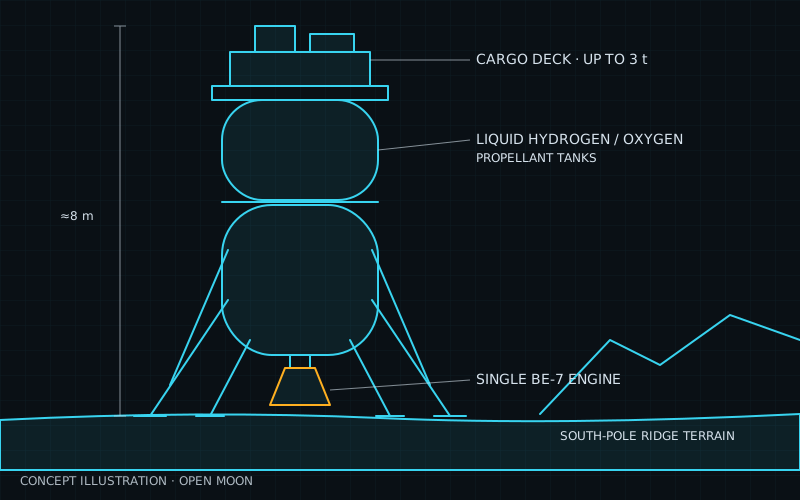
| Blue Origin Blue Moon Mark 1 | Single-use robotic cargo lander carrying up to about 3 t. Much smaller than Starship, but it needs no refuelling and is closer to its first landing. Heavy items would have to be split into pieces. | In development; Pathfinder landing planned for 2027 |
| ESA Argonaut | European robotic lander launched on Ariane 6, delivering up to 1.5 t. Gives a non-US option, but carries about a tenth of Starship's planned cargo and flies later. | In development; first launch planned for 2030 |
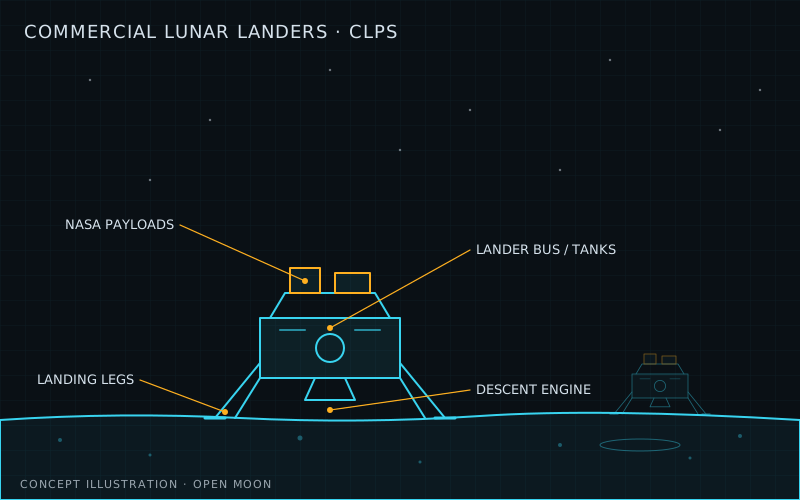
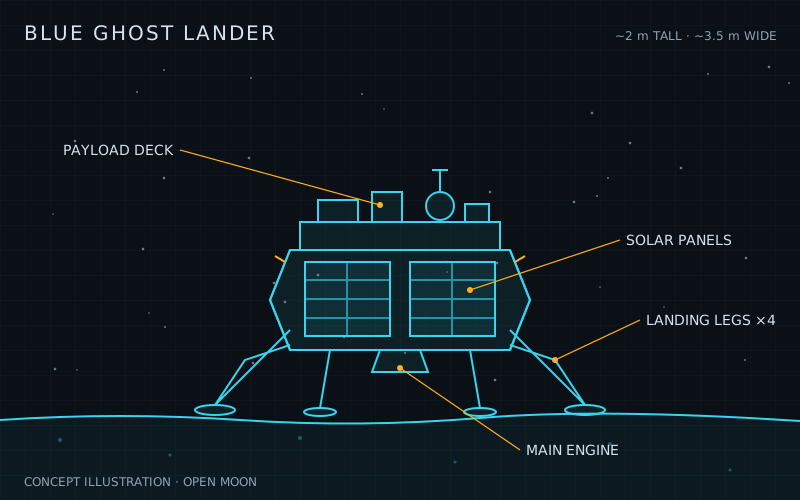
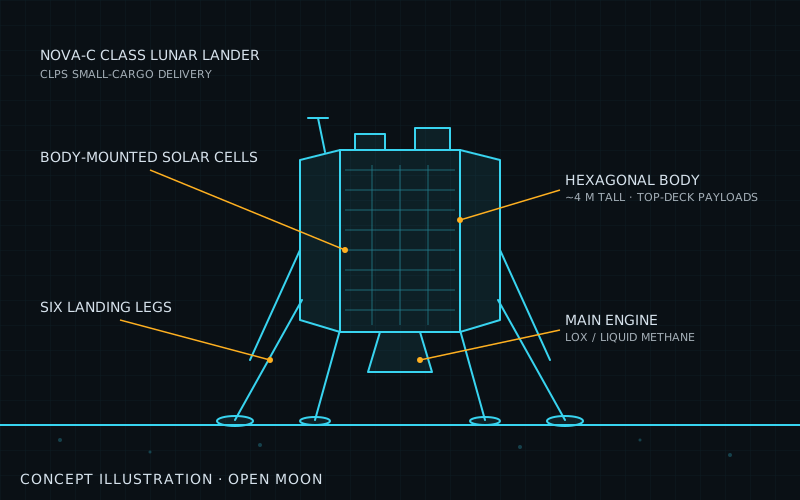
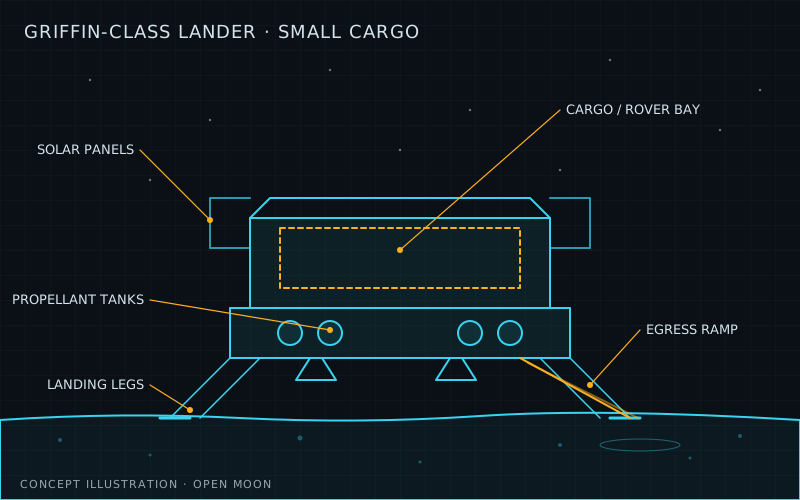
| CLPS small commercial landers | NASA-bought deliveries on small landers such as Blue Ghost, Nova-C and Griffin. Already flying, but far too small for habitats or reactors; landing reliability has been mixed. | Operational; several landings since 2024 |
- official NASA OIG IG-26-004: NASA's Management of the Human Landing System Contracts (Mar 2026)
- official NASA's Human Landing System: Demonstrating the Capability to Land Artemis Astronauts on the Moon by 2028 (IAC 2026) (Oct 2026)
- official NASA: NASA shares plans to accelerate Artemis return to Moon (Nov 2026)
- official NASA: Human Landing Systems reference page (accessed Nov 2026)
- official NASA: Artemis mission progresses with SpaceX Starship test flight (Flight 3 propellant transfer) (Mar 2024)
- official NASA NTRS: Guidelines for In-Space Cryogenic Propellant Transfer (ISCPT) (2025)
- wiki Starship HLS, Wikipedia (accessed Nov 2026)
- wiki Starship flight 14, Wikipedia (Sep 2026)
- wiki Starship flight 15, Wikipedia (Nov 2026)
- wiki Starship Propellant Transfer Demonstration, Wikipedia (accessed Nov 2026)
- wiki Blue Moon (spacecraft), Wikipedia (accessed Nov 2026)
- wiki SpaceX Starship, Wikipedia (accessed Nov 2026)
Summary
| System | Transport |
| Phase | 1 |
| Milestones | M02 |
| Readiness | TRL 6 / 9 |
| Plan status | ready to use |
Sources
- Starship flight 15, Wikipedia (status and facts)
- Reference for the illustration
More sources are on each milestone page that uses this technology.