Firefly Blue Ghost lander
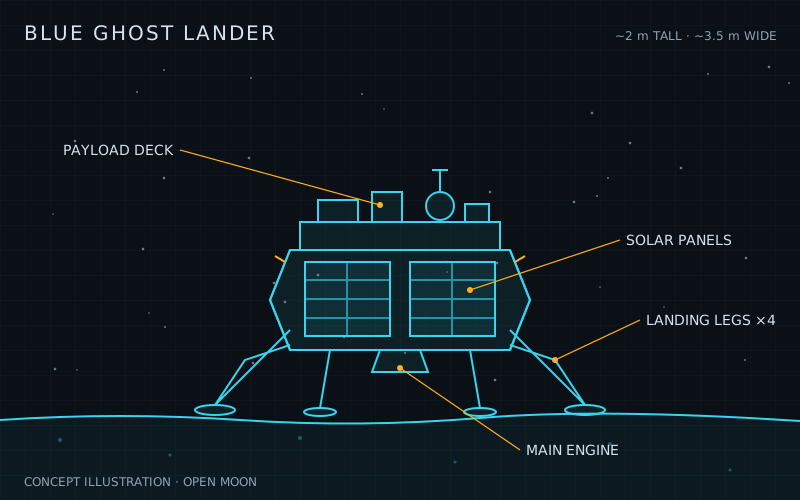
Fully successful landing Mar 2025; 14 days of operations
What it is
Blue Ghost is a small robotic lunar lander built and operated by Firefly Aerospace of Cedar Park, Texas. It carries small payloads to the Moon’s surface and provides them with power, data and heat (Wikipedia). NASA paid about $93.3 million in 2021 for its first flight, which carried 10 NASA science and technology payloads to Mare Crisium on the Moon’s near side (NASA).
Blue Ghost Mission 1 launched on a Falcon 9 on 15 January 2025 and landed on 2 March 2025 (Wikipedia). Firefly calls it the first fully successful commercial Moon landing. The lander worked for 346 hours of daylight, then just over 5 hours into the lunar night, and sent back more than 119 GB of data, 51 GB of it science and technology data (Firefly). All 10 NASA payloads switched on and collected data (NASA).
More flights are booked. Mission 2 will go to the far side with ESA’s Lunar Pathfinder relay satellite (ESA). It has slipped into 2027, and in October 2026 the lander still had no engines installed (The Space Review). Mission 3 targets the Gruithuisen Domes (NASA Science). Mission 4, a $176.7 million award, targets the south pole region in 2029 (NASA).
Why Open Moon uses it
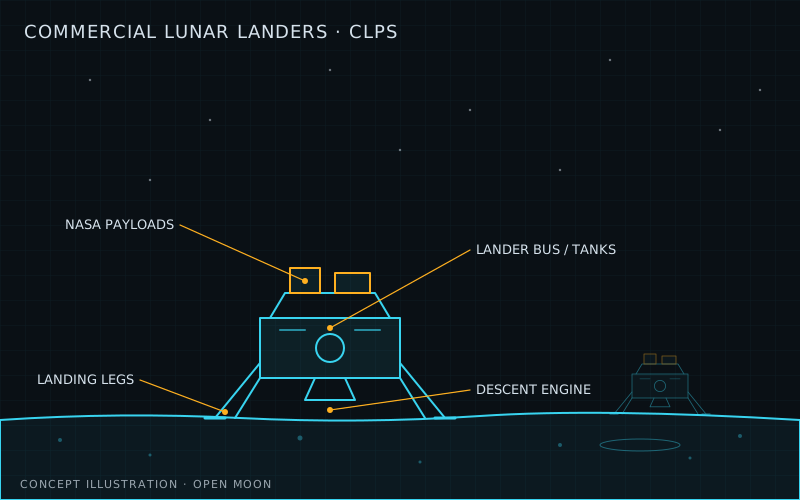
Open Moon’s transport milestone (M02) splits deliveries by size. Blue Ghost is one of three commercial landers in the “small cargo, under 1 t” class, beside Astrobotic Griffin and Intuitive Machines Nova-C. It is the only one so far with a fully successful landing that stayed upright and worked through a whole lunar day (Firefly). That makes it the most proven way to land instruments, small rovers and test hardware early in Phase 1.
The prospecting milestone (M01) also leans on commercial landers to deliver its instruments, and the comms milestone (M03) depends on Lunar Pathfinder, which flies on Blue Ghost Mission 2 (ESA). Without Blue Ghost, Open Moon would rely on landers that have either tipped over or not yet flown, and small payloads would wait longer for a ride.
How it works
Blue Ghost is a low, wide, four-legged lander. Its wide footprint, low centre of mass and shock-absorbing feet are meant to stop it tipping on landing (Firefly graphic). A single main engine, the Nammo LEROS 4-ET, does the lunar orbit insertion and powered descent. Reaction control thrusters hold its attitude and help with the soft landing. Contact sensors on the legs shut the engine down at touchdown (Wikipedia). Vision navigation cameras guide it down without GPS (Firefly graphic).
Solar panels charge batteries, so the lander works through one lunar day (about 14 Earth days) and dies a few hours after sunset (NASA). On Mission 2, an Elytra transfer vehicle will carry the lander and Lunar Pathfinder into lunar orbit (Wikipedia).
| Spec | Value |
|---|---|
| Height × width | 2 m × 3.5 m (Firefly) |
| Dry mass (Mission 1) | 469 kg (Firefly) |
| Propellant | 1,000 kg: MMH, MON-3 and helium, in 6 carbon fibre tanks (Firefly) |
| Thrusters | 1 main engine, 8 RCS, 12 attitude control (Firefly) |
| Payload to surface | Up to 240 kg (Firefly) |
| Payload power | Over 400 W (Firefly) |
| Landing precision | 4 m, without GPS (Firefly) |
| Communications | 1 X-band, 3 S-band antennas; direct to Earth or via relay (Firefly, Firefly) |
Limitations and open issues
- Small payload. Up to 240 kg reaches the surface (Firefly). Mission 1 carried only about 94 kg of NASA payloads (NASA). Pilot plants, power units and big rovers need larger landers.
- No night survival. Mission 1 lasted one lunar day plus about 5 hours of night (Firefly). On Mission 2 the lander will shut down after its first day; only the LuSEE-Night payload has its own battery for the night (Wikipedia).
- One success so far. A single landing, at an easy, flat, near-side mare site, does not prove the design for polar craters or far-side terrain.
- Schedule slips. Mission 2 was planned for 2026 but slipped into 2027, and in October 2026 the lander still lacked its engines and propulsion parts (The Space Review).
- Price per kilogram is not published. NASA prices whole task orders, not cost per kilogram, so Open Moon cannot compare cost directly with other landers.
| Alternative | How it compares | Status |
|---|---|---|
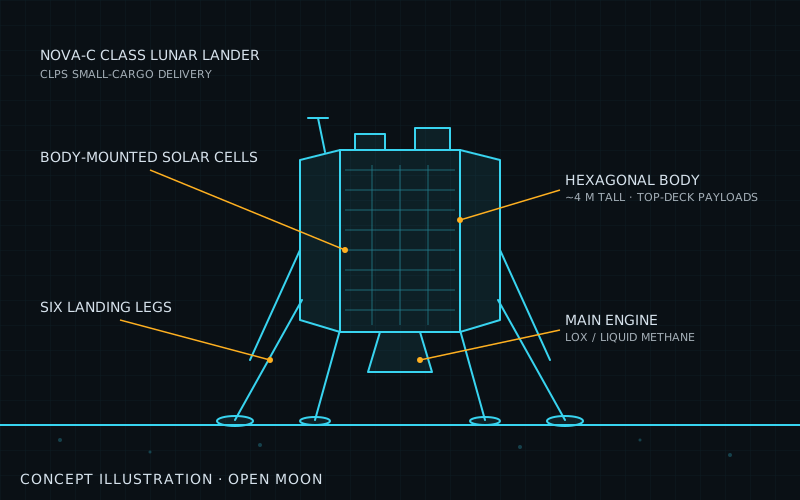
| Intuitive Machines Nova-C | Taller, narrower lander with liquid oxygen/methane engine and over 130 kg payload. Lands closer to the south pole, but its tall, narrow shape has tipped over on both landings so far. | Landed twice (IM-1 Feb 2024, IM-2 Mar 2025), both ended on their side; IM-3 pending |
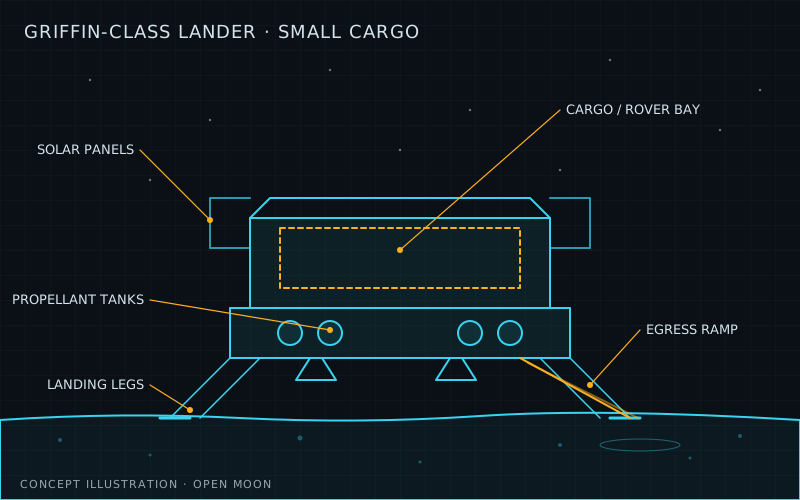
| Astrobotic Griffin | Larger lander (1,265 kg) designed to carry over 445 kg, including a 500 kg rover. Carries nearly twice Blue Ghost's payload but has not flown, and needs a Falcon Heavy. | Griffin-1 to Nobile crater near the south pole, launch no earlier than January 2027 |
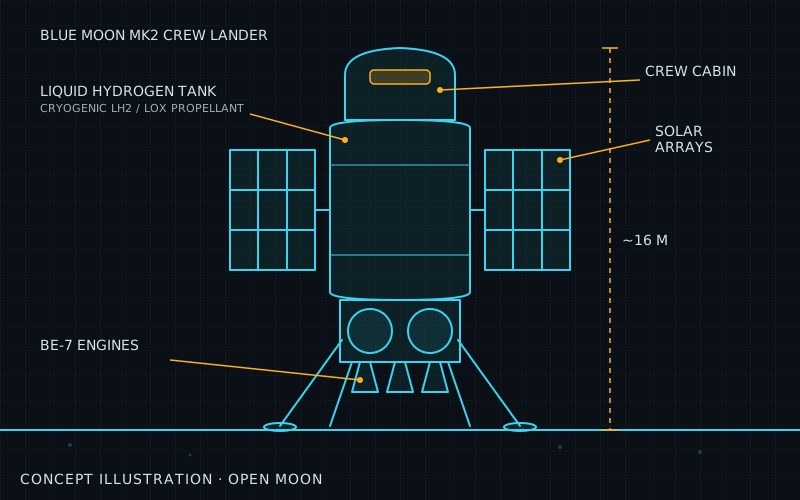
| Blue Origin Blue Moon Mark 1 | Much bigger single-use cargo lander, planned to deliver up to about 3 t. Fits medium cargo that Blue Ghost cannot carry, but is unflown. | First Mark 1 grounded by the New Glenn pad explosion; launch expected early 2027 |
| ispace Hakuto-R / Series landers | Small Japanese lander (340 kg) that took a slow low-energy path to the Moon. Cheaper ride for very small payloads, but its Mission 2 lander crashed. | Mission 2 (Resilience) lost contact about 90 seconds before landing, Jun 2025 |
- official Firefly: Blue Ghost completes 14 days of surface operations on the Moon (Mar 2025)
- official Firefly: Blue Ghost lunar lander product page (accessed Nov 2026)
- data Firefly: Blue Ghost Mission 1 component graphic (mass, size, power, propulsion) (Jan 2025)
- official NASA: NASA science continues after Firefly's first Moon mission concludes (Mar 2025)
- official NASA: NASA selects Firefly Aerospace for Artemis commercial Moon delivery (Feb 2021)
- official NASA: NASA selects Firefly for new Artemis science, tech delivery to Moon (Mission 4) (Jul 2025)
- official NASA Science: CLPS CP-21 science (Gruithuisen Domes, Blue Ghost Mission 3) (Dec 2024)
- official ESA: Firefly to take Lunar Pathfinder to the Moon (Mar 2023)
- wiki Firefly Aerospace Blue Ghost, Wikipedia (accessed Nov 2026)
- wiki Blue Ghost Mission 1, Wikipedia (accessed Nov 2026)
- wiki Blue Ghost Mission 2, Wikipedia (accessed Nov 2026)
- press The Space Review: Dodging bullets and firing blanks (CLPS delays, Blue Ghost 2 status) (Oct 2026)

Summary
| System | Transport |
| Phase | 1 |
| Milestones | M02 |
| Readiness | TRL 9 / 9 |
| Plan status | ready to use |
Sources
- Firefly: Blue Ghost completes 14 days of surface operations (status and facts)
- Reference for the illustration
More sources are on each milestone page that uses this technology.