Commercial lunar landers (CLPS)
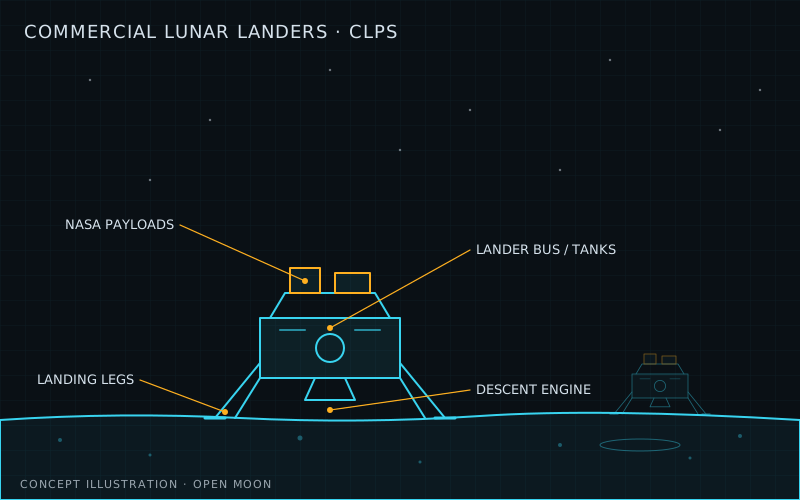
Mixed record: Peregrine never attempted a landing (2024); IM-1 and IM-2 tipped; Blue Ghost M1 fully successful (2025)
What it is
Commercial Lunar Payload Services (CLPS) is a NASA programme that buys rides to the Moon from US companies instead of building its own landers. NASA pays a fixed price per delivery, and the company is responsible for the lander, the rocket, payload integration and surface operations (NASA). The programme started in 2018, and the first task orders were awarded in May 2019 (NASA OIG).
NASA says it has 13 eligible companies on contract and has awarded 17 deliveries carrying more than 60 payloads. The original contracts are worth up to $4.2 billion in total through November 2028 (NASA). In November 2026 NASA picked eight companies for “CLPS 2”, a 10-year contract worth up to $10 billion in total (NASA).
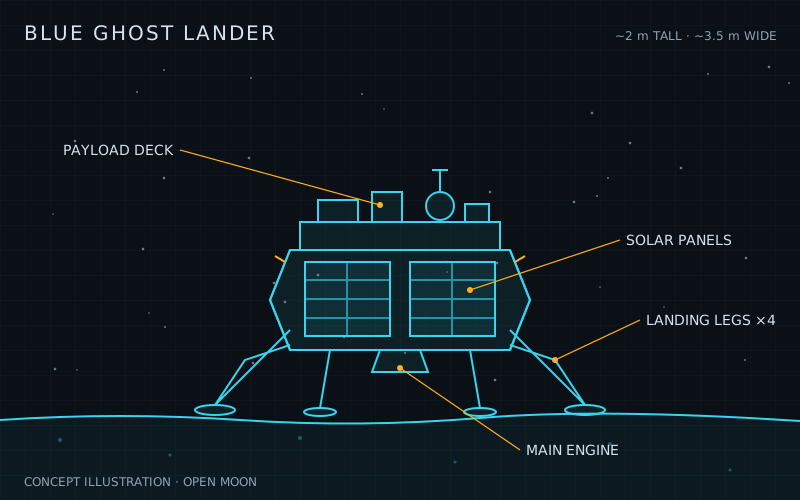
The flight record is mixed. Astrobotic’s Peregrine (January 2024) had a valve failure that ruptured an oxidizer tank, so it never tried to land (Astrobotic). Intuitive Machines’ IM-1 (February 2024) made the first US soft landing in decades, but tipped over; its instruments still worked for seven days (NASA, Wikipedia). Firefly’s Blue Ghost Mission 1 landed upright in Mare Crisium on 2 March 2025 (NASA) and completed 14 days of surface operations (Firefly). IM-2 (March 2025) landed on its side in a crater, and its batteries ran out before the drill could fully operate (NASA).
Why Open Moon uses it
In milestone M01 (prospecting), CLPS-class landers deliver the prospecting rover, drill and instruments to the south pole. The plan calls for two prospecting landings so that one lander failure does not end the search for ice. In M02 (transport), the same landers form the “small cargo” class, under 1 t per trip, for instruments and small robots.
Buying a ride is far cheaper and faster than designing a lander. Without CLPS-class services, Open Moon would need to fund its own lander or wait for larger landers such as Blue Moon Mark 1 or Argonaut, which have not flown yet.
How it works
NASA, or another customer, buys space on a lander. The company launches the lander on a commercial rocket, flies it to lunar orbit and lands autonomously. Each lander gives payloads power, data and heat control during flight and on the surface. Astrobotic, for example, publishes a price of $1.2 million per kg delivered to the surface (Astrobotic).
| Lander | Company | Surface payload | Engine / propellant | Status |
|---|---|---|---|---|
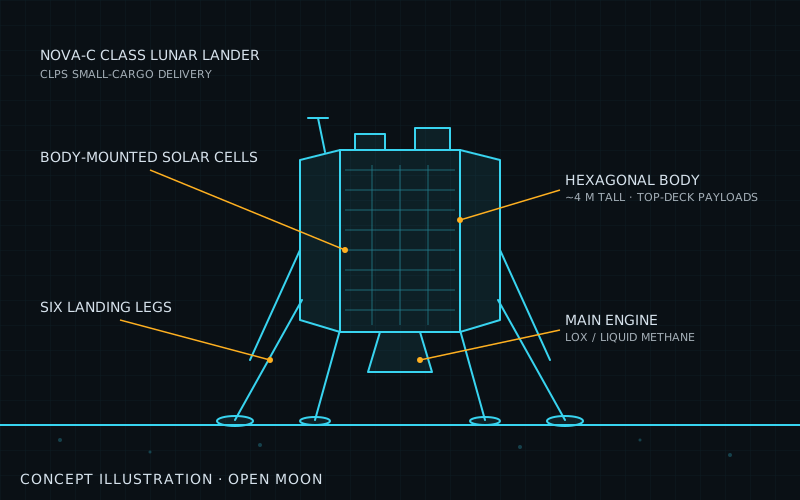
| Nova-C | Intuitive Machines | about 100-130 kg (Wikipedia) | VR900, methane and oxygen, 3,100 N | Landed twice, both tipped |
| Blue Ghost | Firefly Aerospace | 150 kg (Wikipedia) | LEROS 4-ET, MON and hydrazine, over 1,000 N | Landed upright, 2025 |
| Peregrine | Astrobotic | 70-90 kg (mid-latitude), 100 kg (polar) (Astrobotic) | Not stated in the cited guide | Failed in transit, 2024 |
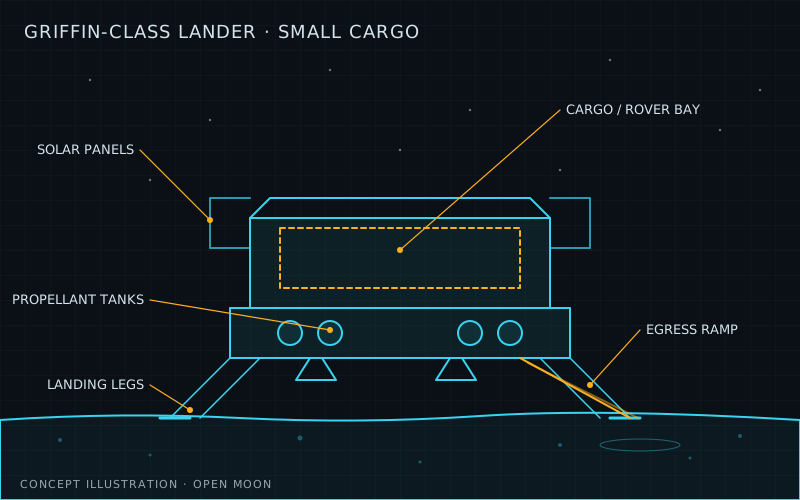
| Griffin | Astrobotic | 625 kg (polar) (Astrobotic) | Not stated in the cited guide | First flight planned January 2027 (Wikipedia) |
Nova-C stands 4.3 m tall and has a launch mass of about 1,900 kg (Wikipedia). Larger landers are joining the programme: Blue Origin’s VIPER delivery is a CLPS task order worth up to $190 million (NASA).
Limitations and open issues
- Landing reliability. Of the four CLPS landers flown in 2024-2025, only Blue Ghost landed upright and worked as planned (Wikipedia). Two landers tipped over and one never reached the Moon.
- Polar landings are unproven. The only fully successful lander landed at a mid-latitude site. IM-2, the attempt nearest the south pole, ended on its side in a crater (NASA).
- Cost growth and delays. NASA’s Inspector General found $208.2 million in cost increases and an average delay of 14 months per task order. Average time from award to launch was 44 months, against a planned 30 (NASA OIG).
- Fragile suppliers. The same audit notes one CLPS vendor went bankrupt and others face financial and market uncertainty (NASA OIG).
- Short surface life. Blue Ghost’s payloads were planned to work for about one lunar day, about 14 Earth days (NASA), and Nova-C’s design life is 14 days (Wikipedia). A rover must leave the lander and survive on its own.
- Prices are not fully public. The only per-kilogram list price we found is Astrobotic’s $1.2 million per kg (Astrobotic). Other providers do not publish one.
| Alternative | How it compares | Status |
|---|---|---|
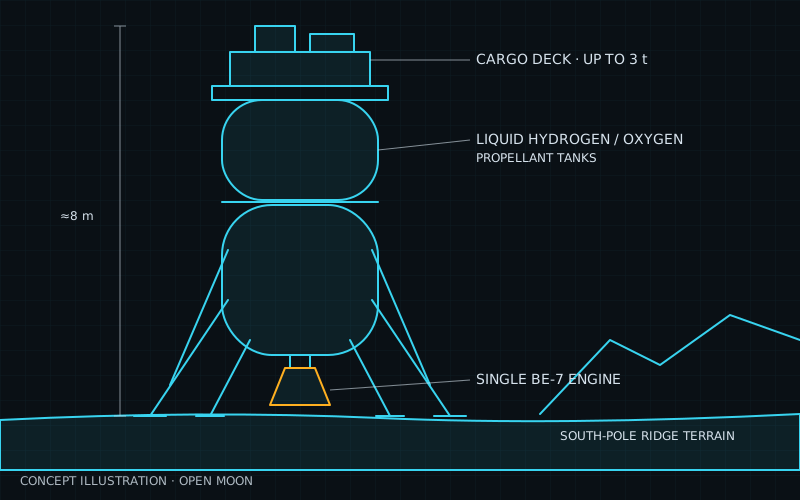
| Blue Origin Blue Moon Mark 1 | A much bigger robotic cargo lander, planned to carry up to 3,000 kg to the surface versus about 100-625 kg for the small CLPS landers. It could deliver a full prospecting rover in one trip, but it has not flown yet and one failure would lose far more cargo. | In development; first Pathfinder mission to the Shackleton connecting ridge planned for early 2027; a second flight may carry VIPER |
| ESA Argonaut lander | A European government-led cargo lander launched on Ariane 6, carrying up to 1,500 kg. It gives a non-US supply route and more mass per trip, but it is years later than the CLPS landers. | Lunar Descent Element under contract to a Thales Alenia Space-led team; first mission planned around 2030-2031 |
| ispace landers (Japan / ispace-U.S.) | A commercial lander company outside the original US CLPS pool that also sells payload rides. It adds a second supplier base, but both of its landing attempts so far (2023 and 2025) ended in hard landings. | Two failed landings; ispace-U.S. was selected for the CLPS 2 contract pool in November 2026 |
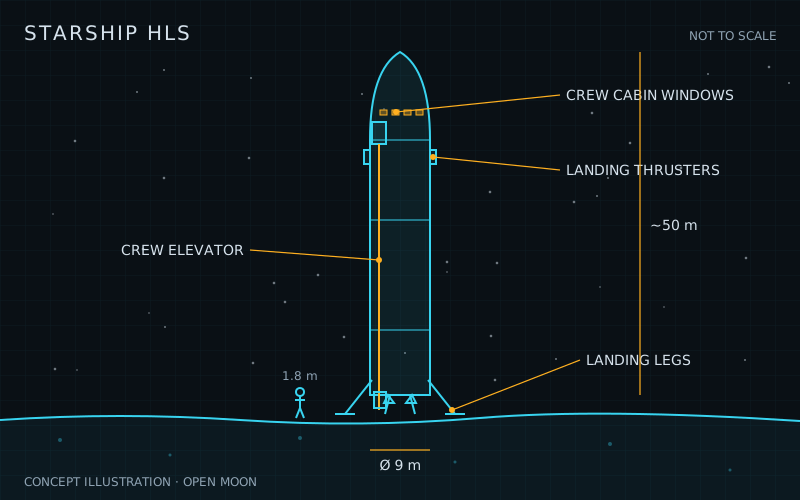
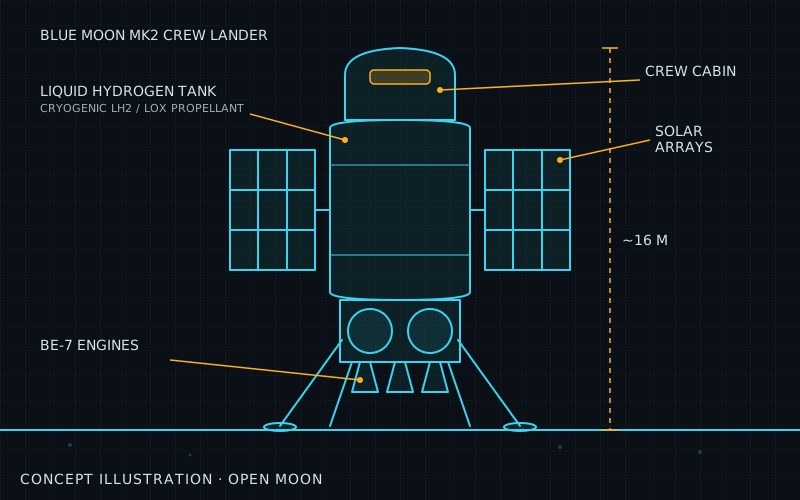
| Starship and Blue Moon cargo landers (heavy class) | Cargo versions of the Artemis crew landers, expected to put about 15 t on the surface. They are far larger than needed for a prospecting rover and are not yet proven, but would suit later base-building cargo. | In development for NASA's Human Landing System; no lunar landing yet |
- official NASA: Commercial Lunar Payload Services (programme page) (accessed Nov 2026)
- official NASA: NASA Awards Moon Base Transportation, Technology, Science Projects (CLPS 2) (Nov 2026)
- official NASA OIG IG-24-013: NASA's Commercial Lunar Payload Services Initiative (Jun 2024)
- official Astrobotic: Peregrine Mission One post-mission report (Aug 2024)
- official NASA: NASA Collects First Surface Science in Decades via Commercial Moon Mission (IM-1) (Mar 2024)
- official NASA: Touchdown! Carrying NASA Science, Firefly's Blue Ghost Lands on Moon (Mar 2025)
- official Firefly: Blue Ghost completes 14 days of surface operations (Mar 2025)
- official NASA: NASA Receives Some Data Before Intuitive Machines Ends Lunar Mission (IM-2) (Mar 2025)
- official NASA: NASA Selects Blue Origin to Deliver VIPER Rover to Moon's South Pole (Sep 2025)
- data Astrobotic Lunar Landers Payload User's Guide v5.0 (Peregrine and Griffin) (Aug 2021)
- wiki Commercial Lunar Payload Services, Wikipedia (accessed Nov 2026)
- wiki Nova-C, Wikipedia (accessed Nov 2026)
- wiki Firefly Aerospace Blue Ghost, Wikipedia (accessed Nov 2026)
Summary
| System | Transport |
| Phase | 0 |
| Milestones | M01 |
| Readiness | TRL 7 / 9 |
| Plan status | ready to use |
Sources
- Commercial Lunar Payload Services, Wikipedia (status and facts)
- Reference for the illustration
More sources are on each milestone page that uses this technology.