Blue Origin Blue Moon Mark 1
Pathfinder to Shackleton connecting ridge NET Q1 2027
What it is
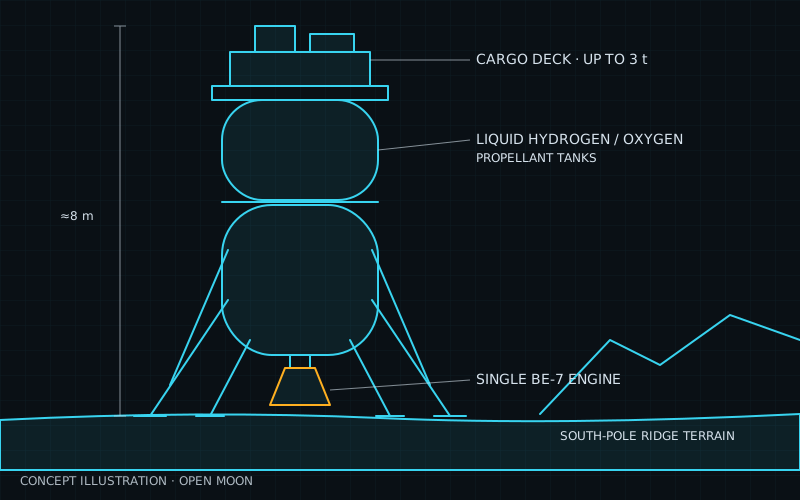
Blue Moon Mark 1 (MK1) is an uncrewed, single-stage cargo lander built by Blue Origin. Blue Origin funds it itself. It serves both as a cargo lander and as a demonstrator for NASA’s Human Landing System (NASA). It is 8.05 m tall and 3.08 m wide. Fuelled, it weighs about 21,350 kg. It can land up to 3,000 kg of payload (Wikipedia). It burns liquid hydrogen and oxygen in one BE-7 engine.
Blue Origin first showed a robotic Blue Moon lander in 2017 and a full-size mockup in 2019. Its first landing was planned for 2024, then slipped (Wikipedia). The first flight lander is named Endurance. In May 2026 it finished thermal vacuum testing in Chamber A at NASA Johnson Space Center (NASA). NASA did not publish detailed results.
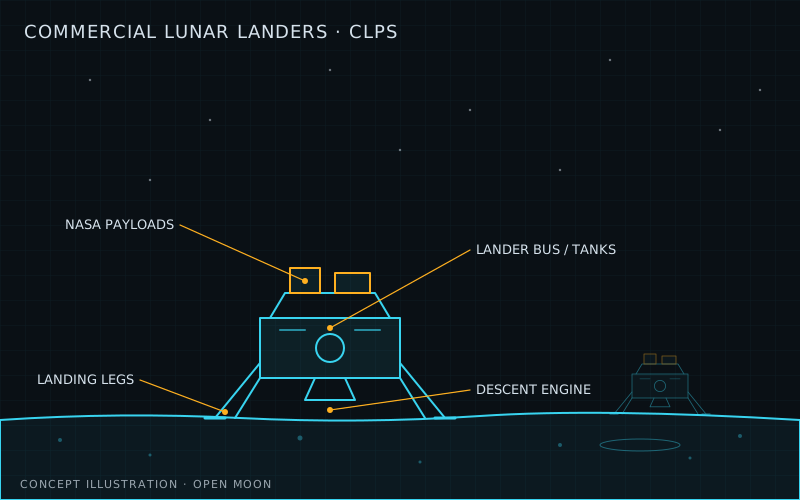
The first mission, Pathfinder (NASA task order CT-3), will land on the Shackleton connecting ridge near the south pole (NASA). It is now no earlier than Q1 2027 on New Glenn (Wikipedia). It carries two NASA payloads: SCALPSS plume cameras and a laser retroreflector array (NASA Science). A second MK1 may deliver NASA’s VIPER rover in late 2027, under a task order worth up to $190 million (NASA).
Why Open Moon uses it
Mark 1 is Open Moon’s medium cargo lander in milestone M02 (Transport), Phase 1. Small landers carry under a tonne. Heavy landers like Starship and Mk2 are still unproven. Mark 1 fills the gap at about 3 t, enough for rovers, pilot ISRU plants and the first power units.
Other milestones lean on it too. NASA’s choice to deliver VIPER, which feeds M01 (Prospecting), waits on MK1’s first flight (NASA). NASA has also paid Blue Origin $188 million, with a $280.4 million option, to deliver the Lunar Terrain Vehicles for M07 (Mobility) to the south pole (NASA).
Without Mark 1, Phase 1 cargo would have to be cut into sub-tonne pieces for small landers, or wait for heavy landers. Mk2’s uncrewed demo is not expected until February 2029 (NASA OIG).
How it works
New Glenn launches MK1 inside its 7 m fairing (Wikipedia). The lander then flies to the Moon and descends on its own engine. The BE-7 is a 3D-printed, dual-expander hydrogen/oxygen engine. It gives about 44 kN of thrust, can throttle down to about 8.9 kN, and has a vacuum specific impulse of about 460 s (Wikipedia, Blue Origin). In June 2026 a BE-7 fired for about 2,500 seconds in one run (Wikipedia). Hydrogen and oxygen were picked partly because they could one day be made from lunar ice (Wikipedia).
The Pathfinder flight will test the BE-7, cryogenic fluid systems, avionics, continuous downlink and landing within 100 m of the target (Blue Origin, Wikipedia). Its avionics, reaction control and power systems are shared with Mark 2 (Wikipedia). Two MK1 flights are meant to buy down risk for Mk2 (NASA OIG).
| Spec | Value |
|---|---|
| Height / diameter | 8.05 m / 3.08 m |
| Fuelled mass | ~21,350 kg |
| Payload to surface | up to 3,000 kg |
| Engine | 1 × BE-7, LH2/LOX, dual expander |
| Thrust | ~44 kN, throttles to ~8.9 kN |
| Landing accuracy goal | within 100 m |
| Launch vehicle | New Glenn |
Dry mass, cargo deck size and offloading method are not published.
Limitations and open issues
- Never flown. No MK1 has launched or landed yet (Wikipedia). Its performance in flight is unproven.
- Launcher risk. In April 2026, a New Glenn upper-stage problem left a satellite in too low an orbit. In May 2026 a New Glenn exploded during a static fire and badly damaged LC-36, the pad Pathfinder needs (Wikipedia).
- Repeated slips. Landing moved from 2024 to 2026 and now early 2027 (Wikipedia, Wikipedia). NASA said in May 2026 it would fly “this year” (NASA).
- Hydrogen storage. Hydrogen boils off easily. Cryogenic fluid management is one of Blue Origin’s biggest challenges (NASA OIG).
- Many eggs in one basket. VIPER, the LTVs and Open Moon’s medium cargo all ride on the same unproven lander. Rover offloading is still being designed under the VIPER task (NASA).
- Price unknown. Blue Origin has not published a commercial price per flight.
| Alternative | How it compares | Status |
|---|---|---|
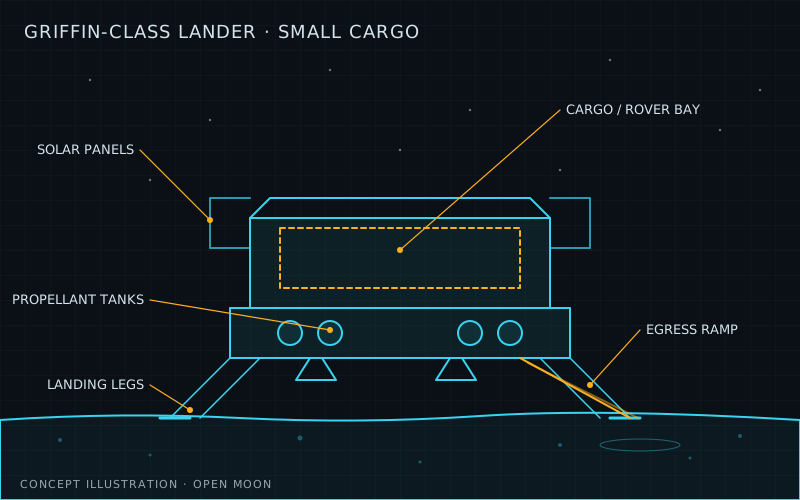
| Astrobotic Griffin | A smaller CLPS lander (about 450 kg itself) launched on Falcon Heavy. Cheaper per flight and enough for one rover, but it cannot carry multi-tonne power units or pilot plants. | First flight (Griffin Mission One, carrying Astrolab's FLIP rover) planned for January 2027 |
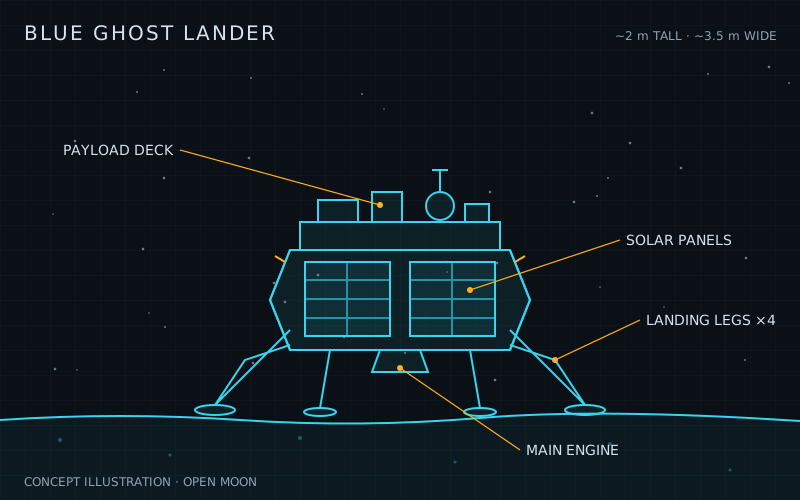
| Firefly Blue Ghost | Small lander with the best landing record so far: Blue Ghost Mission 1 was the first fully successful CLPS landing. Proven, but far smaller payload than Mark 1, so heavy items would have to be split. | Flown successfully in March 2025; Mission 2 to the far side planned for early 2027 |
| ESA Argonaut | European cargo lander for up to 1,500 kg of payload. Gives a non-US supplier, but carries half of Mark 1's payload and arrives years later. | In development, Thales Alenia Space prime; first mission planned for 2030 |
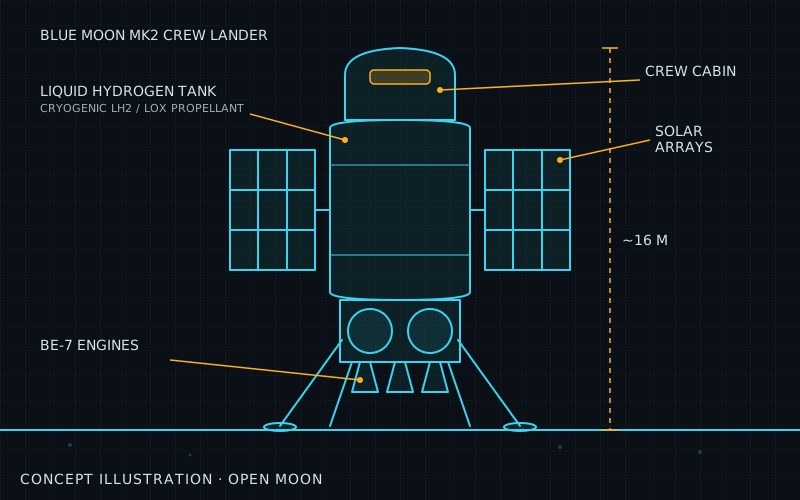
| Blue Origin Blue Moon Mk2 (cargo variant) | Much larger lander from the same company, built for crew and heavy cargo. Can carry habitat-sized items but depends on in-space refuelling. | Under a NASA HLS contract of about $3.1B; uncrewed demonstration expected February 2029 |
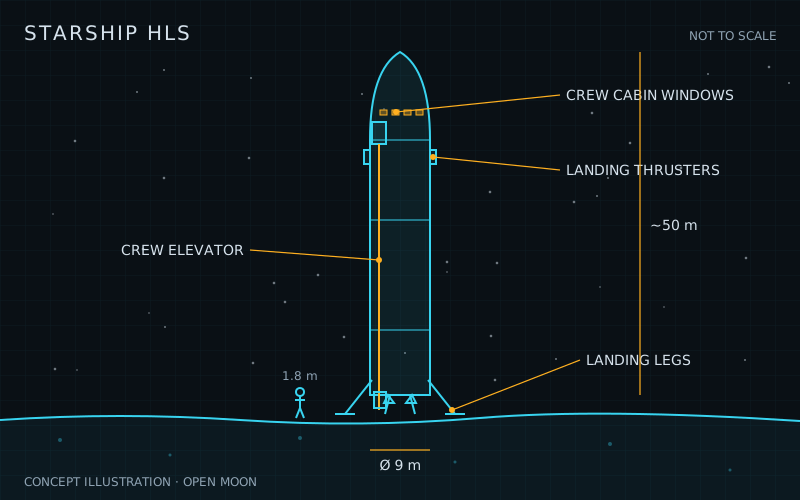
| SpaceX Starship (cargo) | Heavy cargo lander in the ~15 t class per NASA. Far more capacity, but needs ship-to-ship refuelling that has not been demonstrated, and its cargo sits many metres above the ground. | Reached orbit on flights 14 and 15 in 2026; no lunar landing yet |
- official Blue Origin: Blue Moon Mark 1 (accessed Nov 2026)
- official NASA: Blue Origin Moon lander completes testing at NASA vacuum chamber (May 2026)
- official NASA: Moon Base flight, Blue Origin Blue Moon Mark 1 (2026)
- official NASA Science: CT-3 science payloads (SCALPSS and LRA) (Nov 2026)
- official NASA: NASA selects Blue Origin to deliver VIPER rover to Moon's south pole (Sep 2025)
- official NASA: NASA provides update on Moon Base rovers, landers, missions (May 2026)
- official NASA OIG IG-26-004: NASA's management of the Human Landing System contracts (Mar 2026)
- official Blue Origin: BE-7 engine testing (accessed Nov 2026)
- wiki Blue Moon (spacecraft), Wikipedia (accessed Nov 2026)
- wiki Blue Moon Pathfinder Mission 1, Wikipedia (accessed Nov 2026)
- wiki BE-7, Wikipedia (accessed Nov 2026)
- wiki New Glenn, Wikipedia (accessed Nov 2026)
- wiki Commercial Lunar Payload Services, Wikipedia (accessed Nov 2026)
Summary
| System | Transport |
| Phase | 1 |
| Milestones | M02 |
| Readiness | TRL 6 / 9 |
| Plan status | ready to use |
Sources
- Blue Origin: Blue Moon Mark 1 (status and facts)
- Reference for the illustration
More sources are on each milestone page that uses this technology.