Astrobotic Griffin
First flight planned January 2027
What it is
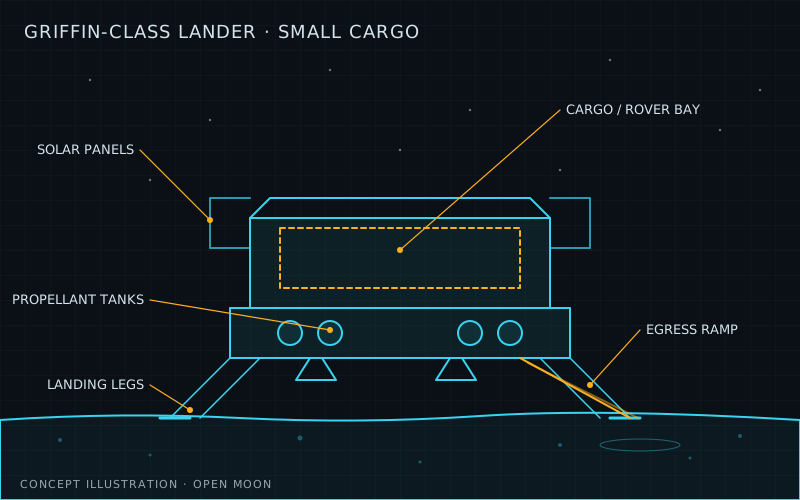
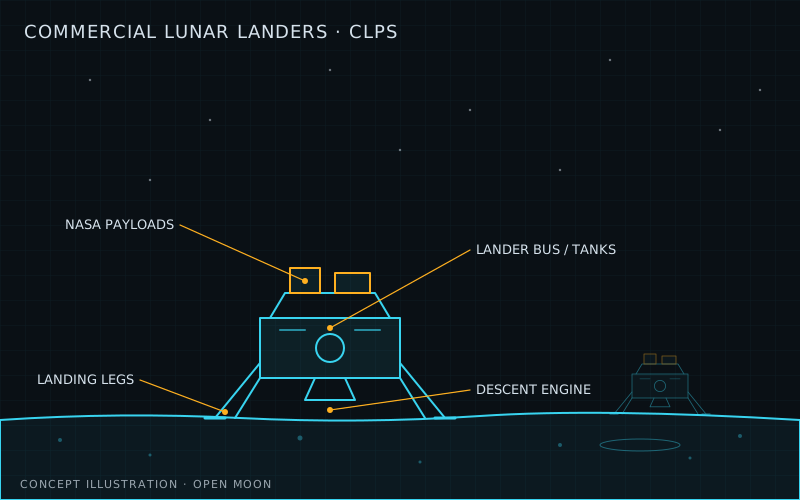
Griffin is a four-legged robotic cargo lander built by Astrobotic, a company founded in Pittsburgh in 2007. Voyager Technologies announced in June 2026 that it was buying Astrobotic (SpacePolicyOnline). Griffin is the larger sibling of Astrobotic’s Peregrine lander and shares its core spacecraft bus (Astrobotic PUG). Astrobotic rates it at 625 kg of payload to the lunar surface, with 100 m landing accuracy. NASA buys deliveries on landers like Griffin through its Commercial Lunar Payload Services (CLPS) program.
NASA picked Griffin in June 2020 to deliver the VIPER rover. The task order started at $199.5 million and had grown to $322.8 million by February 2024 (NASA OIG). In July 2024 NASA ended VIPER, but it kept the Griffin contract as a flight demonstration of the lander and its engines. Griffin’s predecessor, Peregrine, launched in January 2024 but never reached the Moon because of a propellant leak.
The first flight, Griffin Mission One, will carry Astrolab’s 500 kg FLIP rover and smaller payloads to Nobile Crater near the south pole (Wikipedia). NASA named it “Moon Base II” in May 2026. The lander finished environmental testing at JPL on 13 October 2026, and launch on a SpaceX Falcon Heavy is planned for no earlier than January 2027 (Wikipedia; NASA).
Why Open Moon uses it
Griffin is one of three small-cargo landers in milestone M02 (Transport), next to Firefly Blue Ghost and Intuitive Machines Nova-C. It fills the gap between landers that carry about 100 kg and Blue Moon Mark 1’s 3 t. That size suits single rovers, science packages and small power or communications units. Its optional egress ramps let a rover drive off without a crane.
Open Moon’s rule is to fly each payload class with two providers where possible. Without Griffin, the only flown landers in the plan carry much less than a 500 kg rover. Payloads of that size would wait for the first Blue Moon Mark 1 flights, which are larger, costlier and also not yet flown.
How it works
Griffin uses an aluminum structure with a launch adapter cone, deck panels and four radiator panels. Payloads mount on the deck, below it or on rover ramps (PUG). Four landing legs absorb the touchdown shock.
The propulsion system burns a hypergolic bipropellant (M20, a hydrazine derivative, with MON-3 oxidizer) that ignites on contact. The 2021 user’s guide lists five 700 lbf main engines and twelve 25 lbf attitude thrusters (PUG). Astrobotic’s current page lists seven main engines and four thruster clusters. The engines pulse on and off to throttle.
For landing, Griffin uses a star tracker, sun sensors, an inertial unit, a Doppler LiDAR and terrain-relative navigation, with an optional scanning LiDAR to spot hazards down to 15 cm (Astrobotic). Power comes from triple-junction solar cells and a lithium-ion battery on a 28 V bus. Polar missions use side-mounted panels. The lander talks to Earth on X-band and to deployed rovers over a 2.4 GHz WLAN link (PUG).
| Specification | Value |
|---|---|
| Payload to surface | 625 kg (Astrobotic) |
| Lander mass (Mission One) | 1,265 kg (Wikipedia) |
| Landing accuracy | 100 m |
| Surface operations (polar) | Up to 14 days (PUG) |
| Payload power | 1.0 W/kg nominal, 2.5 W/kg peak |
| Launch vehicle | SpaceX Falcon Heavy |
| Published surface price (2021) | $1.2 million per kg (PUG) |
Astrobotic does not publish Griffin’s dimensions or its propellant load.
Limitations and open issues
- No flight heritage. Griffin has never flown. Its only sibling, Peregrine, failed in space after a valve problem.
- New engines. NASA’s Inspector General noted Griffin uses a scaled-up version of Peregrine’s engine, and that Peregrine’s engines were never qualification-tested or fired for full duration before flight (OIG).
- Schedule slips. The first launch was set for November 2023 and has slipped many times. It is now planned for January 2027 (OIG; Wikipedia).
- Cost growth. The VIPER task order rose 62% before the rover was cancelled (OIG).
- Short surface life. The polar configuration is rated for up to 14 days, so Griffin delivers payloads but cannot serve as long-term infrastructure.
- Unclear specs. The published main-engine count differs between the 2021 guide (five) and the current product page (seven).
- Follow-on flights. No dates have been published for later Griffin missions (Wikipedia).
| Alternative | How it compares | Status |
|---|---|---|
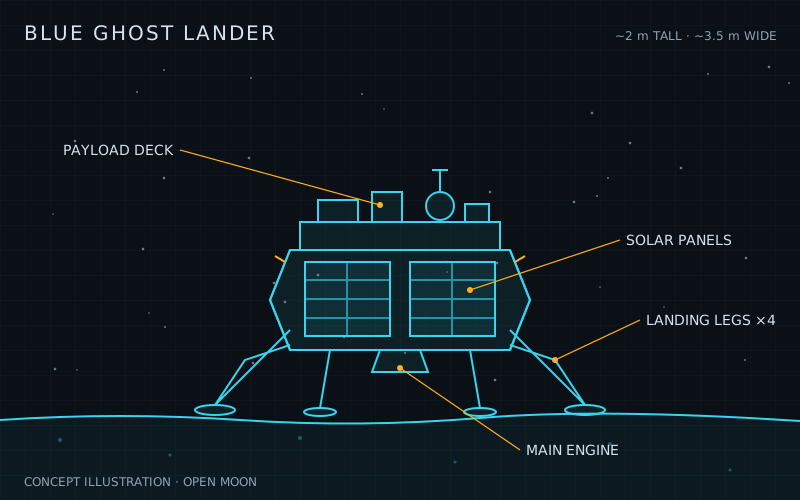
| Firefly Blue Ghost | Smaller lander that carried about 94 kg of NASA payloads on its first flight. It has the best record of any commercial lander, but it cannot carry a 500 kg rover the way Griffin is meant to. | Flown: fully successful soft landing in Mare Crisium on 2 March 2025 |
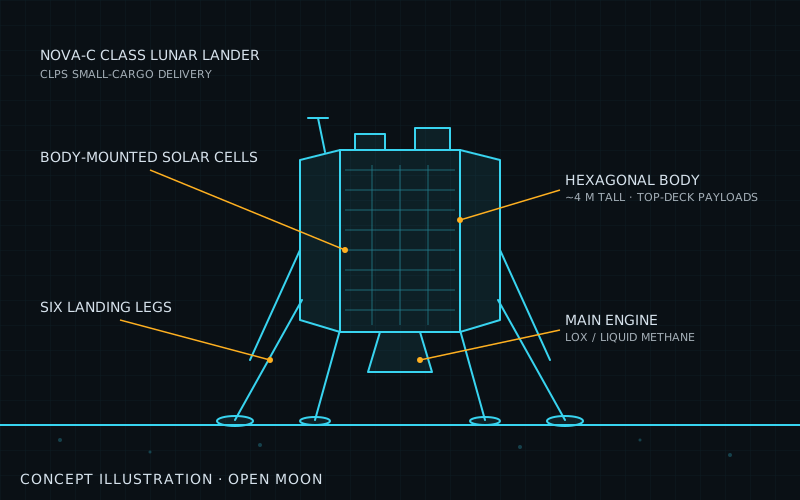
| Intuitive Machines Nova-C | Methane/oxygen lander for about 100-130 kg of payload, much less than Griffin. It has reached the surface twice, but both landers ended up on their sides. | Flown twice (IM-1 Feb 2024, IM-2 Mar 2025); IM-3 planned |
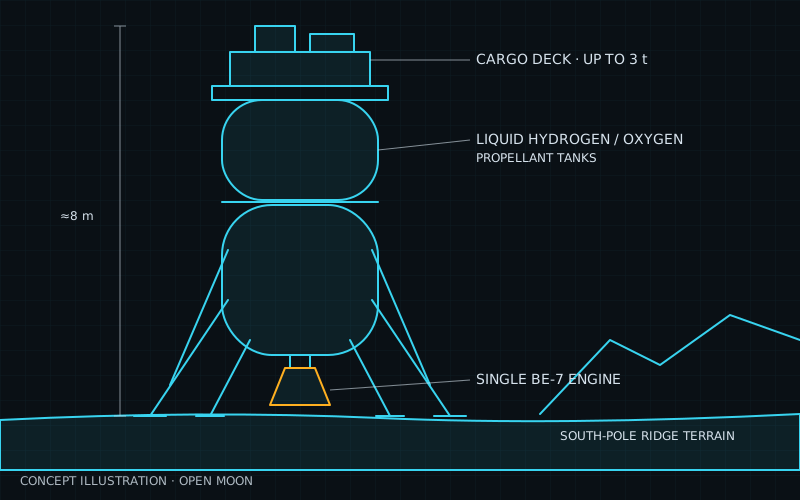
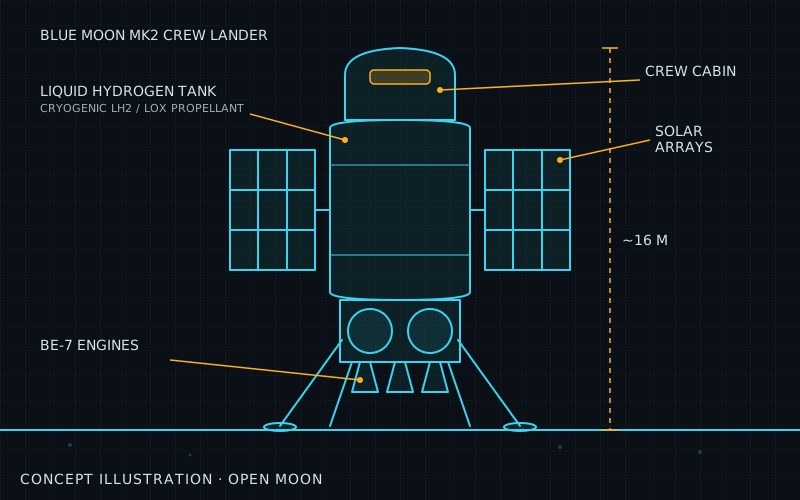
| Blue Origin Blue Moon Mark 1 | Hydrogen/oxygen lander for up to 3,000 kg, about five times Griffin's capacity. It suits larger cargo but needs a New Glenn launch and has not flown yet. | Pathfinder flight planned for 2027 |
- official Astrobotic: Griffin Lander (product page and specifications) (accessed Nov 2026)
- data Astrobotic Lunar Landers Payload User's Guide (Peregrine and Griffin) (Aug 2021)
- official NASA: Moon Base, Voyager Griffin-1 mission page (Oct 2026)
- official NASA: NASA Ends VIPER Project, Continues Moon Exploration (Jul 2024)
- official NASA OIG IG-24-013: NASA's Commercial Lunar Payload Services Initiative (Jun 2024)
- wiki Griffin Mission One, Wikipedia (accessed Nov 2026)
- wiki Astrobotic Technology, Wikipedia (accessed Nov 2026)
- wiki Peregrine Mission One, Wikipedia (accessed Nov 2026)
- wiki Commercial Lunar Payload Services, Wikipedia (accessed Nov 2026)
- press SpacePolicyOnline: Astrobotic Unveils Griffin Moon Base II Lander (Jun 2026)
Summary
| System | Transport |
| Phase | 1 |
| Milestones | M02 |
| Readiness | TRL 6 / 9 |
| Plan status | ready to use |
Sources
- Commercial Lunar Payload Services, Wikipedia (status and facts)
- Reference for the illustration
More sources are on each milestone page that uses this technology.