Intuitive Machines Nova-C
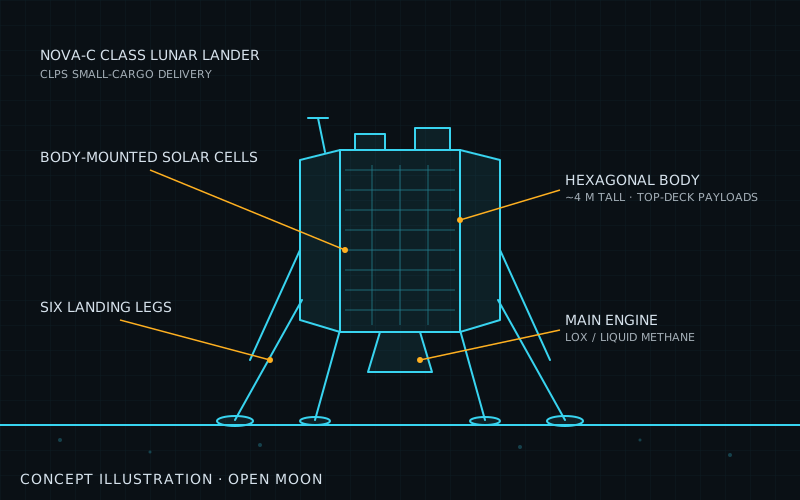
Landed twice (2024, 2025); both times ended on its side
What it is
Nova-C is a small robotic Moon lander built by Intuitive Machines of Houston, Texas. It is a hexagonal craft about 4.3 m tall on six legs. It weighs about 1,900 kg at launch and 675 kg dry, and it is quoted as carrying 100 kg to over 130 kg of payload (Wikipedia). Its design grew out of NASA’s Morpheus test lander, which several of the company’s founders worked on (NASA Spinoff; Wikipedia).
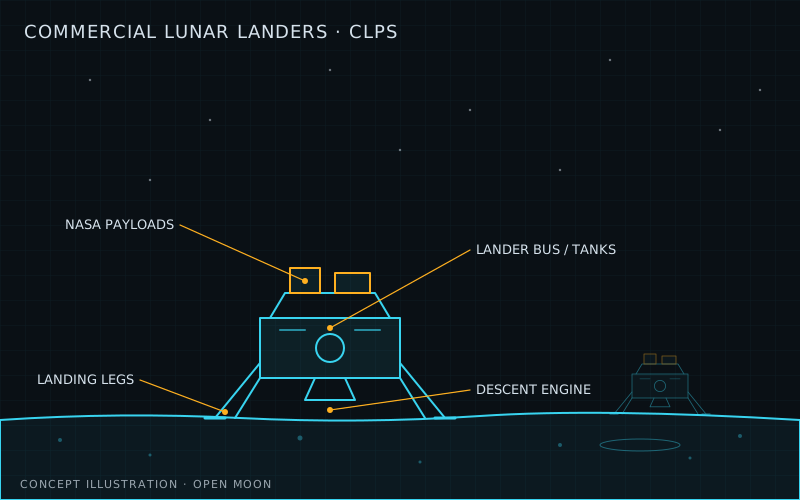
NASA picked Nova-C in May 2019 as one of the first landers for its Commercial Lunar Payload Services (CLPS) programme. The first award was $77 million and grew to $118 million by January 2024 (Wikipedia). The first mission, IM-1 Odysseus, touched down near Malapert A in the south polar region on 22 February 2024 (Wikipedia). It was the first commercial Moon landing (Wikipedia). It broke a leg on touchdown and came to rest tilted at about 30 degrees, but its six NASA instruments worked for seven days and sent back more than 500 MB of data (NASA; Wikipedia).
The second mission, IM-2 Athena, landed on Mons Mouton near the south pole on 6 March 2025. It ended up on its side in a cold, shadowed crater, and its batteries ran down the next day (NASA; Wikipedia). The third mission, IM-3, heads for the Reiner Gamma swirl. NASA now lists it for early 2027 (NASA; Wikipedia).
Why Open Moon uses it
Open Moon’s transport milestone (M02) buys small cargo rides of under 1 t from commercial landers instead of building its own. Nova-C is one of three named options, next to Firefly Blue Ghost and Astrobotic Griffin. The plan wants two providers per payload where possible. Nova-C gives that second (or third) supplier for instruments, small robots and early site surveys.
Nova-C also has the most flight experience of any US commercial lander: two landings near the south pole, the region Open Moon targets (Wikipedia). Both missions returned data, but neither landed upright. Open Moon therefore treats Nova-C as a useful but not yet proven carrier. Without it, small-cargo delivery would rest on one flown lander (Blue Ghost) and one untested lander (Griffin).
How it works
Nova-C launches on a SpaceX Falcon 9 and flies itself to the Moon. Its main engine, the VR900, burns liquid methane and liquid oxygen. Helium gas pushes the propellants into the engine (Wikipedia). This is the same propellant pair NASA tested on Morpheus. Both fuels could in principle be made from local resources one day (NASA Spinoff). Small helium cold-gas thrusters steer the craft. Solar panels and a battery provide power.
For landing, the lander uses laser rangefinders and cameras that match craters against Lunar Reconnaissance Orbiter maps. It then descends under engine power onto its six legs (SpacePolicyOnline).
| Specification | Value |
|---|---|
| Height | 4.3 m |
| Launch mass | about 1,900 kg (1,908 kg in article body) |
| Dry mass | 675 kg |
| Payload | 100 kg (infobox) to over 130 kg (article body) |
| Propellants | 845 kg liquid oxygen, 422 kg liquid methane, 17 kg helium |
| Main engine | VR900, gimbaled, about 3,100 N thrust |
| Specific impulse | Not published in the sources used here |
| Power | 200 W maximum from solar panels; 25 Ah battery; 28 V bus |
| Landing legs | 6; designed to stay upright on slopes up to 10° |
Source for the table: Wikipedia.
Limitations and open issues
- No upright landing yet. Both missions ended tilted or on their side, which cut surface operations to days (IM-1) or hours (IM-2) (NASA; NASA).
- Landing sensors are the weak point. On IM-1, a safety switch on the primary laser rangefinder was left inactive before launch. Controllers switched to a NASA Navigation Doppler Lidar payload instead (Wikipedia). On IM-2, noise disturbed the laser altimeter, and long polar shadows confused crater-matching navigation (SpacePolicyOnline).
- Fixes not yet flown. For IM-3 the company plans redundant altimeters of different types, a velocity sensor that works in any lighting, and a larger crater database (SpacePolicyOnline). IM-3 goes to Reiner Gamma, not the south pole (Wikipedia). So it will not prove landings in polar lighting.
- Tall and narrow. A 4.3 m height on a 1.6 m-wide body makes tipping more likely on rough ground. The lander is only designed for slopes of up to 10° (Wikipedia).
- Short surface life. Nova-C has no published way to survive the lunar night. IM-1 did not wake after its first night (Wikipedia).
- Schedule slips. IM-3 was first planned for 2024 (Wikipedia) and is now listed for early 2027 (NASA).
- Small payload. About 100-130 kg is enough for instruments, not for rovers or power plants. Larger cargo needs Nova-D or other landers (Wikipedia).
| Alternative | How it compares | Status |
|---|---|---|
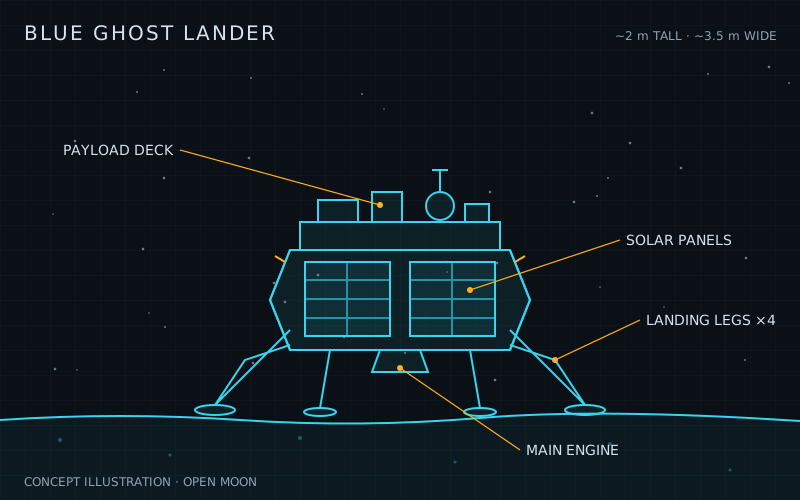
| Firefly Blue Ghost | A similar-sized, four-legged commercial lander with a lower, wider stance. It landed on its first try in March 2025 and worked for about two weeks, a better record than Nova-C. It carried about 94 kg of science payloads on that flight, a little less than Nova-C's quoted capacity. | Flown once successfully (Mare Crisium, Mar 2025); more CLPS missions booked |
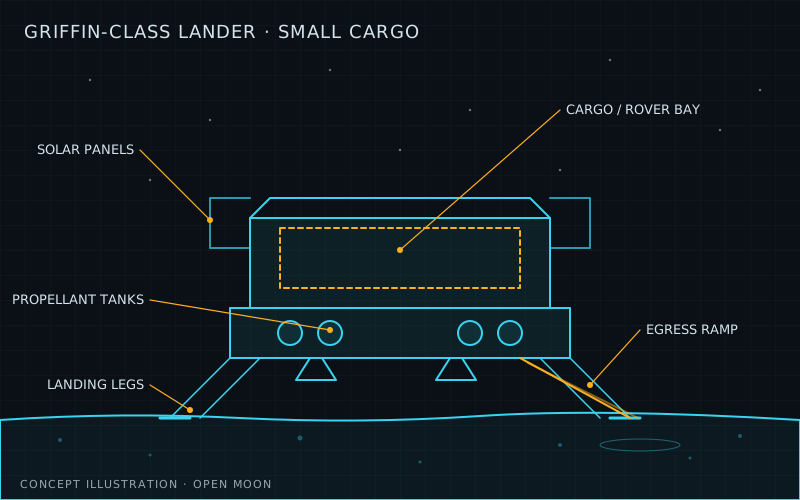
| Astrobotic Griffin | A larger, four-legged lander rated for 625 kg of payload, with egress ramps for rovers. It can carry far more than Nova-C, but it has not flown yet. | First flight (Griffin Mission One) listed for January 2027 |
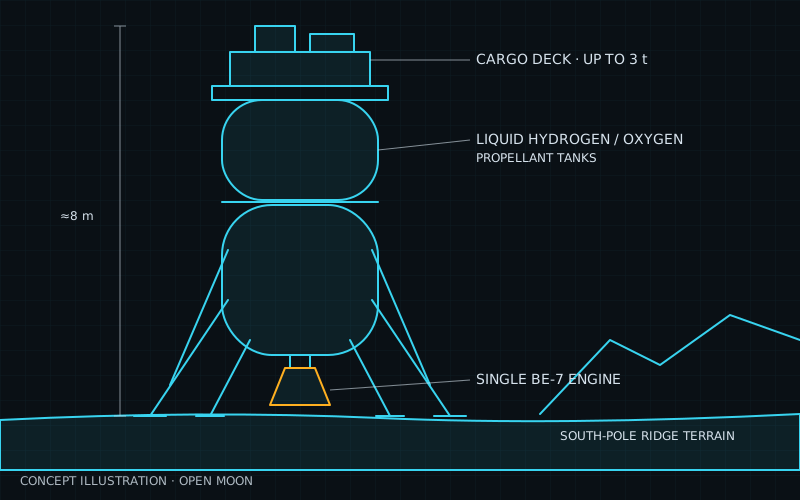
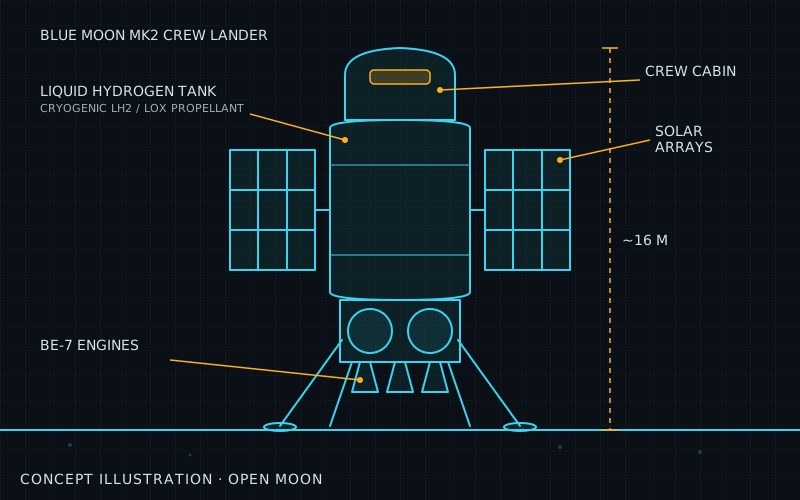
| Blue Origin Blue Moon Mark 1 | A much bigger robotic cargo lander burning liquid hydrogen and oxygen, rated for about 3 t to the surface. It suits rovers and power units rather than small instruments, and it has not flown. | Pathfinder mission in development; listed for 2027 |
| Intuitive Machines Nova-D | Intuitive Machines' own larger successor, reported to use two VR900 engines and carry more than 500 kg. It shares Nova-C's engine and avionics heritage, so it also inherits Nova-C's open landing-sensor questions. | In development; NASA task order CT-4 assigns it to IM-5, scheduled for 2030 |
| ispace lunar landers (Japan) | A Japanese commercial lander line in the same small-cargo class. Its Mission 2 lander was lost in June 2025 after a laser rangefinder anomaly, a failure close to Nova-C's own landing-sensor problems. | Mission 2 crashed (Jun 2025); further missions listed for 2027-2029 |
- wiki Intuitive Machines Nova-C (design, specifications, missions) (Nov 2026)
- wiki IM-1 (Odysseus) mission (Nov 2026)
- wiki IM-2 (Athena) mission (Nov 2026)
- wiki IM-3 mission (Nov 2026)
- official NASA: NASA Collects First Surface Science in Decades via Commercial Moon Mission (IM-1) (Mar 2024)
- official NASA blog: NASA, Intuitive Machines share images from the Moon, provide science updates (Feb 2024)
- official NASA: NASA Receives Some Data Before Intuitive Machines Ends Lunar Mission (IM-2) (Mar 2025)
- official NASA: Moon Base: Intuitive Machines IM-3 (Nov 2026)
- official NASA Spinoff: With NASA's Help, the Moon Becomes a Commercial Destination (Morpheus heritage) (2021)
- official NASA: Commercial Lunar Payload Services (CLPS) (Nov 2026)
- wiki Commercial Lunar Payload Services (contract history and values) (Nov 2026)
- wiki Project Morpheus (NASA methane-oxygen test lander) (Nov 2026)
- press SpacePolicyOnline: IM-2's imperfect landing due to altimeter interference, south pole lighting conditions (May 2025)
Summary
| System | Transport |
| Phase | 1 |
| Milestones | M02 |
| Readiness | TRL 7 / 9 |
| Plan status | ready to use |
Sources
- Commercial Lunar Payload Services, Wikipedia (status and facts)
- Reference for the illustration
More sources are on each milestone page that uses this technology.