Lunar AC power transmission (3 kVac, 1 kHz)
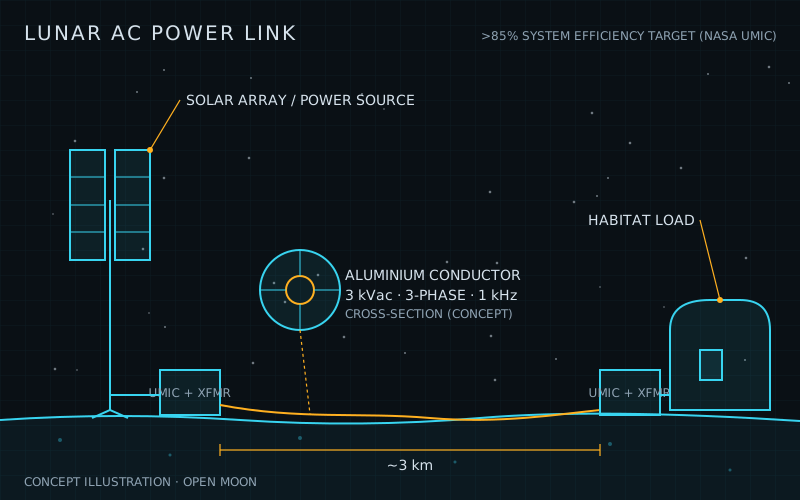
NASA's lunar grid baseline since 2022 (switched from DC; see DD-001). UMIC 1 kW module bench-tested 2023; AC cable tested in vacuum with regolith simulant 2025
To match NASA's own lunar grid baseline, which NASA chose because DC cannot yet be raised to the needed voltage with radiation-hard parts. This page used to describe a ±4 kV DC cable. Open Moon changed to NASA's AC baseline on 18 November 2026.
NASA sources: Feb 2022 · Aug 2022 · Sep 2023 · 2025 · Dec 2025 · Full decision record →
What it is
Lunar AC power transmission is a three-phase, 3,000 V, 1,000 Hz power line laid across the Moon’s surface. It carries electricity from power plants (a fission reactor, solar towers, storage) to users a few kilometres away. Raising the voltage lowers the current, so thinner, lighter wire can carry the same power. This is NASA’s lunar grid baseline, set in a 2022 NASA Glenn trade study. NASA/DOE’s 2025 fission reactor reference design uses the same link.
For comparison, the US grid on Earth runs at 60 Hz, with long-distance lines mostly at 230–500 kV. The lunar grid is far smaller: tens of kilowatts over 1–3 km, so 3 kV is enough. Its 1 kHz frequency is unusually high. Aircraft and spacecraft use 400 Hz because “transformers and motors for 400 Hz are much smaller and lighter”, and NASA’s lunar grid takes the same idea further.
Why NASA chose it, and when
| When | What NASA found |
|---|---|
| Feb 2022 | A NASA Glenn review of transmission for 40 kW fission power found high-voltage metal cable best. It identified about ±4,000 VDC as mass-optimal for 3 km, but it states it is not a NASA preference. |
| Aug 2022 | The NASA grid trade study compared 1.2–6 kV, DC and three-phase AC, at 60 Hz to 1 kHz. 1 kHz was the lightest AC option; 3 kV AC was the mass-optimal feasible design (NASA). |
| Sep 2023 | NASA published the UMIC, which connects 120 V DC space equipment to a 3 kV AC grid. |
| 2025 | NASA/DOE’s reactor reference design adopted a 3 kVac, 1 kHz link, “selected to leverage” the UMIC (NASA). |
| Dec 2025 | NASA tested AC cables with regolith simulant in vacuum. It found no major losses, and frequency did not change the results (NASA). |
NASA’s reason, in its own words: a DC grid is “practically limited to 1.2-1.5 kV, due to lack of high voltage rad-hard switches”, whereas AC is “easier to increase voltage and expand, as transformers can change voltage”. It concludes: “These facts drove team to select AC” (NASA, 2022).
Why Open Moon uses it
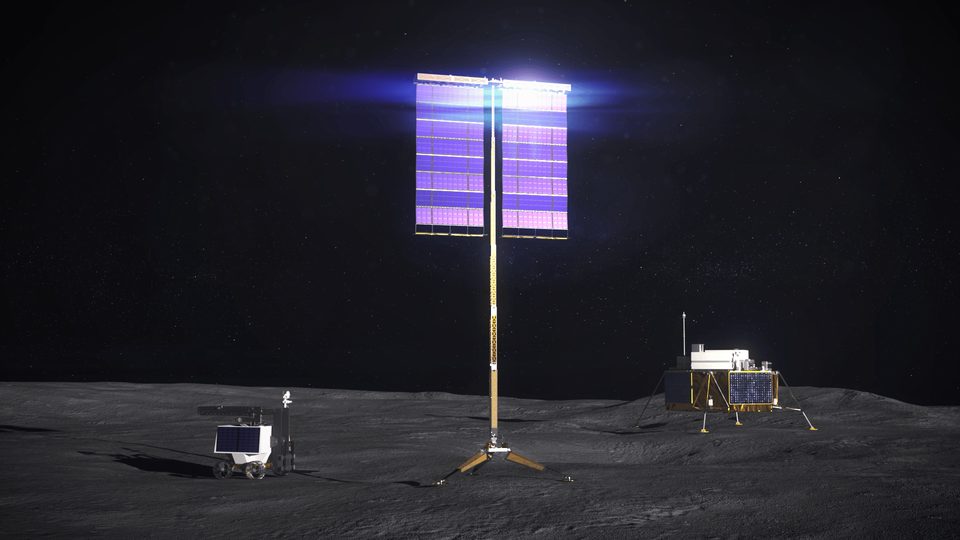
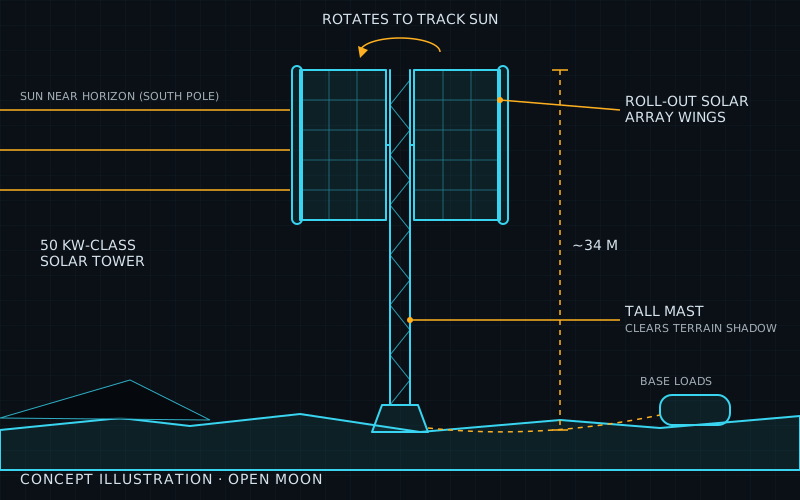
Milestone M04 builds the base’s power grid. It links solar towers, a fission reactor and storage to the oxygen plant and the habitat. The reactor has to sit away from the crew: NASA’s design puts the user interface 1 km away, and the oxygen plant needs power over 3–5 km.
Efficiency matters because fission power is heavy, about 0.25–0.27 kg per watt. Every watt lost in the cable means more reactor mass. Using NASA’s AC baseline means Open Moon can plug in a NASA-designed reactor directly and use NASA’s interface converters, instead of developing high-voltage DC parts no one makes yet.
How it works
Each power source’s inverters produce low-voltage AC. A transformer raises it to 3 kV for the cable. At the far end, another transformer lowers it, and NASA’s Universal Modular Interface Converter (UMIC) turns it into 120 V DC for equipment. The UMIC is built from parallel, standard 1 kW inverter modules, with DC switch modules to isolate faults. Parallel units share load by droop control.
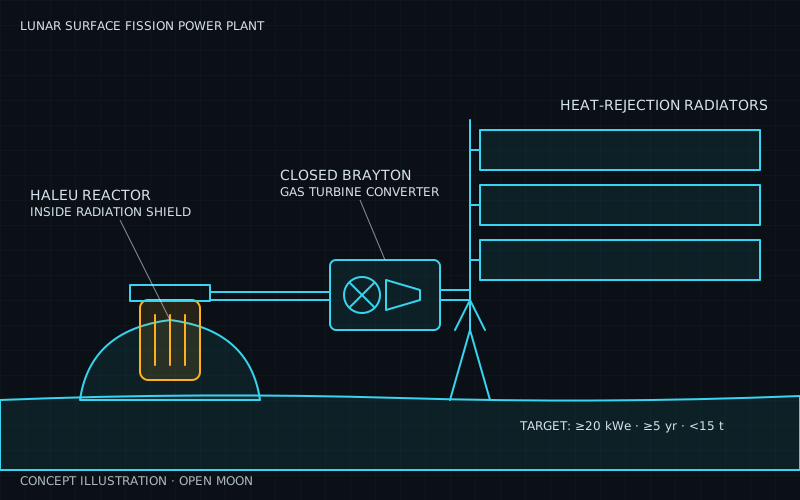
The Brayton reactor option’s three-phase alternators can feed the 3 kVac step-up transformer directly, at about 90% PMAD efficiency. The Stirling option needs an extra converter stage and reaches about 83%. The cable lies on the surface: NASA says “burying the cable is not advised due to the poor thermal conductivity of the regolith”.
| Parameter | Value | Source |
|---|---|---|
| Voltage | 3 kV AC, three-phase | NASA 2022 |
| Frequency | 1 kHz (lowest-mass AC option) | NASA 2022 |
| User side | 120 V DC | NASA UMIC |
| Converter building block | 1 kW inverter module | NASA UMIC |
| Efficiency target | >85% transmission system | NASA UMIC |
| Mass target | <0.55 kg/m | NASA UMIC |
| Main cable and spool | 325 kg per 1 km | NASA 2025 |
| Voltage sensitivity | 1 kVac adds 570 kg; no gain above 3 kVac at 1 km | NASA 2025 |
Limitations and open issues
- Heavier than ideal DC. NASA’s own study says DC is “significantly lighter than AC for voltages above 3-4 kV”. AC is chosen because its parts can be built, not because it is the lightest in theory.
- Early converter hardware. NASA has bench-tested a single 1 kW UMIC module and simulated parallel units. A full multi-kilowatt unit has not been tested in vacuum.
- Stability without rotating machines. Every source is an inverter, so the grid’s frequency and voltage are held entirely by control software (UMIC droop control).
- Longer grids. NASA notes that grids much larger than Artemis scale may need a lower frequency to avoid stability and propagation problems.
- Insulation in vacuum. Vacuum-rated high-voltage cables that avoid partial discharge are still being studied.
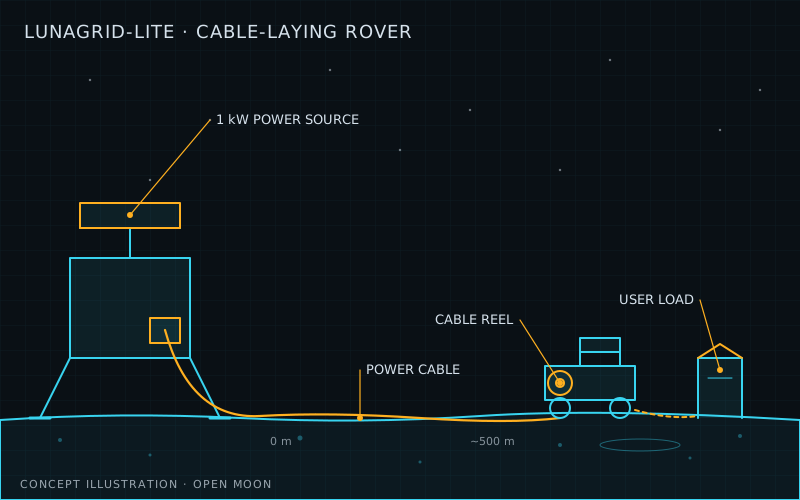
- Surface exposure. Because the cable is not buried, it faces rover traffic and micrometeoroids. NASA’s first cable-laying demonstration was scoped at 1 km, and Astrobotic’s 2025 design lays 500 m.
| Alternative | How it compares | Status |
|---|---|---|
| High-voltage DC cable (±2.8 to ±4 kV) | Lighter: NASA found DC significantly lighter than AC above 3–4 kV, and a 2022 NASA review found ±4 kVDC mass-optimal for a 3 km, 40 kW link. But it needs high-voltage radiation-hard switches that do not exist, about four times as many parts as AC, and DC breakers that are still research. Open Moon's original design (see DD-001). | Studied by NASA in 2008 and 2022; no flight hardware; NASA dropped it as its baseline in 2022. |
| Lower-voltage DC tether (500 V to 1.5 kV) | Stays inside the voltage range that radiation-hard parts can handle today and suits light, mobile loads such as rovers. For a 40 kW, 3 km link it needs far more conductor mass than a 3 kV line. | NASA's TYMPO project aimed for flight readiness in 2024; Astrobotic's LunaGrid-Lite (1 kW, ~500 m) passed critical design review in Aug 2025. |
| Wireless power beaming (laser, millimetre-wave, microwave) | No cable to lay or damage, and useful for moving or very distant users. For bulk power from a heavy fission plant, its 13-27% end-to-end efficiency would add 30-60 t of extra generating capacity. | Low maturity at power; the best-known demonstration sent 400 W over 330 m at 20% efficiency (US Navy PTROL, 2019). |
| Superconducting cable | Almost lossless and the conductor weighs only a few kg per km, but it needs coolant hoses, cryocoolers and radiators. NASA estimated more than 3 t of support hardware and about 18 kW of cooling power for a 1 km line. | Judged not feasible for the Moon by NASA Glenn (2022). |
| Carbon nanotube (CNT) rope conductor | Very strong, fatigue-resistant and stable over a wide temperature range. Today its conductivity per kilogram is 6-10 times worse than copper, so it is not yet lighter. | Research stage; small samples have beaten copper's specific conductivity but full cables have not. |
- official Thomas, Granger, Csank & Gardner, NASA GRC: Establishing a Lunar Surface Power Grid (trade study selecting 3 kV AC) (Aug 2022)
- paper Thomas et al., NASA GRC: A Modular AC to DC Interface Converter (UMIC) to Enable Lunar Surface Power Transmission (AIAA ASCEND) (Sep 2023)
- paper Mason et al., NASA/DOE: Key Design Trades for a Near-term Lunar Fission Surface Power System (NETS 2025) (2025)
- paper Klopp, Thomas & Csank, NASA GRC: An Experimental Study of Losses in High Voltage AC Lunar Power Cables (SciTech 2026) (Dec 2025)
- official Barth & Pike, NASA GRC: Lunar Power Transmission for Fission Surface Power (NETS 2022) (Feb 2022)
- official Oleson et al.: A Deployable 40 kWe Lunar Fission Surface Power Concept (NETS 2022) (May 2022)
- official Csank & Scott, NASA GRC: Power and Energy for the Lunar Surface (Apr 2022)
- official Kerslake, NASA GRC: Lunar Surface-to-Surface Power Transfer (STAIF 2008) (Feb 2008)
- official Birchenough & Hervol: Test results from a simulated high-voltage lunar power transmission line (2008)
- paper Yang et al., NASA JPL: A High Voltage Tethered Power System for Planetary Surface Applications (TYMPO) (Mar 2022)
- official NASA: 2023 NASA Tipping Point selections (Astrobotic 1 km cable demonstration) (Jul 2023)
- official Astrobotic: LunaGrid-Lite completes critical design review, flight model underway (Aug 2025)
- wiki Wikipedia: Utility frequency (why 400 Hz is used in aircraft and spacecraft) (2026)
- wiki Wikipedia: Electric power transmission (Earth grid voltages for comparison) (2026)
- data Open Moon design decision DD-001: switch from ±4 kV DC to 3 kV AC (Nov 2026)
Summary
| System | Power |
| Phase | 1 |
| Milestones | M04 |
| Readiness | TRL 4 / 9 |
| Plan status | ready to use |
Sources
- Thomas et al., NASA GRC: Establishing a Lunar Surface Power Grid (2022) (status and facts)
- Reference for the illustration
More sources are on each milestone page that uses this technology.