Vertical Solar Array Technology (VSAT)
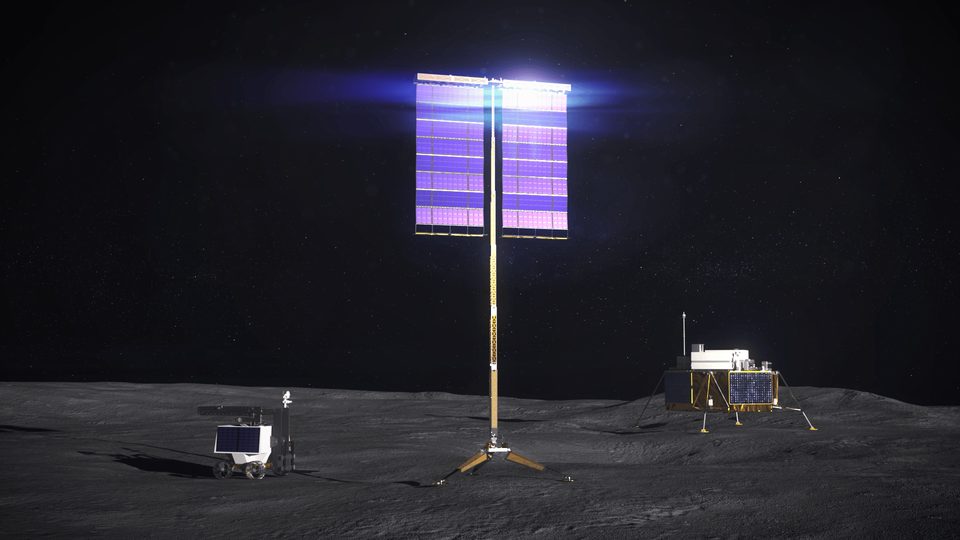
Three NASA prototype contracts (2022); deploy to ~10 m
What it is
Vertical Solar Array Technology (VSAT) is a NASA project to build solar arrays that stand upright on tall masts on the Moon. The arrays deploy on their own, reach up to about 32 feet (about 10 m) high, and can retract so they can be moved (NASA). The project is run by NASA’s Game Changing Development program and Langley Research Center, with Glenn Research Center (NASA).
In 2021 NASA picked five companies for design studies: Astrobotic, Northrop Grumman’s ATK Space Systems, Honeybee Robotics, Lockheed Martin and Maxar’s Space Systems Loral. Each base contract was worth up to $700,000 (NASA). In August 2022 NASA chose three of them to build prototypes for a total of $19.4 million: Astrobotic ($6.2M), Honeybee Robotics ($7M) and Lockheed Martin ($6.2M) (NASA). Honeybee is now part of Blue Origin (Wikipedia).
The aim was to bring all three designs to Technology Readiness Level 6 through thermal-vacuum tests in Chamber A at Johnson Space Center (NTRS). In summer 2024 the Honeybee and Astrobotic prototypes were tested there (NASA). NASA’s stated goal is to deploy at least one system near the lunar south pole (NASA). No flight unit has been ordered yet, as far as public sources show.
Why Open Moon uses it
At the lunar poles the Sun stays low on the horizon. Hills and crater rims then cast long shadows over anything close to the ground. Raising the array on a mast lets it see over that terrain and collect more sunlight (NASA). The Moon’s spin axis sits at 88.5 degrees to the plane of its orbit, which is why some polar ridges get sunlight for long stretches (Wikipedia).
In Open Moon, VSAT is the first source of power in milestone M04 (Power). Two 10 kW-class units go up on separate ridge points on small landers, before the larger VSAT-XL towers and a fission unit arrive. Astrobotic describes its own VSAT as a 10 kW system (Astrobotic). Without a relocatable tall array, the early base would depend on lander-mounted panels that lose power in shadow, or would have to wait for a reactor, which NASA has not yet contracted (NASA).
How it works
Each VSAT unit is a mast on a stable base, a solar blanket carried up the mast, and electronics to track the Sun, store power and send it out. NASA’s goals were autonomous deployment on uneven ground, reliable retraction for moving, and low mass and packed volume (NTRS). Designs must also stay stable on slopes and resist abrasive dust (NASA). The three prototypes are very different (NTRS):
| Team | Mast and array | Mobility and power |
|---|---|---|
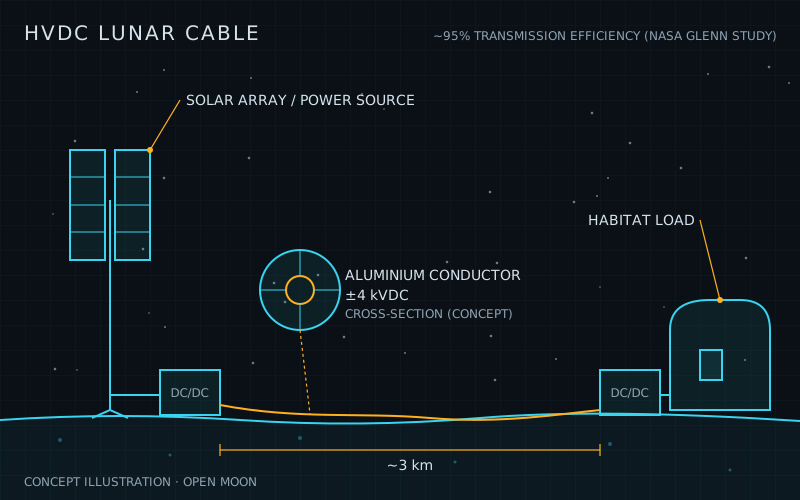
| Astrobotic | Redwire Roll-Out Solar Array (ROSA) | Self-propelled cart; 3 kV AC power grid |
| Honeybee Robotics (LAMPS) | Helical metal-band mast, 12 in diameter; accordion-folded blankets of small silicon cells | 10 kW; designed for 10 years at the south pole |
| Lockheed Martin | Thin-wall rolled composite lenticular mast; flight-heritage blanket and deployer | Towed cart based on a GM lunar mobility vehicle |
ROSA is a flexible array that rolls out on booms. It was first tested on the International Space Station in 2017 (Wikipedia). Astrobotic and Lockheed Martin planned to use a Kennedy Space Center electrodynamic dust shield (NTRS). The systems must survive the lunar night; NASA mentions up to 96 hours of darkness, and Chamber A can reach 20 K (NASA). Mass per unit is not published.
Limitations and open issues
- Mass. At preliminary design review, all selected designs were heavier than the project goals. NASA later judged the mass to be within the limits of a CLPS lander (NTRS).
- Design risks. NASA’s 2023 risk list included Astrobotic’s low-maturity high-voltage power system, Lockheed Martin mast retraction and buckling, Honeybee’s heat rejection and solar cell maturity, and dust shield maturity (NTRS).
- Test results not public. NASA has said the two 2024 tests happened, but has not published whether TRL 6 was reached (NASA). Lockheed Martin’s test status is not reported in that article.
- No flight mission yet. In 2023 the project proposed a follow-on flight demonstration around 2028-2029 (NTRS). No such mission has been announced in the sources used here.
- Night and shadow. A 10 m mast does not remove the lunar night. The base still needs storage or fission power.
- Cost risk. All VSAT contracts were firm fixed price, and NASA flagged that cost growth could push vendors to cut technical work (NTRS).
| Alternative | How it compares | Status |
|---|---|---|
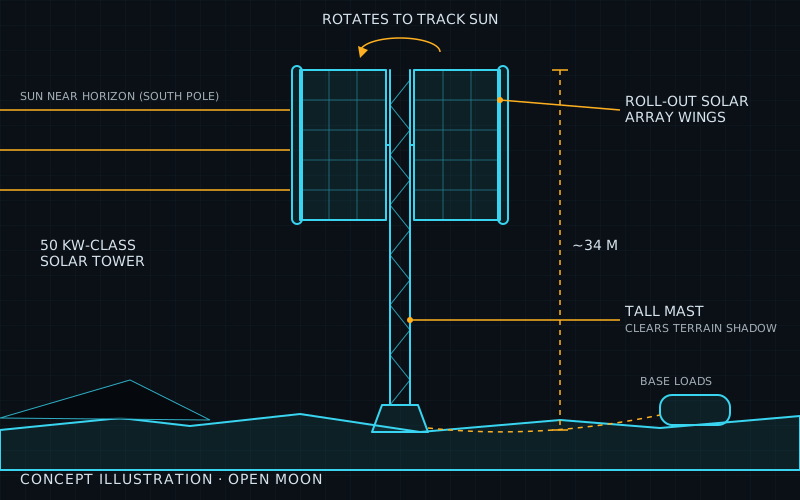
| Astrobotic VSAT-XL | A scaled-up follow-on to Astrobotic's 10 kW VSAT: about 34 m tall and 50 kW, using Redwire roll-out arrays. Five times the power and a higher view over the terrain, but much larger and less mature. | NASA SBIR Phase I study (2024), then a Phase II contract announced in 2025; still in development |
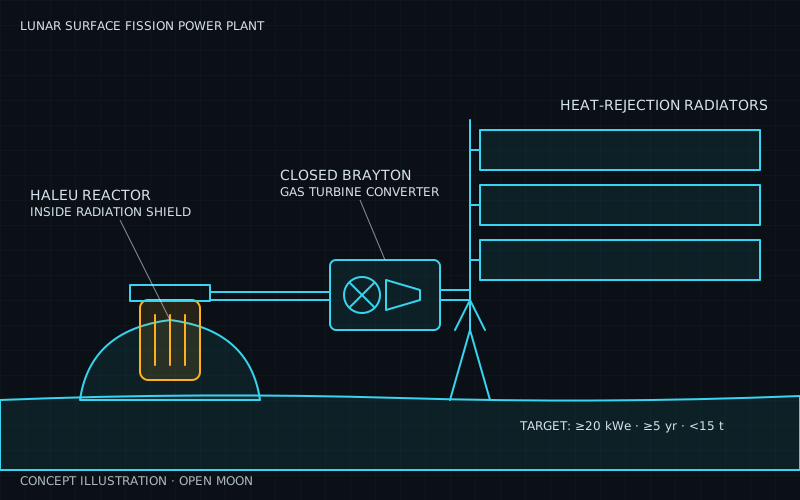
| Fission Surface Power | A small nuclear reactor gives steady power through the lunar night and in shadow, which no solar array can. NASA's 40 kWe reference concept is a large system, and no reactor has yet been contracted. | NASA seeking industry partners for a system of at least 100 kWe with closed Brayton conversion (2025); no reactor built or flown |
| Honeybee Robotics LUNARSABER | A much taller (about 100 m) tower concept that would combine solar power, communications and lighting. It could see over far more terrain than a 10 m mast, but building a tower that tall on the Moon is unproven. | Concept study only (2024) |
| Low or horizontal surface arrays | Conventional arrays mounted flat or low on a lander are simpler and have flight heritage, but at the poles the low Sun lets nearby hills shadow them, so they lose power for long periods. | Standard on landers today; NASA says existing space-rated arrays were designed for microgravity or horizontal deployment |
- official NASA RELEASE 22-090: Three companies to help NASA advance solar array technology for Moon (Aug 2022)
- official NASA: NASA, industry to mature vertical solar array technologies for lunar surface (Mar 2021)
- official NASA NTRS 20230012849: Game Changing Development Program, VSAT project annual review (Sep 2023)
- official NASA Johnson: From Houston to the Moon, thermal vacuum chamber tests lunar solar technology (Nov 2024)
- official Astrobotic: Astrobotic awarded lunar power study with VSAT-XL (Aug 2024)
- official Astrobotic: Astrobotic developing XL solar array tech for lunar power infrastructure (Jul 2025)
- data USAspending: NASA contract 80NSSC25C0032, SBIR Phase II VSAT-XL (Jun 2025)
- official NASA Glenn: NASA seeks industry feedback on Fission Surface Power (Aug 2025)
- paper Oleson et al., NETS 2022: deployable 40 kWe fission surface power concept (NTRS 20220004670) (2022)
- wiki Wikipedia: Roll Out Solar Array (2026)
- wiki Wikipedia: Lunar south pole (2026)
- wiki Wikipedia: Honeybee Robotics (2026)
- press Universe Today: A tower on the Moon could provide astronauts with light, power and guidance (LUNARSABER) (Aug 2024)
Summary
| System | Power |
| Phase | 1 |
| Milestones | M04 |
| Readiness | TRL 6 / 9 |
| Plan status | ready to use |
Sources
- NASA RELEASE 22-090: Vertical Solar Array Technology awards (status and facts)
- Image: NASA
More sources are on each milestone page that uses this technology.