US Lunar Reactor-1 (SPARC)
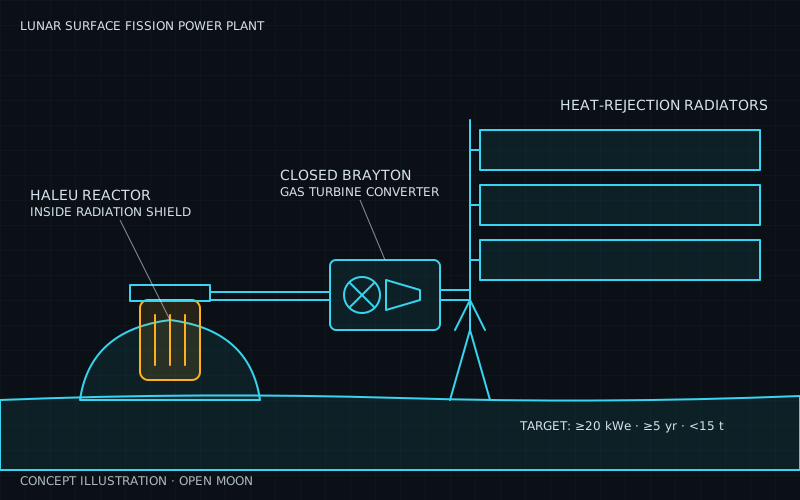
Draft solicitation Aug 2026: ≥20 kWe, ≥5 yr, HALEU, closed Brayton, <15 t. No award yet
What it is
Lunar Reactor-1 (LR-1) is NASA’s planned first fission reactor on the Moon. NASA says it will land on the lunar surface in 2030. SPARC (Space Power and Reactor Capabilities) is the contract NASA Glenn Research Center will use to buy it. The draft request for proposals, number 80GRC026R0009, was posted on 30 August 2026. It followed a sources sought notice in early August. SPARC is a multiple-award contract. Under it, NASA expects to award competing LR-1 Phase 1 task orders to prime integrators.
The target has changed several times. NASA’s earlier project aimed at a 40 kW class system, and three industry teams got concept contracts in 2022. In August 2025 NASA asked industry for at least 100 kWe with closed Brayton conversion. In January 2026 NASA and the Department of Energy signed an agreement to develop a lunar surface reactor by 2030. LR-1 has now set the minimum at 20 kWe. A White House directive in April 2026 also called for a “mid-power” reactor of at least 20 kW.
Status today: the draft was amended on 16 November 2026 ahead of the final RFP. No contract has been awarded. The planned Phase 1 period of performance is 15 April 2027 to 15 October 2028.
Why Open Moon uses it
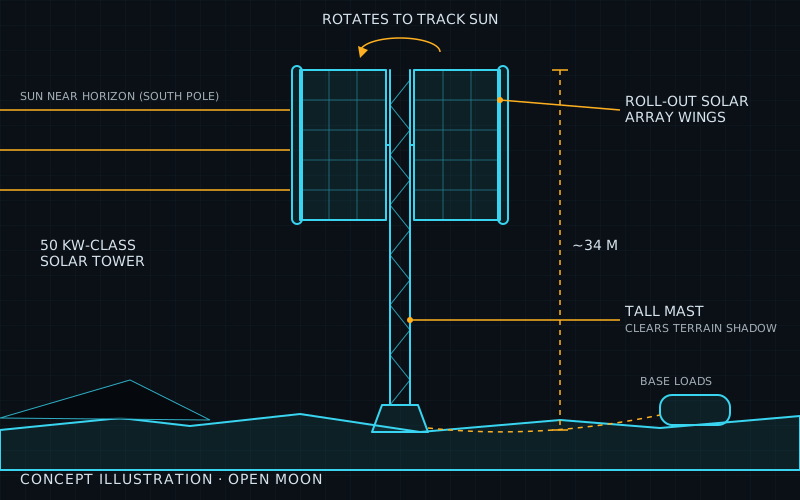
M04 (Power) needs steady power through the polar night, when solar towers are dark. LR-1 is the most concrete purchase path for that baseload: a real solicitation with firm requirements for the lunar south pole. Open Moon’s grid is sized to take any reactor of 20-100 kWe. It treats LR-1 as the first unit it can buy. Later milestones (M10 food, M11 propellant) assume more reactor units. Without a reactor, the base must rely on solar plus very large energy storage for long shadow periods.
How it works
A reactor fuelled with high-assay low-enriched uranium (HALEU) makes heat. A heat exchanger passes the heat to a closed Brayton converter, a turbine loop that turns heat into electricity. Radiators reject the waste heat. A controller and power electronics send AC power to the user. A shield and distance protect people (NASA block diagram). The same fuel and converter type will first fly on Space Reactor-1 Freedom. That 20 kWe HALEU reactor is targeted to launch in late 2028, and NASA says it “will inform and enable Lunar Reactor-1”.
Key draft requirements (NASA Industry Day):
| Item | Requirement |
|---|---|
| Power | ≥20 kWe at the output, even after a single failure |
| Output | 3 kV RMS AC, load 0-100% |
| Fuel / conversion | HALEU / closed Brayton cycle |
| Life | ≥5 years continuous full power |
| Site | 84°S-90°S, slopes up to 10°, 354 h of darkness |
| Mass | <15,000 kg including lander adapters |
| Stowed size | 4.57 m diameter × 7.8 m tall |
| Radiation | <5 rem/yr above background at 1 km inside a 36° cone; <50 rem/yr outside it |
Phase 1 ends in a preliminary design review at month 18. It also includes a non-nuclear Engineering Test Unit. That unit uses electric heaters in place of the reactor and is tested in thermal vacuum.
Limitations and open issues
- No award, no hardware. Only a draft RFP exists. NASA keeps the right to make zero awards.
- Moving requirements. The target went from 40 to 100 to 20 kWe in four years (2022, 2025, 2026).
- Tight schedule. Phase 1 runs until October 2028, leaving little time for a flight unit to land in 2030. NASA has not published a flight-unit schedule or cost.
- Heavy. At up to 15 t, it needs a human-class cargo lander. NASA set the mass and volume to match such landers.
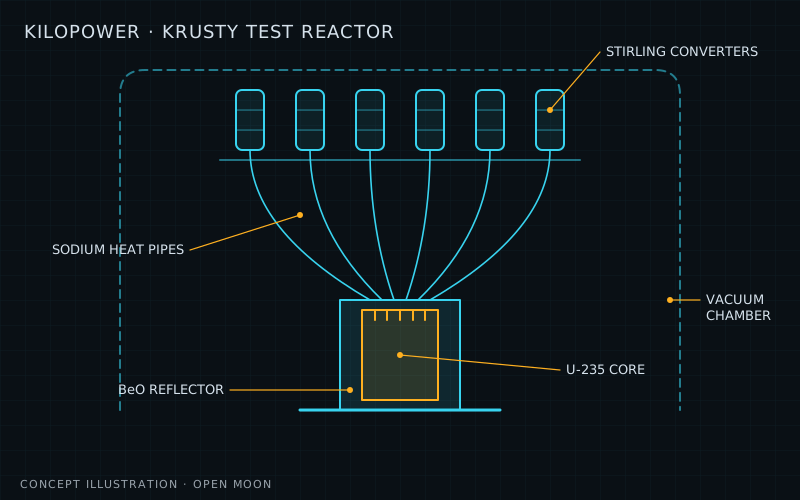
- Untested converter in space. Only a small Stirling-based reactor has run a nuclear test (KRUSTY, 28 hours). The Brayton system first flies on SR-1, which may slip.
- Fuel supply. HALEU still depends on DOE efforts to build a domestic supply chain.
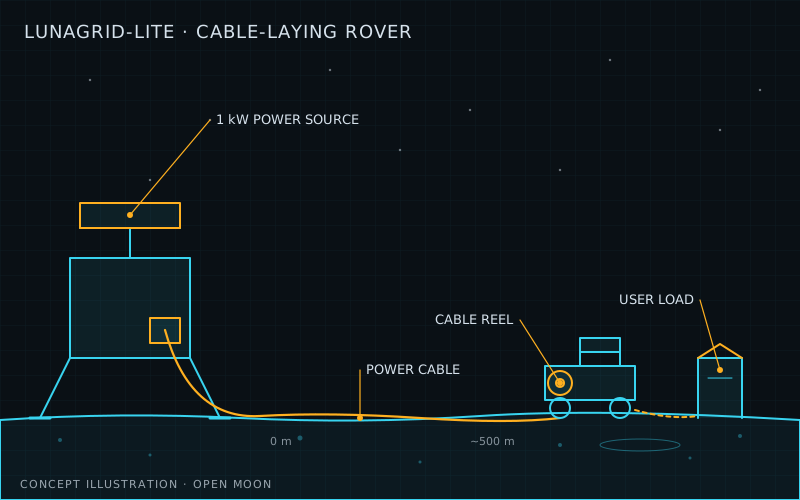
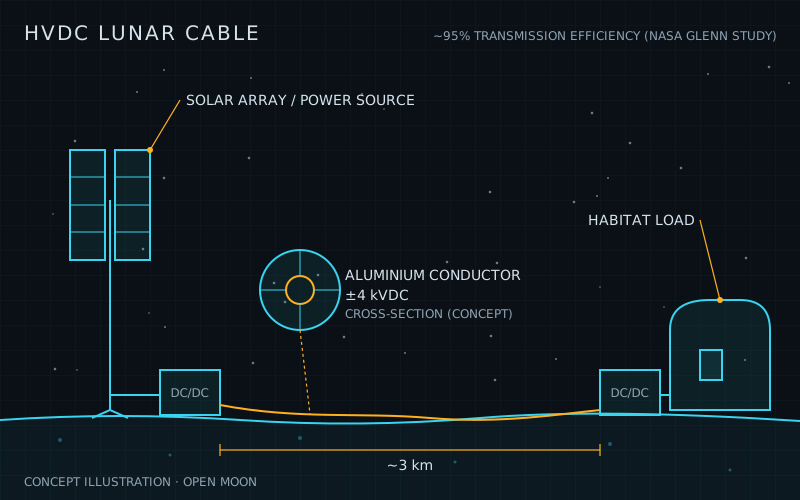
- Siting. The radiation limit applies only at 1 km. Habitats need distance, berms or terrain shielding. The user must also supply the long-distance cable (NASA).
| Alternative | How it compares | Status |
|---|---|---|
| Kilopower-class 1-10 kWe Stirling reactor | Smaller, simpler reactor using Stirling converters and sodium heat pipes. Its core was tested in KRUSTY, so it has real nuclear test data, but at up to 10 kWe it gives only half of LR-1's minimum power. | KRUSTY ground test in 2018; the Kilopower project has ended and no flight unit is being built |
| 2022 NASA/DOE 40 kWe Fission Surface Power concepts | Three industry teams (Lockheed Martin, Westinghouse, IX) produced preliminary 40 kWe designs. Twice LR-1's minimum power, but these were paper studies, and NASA has since moved to the 20 kWe LR-1 requirement. | 12-month concept contracts awarded June 2022; superseded by LR-1 |
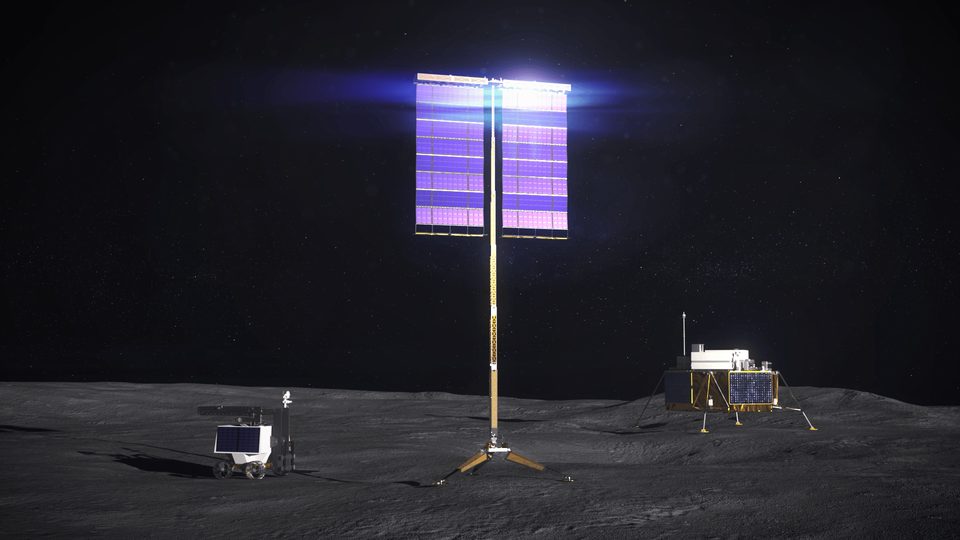
| Vertical solar towers with regenerative fuel cell storage | No nuclear fuel, launch approval or exclusion zone. But it gives nothing in darkness, so it needs large energy storage for long shadow periods. Storage technology is less mature. | VSAT prototypes contracted 2022; NASA Glenn regenerative fuel cell breadboard tested in the lab |
| Russia-China ILRS lunar reactor | A separate national reactor planned for the Russia-China lunar base. It could serve the same job, but almost no technical details are public and it is not available to a US-led base. | Announced in 2024 with a target of 2035; no public design data |
- official SAM.gov: Space Power and Reactor Capabilities (SPARC) Draft RFP 80GRC026R0009 (Aug 2026)
- official NASA GRC: SPARC Industry Day presentation (LR-1 requirements and procurement details) (Sep 2026)
- official SAM.gov: SPARC Sources Sought Notice (Aug 2026)
- official NASA: Space Reactor-1 Freedom mission page (Nov 2026)
- official NASA: Lunar Surface Technology (Fission Surface Power and Lunar Reactor-1) (Nov 2026)
- official NASA RELEASE 26-004: NASA, Department of Energy to develop lunar surface reactor by 2030 (Jan 2026)
- official NASA: NASA seeks industry feedback on fission surface power (100 kWe directive) (Aug 2025)
- official NASA: Fission Surface Power project page (Sep 2025)
- official NASA: NASA announces Artemis concept awards for nuclear power on Moon (Jun 2022)
- paper Poston et al.: Results of the KRUSTY nuclear system test (NTRS 20205009351) (2020)
- official DOE: Availability of High-Assay Low-Enriched Uranium (HALEU) (May 2023)
- wiki Wikipedia: Nuclear power in space (Nov 2026)
- press Scientific American: White House plan for lunar nuclear power (Apr 2026)
- press New Space Economy: What NASA's SPARC procurement reveals about Lunar Reactor-1 (secondary) (Sep 2026)
Summary
| System | Power |
| Phase | 1 |
| Milestones | M04 |
| Readiness | TRL 5 / 9 |
| Plan status | ready to use |
Sources
- NewSpace Economy: What NASA's SPARC procurement reveals about Lunar Reactor-1 (secondary) (status and facts)
- Reference for the illustration
More sources are on each milestone page that uses this technology.