Astrobotic VSAT-XL
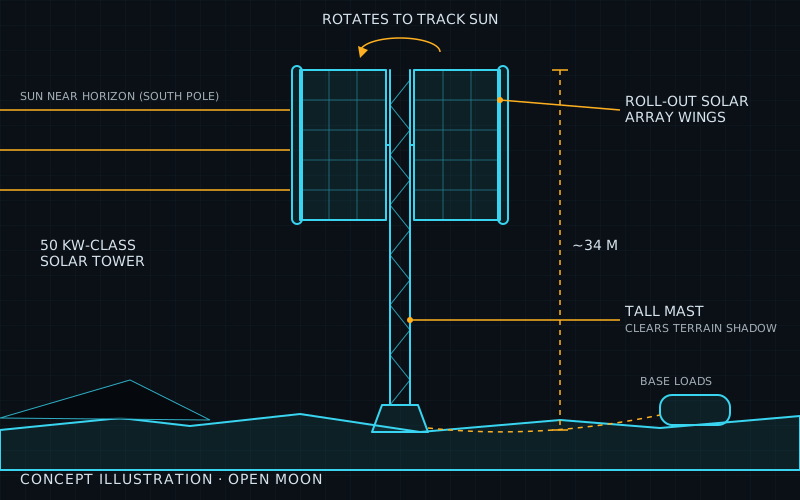
NASA SBIR study award 2024; 34 m tall; Redwire ROSA arrays. Phase II follow-on Jun 2025–Jun 2027
What it is
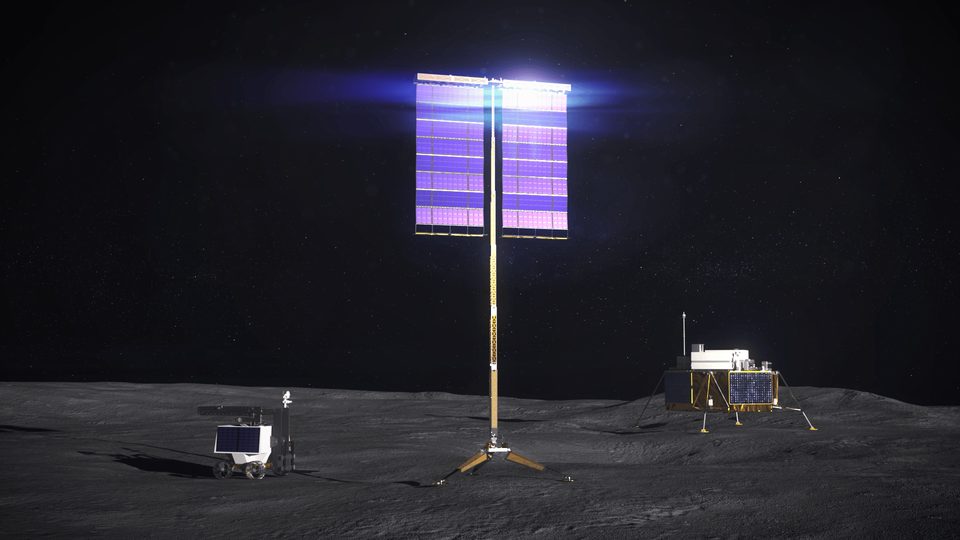
VSAT-XL (Extra Large Vertical Solar Array Technology) is a giant, sun-tracking solar tower for the Moon’s south pole, designed by Astrobotic of Pittsburgh. It is meant to produce 50 kW, five times its 10 kW sibling, the VSAT. In the Phase I study it was 34 m tall and 12.5 m wide, which Astrobotic called the largest planned lunar power infrastructure technology to date. Like the VSAT, it is described as deployable, relocatable, self-leveling and sun-tracking. Its solar blankets are Roll-Out Solar Arrays (ROSA) from Redwire Space.
NASA funded it through its Small Business Innovation Research (SBIR) program. The Phase I purchase order was worth $148,394 and ran about six months from August 2024 to February 2025, according to the award record. Phase I set out to find a stable design and fit it on a current-generation launch vehicle, Astrobotic says. The Phase II contract is worth $849,694 and runs from 5 June 2025 to 5 June 2027. Under it, Astrobotic will build a prototype to test the solar array deployment system. (Astrobotic’s Phase II release is dated 15 July 2025, but its body text says “July 15, 2024”, which looks like a typo.)
As of November 2026, no test results from the Phase II prototype have been published. The tower is a ground-development project. No flight is scheduled.
Why Open Moon uses it
Open Moon’s power milestone (M04) plans two 50 kW VSAT-XL towers alongside two 10 kW VSATs and a fission reactor. The towers supply the bulk of the solar power for the oxygen pilot plant and the habitat. Astrobotic itself names the target loads: pressurized rovers, habitats and ISRU pilot plants.
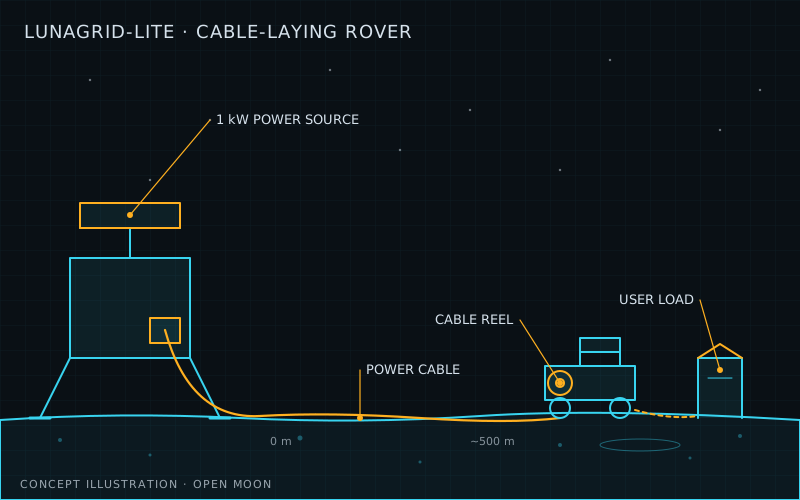
Height is the point. At the poles the Sun stays close to the horizon, and terrain can block light from low arrays. Masts lift the arrays into steadier light, NASA explains. VSAT-XL is part of Astrobotic’s LunaGrid power service. That service also uses cable-laying rovers and wireless chargers to carry power to users. Astrobotic and Honda are also studying how to pair VSAT and VSAT-XL with Honda’s regenerative fuel cell to get through dark periods.
Without VSAT-XL, Open Moon would need about five times as many 10 kW towers to reach the same solar capacity. The alternative is to rely more on a fission reactor that does not exist yet. Astrobotic says no existing lunar power solution meets needs at the 50 kW scale and above.
How it works
The Phase I abstract describes several ROSA wings linked into one “Mega-ROSA”. This large array sits on a gimbal that levels it and points it at the Sun. ROSA is a flexible blanket of solar cells held between two rolled composite booms. The booms straighten as they unroll, like a tape measure, so the wing needs no motor to deploy in orbit. For the 10 kW VSAT, Redwire added dual motors so the array can deploy and retract vertically many times on the Moon. Astrobotic has not said whether VSAT-XL uses the same motors.
In the Phase II design, retractable solar blankets 20 m long are raised more than 10 m above the ground, and the tower mounts on top of a Griffin lander. A mobile version on a self-driving base could drive to new sites without needing a separate rover. Linking several towers could scale output well beyond 50 kW.
| Specification | Value |
|---|---|
| Power output | 50 kW |
| Height | 34 m (Phase I); “over 30 m” (Phase II) |
| Width | 12.5 m |
| Solar panel length | 20 m |
| Array type | Redwire ROSA, linked as a “Mega-ROSA” |
| Carrier | Astrobotic Griffin lander, or a mobile base |
| Mass, stowed volume, cost per unit | Not published |
| NASA funding | $148,394 (Phase I) + $849,694 (Phase II) |
Limitations and open issues
- Early maturity. NASA has funded only a study and a deployment prototype, about $1M in total (Phase I, Phase II). No test results have been published, and no flight is funded.
- No published mass. Astrobotic has not published the tower’s mass or stowed size. Open Moon’s delivery cost for two towers is therefore an estimate.
- The smaller version is not flown either. The 10 kW VSAT prototypes from Astrobotic and Honeybee went through thermal-vacuum tests at NASA Johnson in 2024, but none has been to the Moon. NASA’s first funded vertical-array pathfinder is now a component purchase for miniCAST, with ROSA arrays from Redwire, not from Astrobotic.
- Stability. A 30 m-plus structure must stay stable on sloped terrain, which NASA named as a VSAT challenge. NASA’s 10 kW VSAT goal uses masts of only up to 20 m. Astrobotic says finding a stable and practical design was the main Phase I task.
- Dust. NASA has warned that lunar dust, including dust thrown up by landers and other activity, can reduce the output of vertical solar arrays at the south pole.
- Darkness. Solar towers produce nothing in shadow. Open Moon still needs storage and a reactor. NASA notes that nights near the poles can last more than 14 Earth days.
- Depends on Griffin. The Phase II design mounts on Astrobotic’s Griffin lander, so any lander delay also delays the tower.
| Alternative | How it compares | Status |
|---|---|---|
| 10 kW-class vertical solar arrays (NASA VSAT: Astrobotic, Honeybee Robotics, Lockheed Martin) | Same idea at one-fifth the power: a ROSA or similar blanket on a mast of up to about 20 m. Smaller, lighter and further along (thermal-vacuum tested in 2024), but five units are needed to match one VSAT-XL. | NASA-funded prototypes; Astrobotic and Honeybee units tested in vacuum at NASA Johnson in 2024. No flight yet. |
| Redwire miniCAST power generation (vertical ROSA) | Uses the same Redwire roll-out arrays deployed vertically, as part of a NASA-bought power and communications tower. Smaller pathfinder with a funded path to the Moon, but not a 50 kW system. | About $40M NASA award announced Nov 2026; components, not a full integrated system. |
| Honeybee Robotics LUNARSABER | A much taller (over 100 m) self-building tower that combines solar power, storage, communications and navigation. Sees over more terrain, but it is a study concept with far more deployment risk. | DARPA LunA-10 study concept (Dec 2023); no flight hardware. |
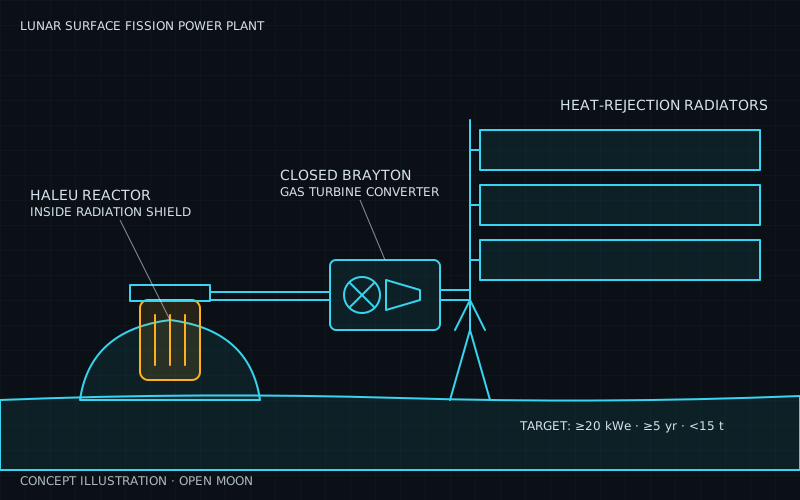
| Fission Surface Power (NASA) | A nuclear reactor gives power day and night without needing sunlit ridges. It is heavier, slower to develop and politically harder, and has no award yet. Open Moon uses both. | NASA asked industry in Aug 2025 for a reactor of at least 100 kWe, aiming for the Moon by early FY2030. |
- official Astrobotic: Astrobotic awarded lunar power study with VSAT-XL (SBIR Phase I) (Aug 2024)
- official Astrobotic: Astrobotic developing XL solar array tech for lunar power infrastructure (SBIR Phase II) (Jul 2025)
- data USAspending: NASA purchase order 80NSSC24PB267, SBIR Phase I VSAT-XL (Jul 2024)
- data USAspending: NASA contract 80NSSC25C0032, SBIR Phase II VSAT-XL (Jun 2025)
- data HigherGov: 80NSSC24PB267 record with the NASA SBIR Phase I abstract (Aug 2024)
- official Astrobotic: LunaGrid lunar surface power service (2026)
- official Redwire: Roll-Out Solar Arrays to enable lunar power infrastructure for Astrobotic VSAT program (Mar 2023)
- official NASA: Three companies to help NASA advance solar array technology for Moon (Aug 2022)
- official NASA: Johnson's thermal vacuum chamber tests lunar solar technology (Nov 2024)
- official NASA: Lunar Surface Technology (VSAT and regenerative fuel cells) (2025)
- official NASA NTRS 20240003496: Lunar dust considerations for vertical solar arrays, Vol. 1 (2024)
- wiki Wikipedia: Roll Out Solar Array (2026)
- official Astrobotic: Honda and Astrobotic joint development agreement on lunar power (Sep 2025)
- official NASA: NASA awards Moon Base transportation, technology, science projects (miniCAST) (Nov 2026)
- official Redwire: Selected for $40 million contract to demonstrate power generation for NASA Moon Base (Nov 2026)
Summary
| System | Power |
| Phase | 1 |
| Milestones | M04 |
| Readiness | TRL 5 / 9 |
| Plan status | needs development |
Sources
- Astrobotic: awarded lunar power study with VSAT-XL (status and facts)
- Reference for the illustration
More sources are on each milestone page that uses this technology.