Blue Origin Blue Alchemist
Passed CDR Sep 2025; autonomous demo in simulated lunar environment planned 2026
What it is
Blue Alchemist is Blue Origin’s system for turning lunar soil (regolith) into oxygen, metals and solar cells. Blue Origin made it public in February 2023. The company said it had been making solar cells and power-transmission wire from regolith simulant since 2021. The simulant was made to match real lunar soil in chemistry and minerals. Blue Origin calls it an end-to-end, scalable, autonomous and commercial way to make solar cells from regolith.
In July 2023 NASA picked the project in its sixth Tipping Point round. Blue Origin got about $34.7 million, the largest of the 11 awards, which together came to about $150 million. Tipping Point deals are milestone-based Space Act Agreements of up to four years. The company must pay at least 10–25% of the project cost itself. NASA says the system will extract oxygen, iron, silicon and aluminium from simulant and use them to make solar cells and wire.
In September 2025 Blue Alchemist passed its Critical Design Review. The next step is an autonomous demonstration in a simulated lunar environment, planned for 2026. The work is done at Blue Origin’s Space Resources Center of Excellence, which the company says has more than 65 staff. Nothing has flown yet. Open Moon rates it TRL 5. That is our own estimate, not a published figure.
Why Open Moon uses it
Blue Alchemist does two jobs in the plan:
- Oxygen from rock (M06). The feedstock is ordinary regolith, so it does not depend on finding ice. It is one of the two oxygen-from-rock processes in the ISRU pilot. Blue Origin’s own pitch: “each kilogram of oxygen we make on the lunar surface is one less that we have to launch from Earth.”
- Silicon, metals and solar cells (M12). Making solar cells, cover glass and aluminium wire on the Moon is the main way Open Moon hopes to grow power beyond what can be shipped. Today the only option is to land every array, such as Astrobotic’s planned 50 kW VSAT-XL.
Without it, oxygen from rock would rest on other processes (see alternatives). Power growth would depend on shipping arrays and reactors from Earth, the most expensive part of the power milestone (M04).
How it works
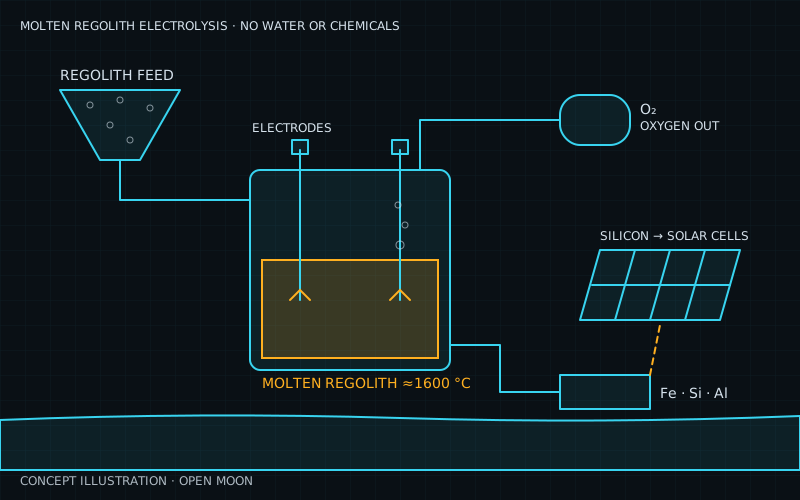
The core is molten regolith electrolysis (MRE). Regolith is heated until it melts at above 1,600 °C. The melt itself acts as the electrolyte. An electric current splits the oxides. Oxygen gas forms at the anode, and silicon, iron and aluminium collect as liquid metal at the cathode. Each oxygen molecule needs four electrons, so the current going in sets the maximum oxygen rate. Blue Origin says the process needs no water, no toxic chemicals and produces no carbon emissions.
The silicon is then refined to make solar cells. Cover glass is made from the process by-products. Without that glass, cells would only last days. With it, Blue Origin expects them to work on the surface for a decade or more. Aluminium becomes wire.
| Item | Value | Source |
|---|---|---|
| Process | Molten regolith electrolysis | Blue Origin |
| Melt temperature | Above 1,600 °C | Solar Daily |
| Silicon purity | More than 99.999% (company claim) | Solar Daily |
| Products | O₂, Si, Fe, Al, solar cells, cover glass, wire | NASA |
| Claimed cell life | 10 years or more on the surface | Engadget |
| NASA funding | About $34.7 million (Tipping Point, 2023) | NASA |
| Oxygen rate, power use, mass, cell efficiency | Not published | none |
For scale, a separate NASA-tested MRE reactor (Lunar Resources LR-1) melted 25 kg of simulant at about 1,700 °C in vacuum. It made about 0.07 kg of oxygen per hour, at about 0.3 mol of O₂ per kWh (NASA, NTRS). Blue Alchemist’s own figures may differ.
Limitations and open issues
- Almost no public performance data. Blue Origin has not published oxygen output, energy per kilogram, reactor mass or solar cell efficiency. Most numbers above are company claims repeated by the press.
- Simulant only. All results so far use Earth-made simulant, not real lunar regolith, and none in lunar gravity.
- Autonomous demo still ahead. The CDR is a design milestone. The 2026 demonstration in a simulated lunar environment has not been reported as done. No flight mission has been announced.
- Hard hardware. Electrodes and containers must survive molten rock at more than 1,600 °C. NASA’s MRE testing needed special heating and temperature control to reach these temperatures.
- High power need. Oxygen output is limited by current. At the efficiency NASA measured for its MRE test, a useful plant needs tens of kilowatts or more. That makes it dependent on the M04 power grid.
- Cell factory is a big step. Turning silicon into finished, covered and wired solar cells takes many more steps than making oxygen. Doing all of them autonomously on the Moon is unproven.
- Single vendor. It is a proprietary Blue Origin system. Open Moon cannot rely on its schedule, so M06 also carries a second oxygen process.
| Alternative | How it compares | Status |
|---|---|---|
| Molten regolith electrolysis (NASA + Lunar Resources LR-1) | The same basic chemistry, but a separate reactor built by Lunar Resources and tested by NASA. Its oxygen numbers are public, which Blue Alchemist's are not, but it does not aim to make solar cells. | Dec 2024 vacuum test at NASA Kennedy: 25 kg of simulant melted, about 0.07 kg of oxygen per hour; NASA's first molecular oxygen from MRE |
| Carbothermal reduction (Sierra Space + NASA) | Uses concentrated sunlight and methane to pull oxygen out of regolith at about 1,800 °C. It needs carbon that must be recycled, and it gives oxygen but not refined silicon or metal for solar cells. | Flight-like automated reactor passed thermal-vacuum testing in summer 2024 under a NASA Tipping Point |
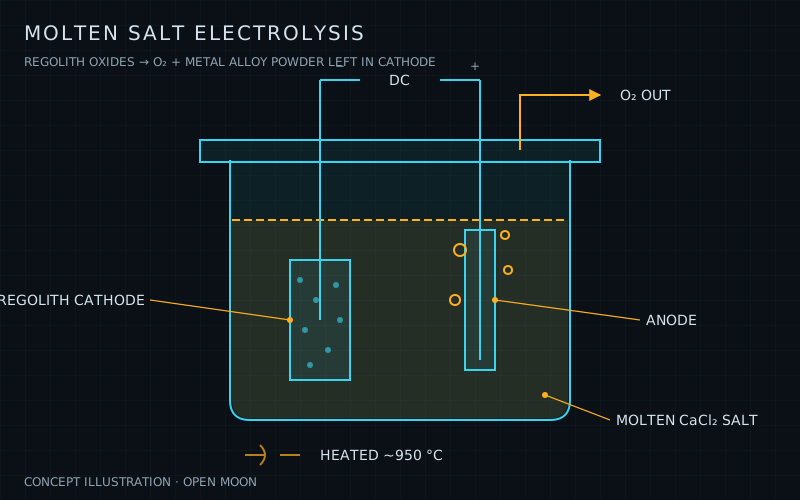
| Molten salt electrolysis (Metalysis FFC process, ESA) | Runs at lower temperature in a molten salt bath instead of molten rock. Gentler on hardware, but the salt must be recycled and the metal left behind is a mixed alloy rather than separate silicon, iron and aluminium. | ESA prototype oxygen plant opened in 2020 at ESTEC |
| Solar arrays shipped from Earth (e.g. Astrobotic VSAT-XL) | Covers the power job without lunar manufacturing. It is much more mature, but every kilowatt has to be launched and landed, and it makes no oxygen or metals. | NASA SBIR Phase II (Jul 2024) for a 50 kW, 30 m tall vertical array |
- official Blue Origin: Blue Alchemist hits major milestone toward permanent, sustainable lunar infrastructure (Sep 2025)
- official Blue Origin: Blue Alchemist powers our lunar future (Feb 2023)
- official NASA: 2023 NASA Tipping Point selections (Jul 2023)
- official NASA: NASA partners with American companies on key Moon exploration tech (Jul 2023)
- official NASA: NASA Kennedy breathes life into Moon soil testing (molten regolith electrolysis) (May 2025)
- paper Toro Medina et al., NASA (ICES 2026): Large-scale demonstration of molten regolith electrolysis for oxygen production (2026)
- official NASA NTRS 20250004151: Environmental testing of a fully automated carbothermal reactor (2025)
- official ESA: ESA opens oxygen plant making air out of moondust (Jan 2020)
- wiki Wikipedia: Blue Origin (space technology section) (2026)
- wiki Wikipedia: In situ resource utilization (2026)
- press IEEE Spectrum: Molten regolith electrolysis could make Moon dust useful (Sep 2025)
- press Solar Daily: Blue Origin unveils Blue Alchemist, a technology that turns Moon dust into solar cells (Feb 2023)
- press Engadget: Blue Origin made solar cells by smelting simulated Moon dust (Feb 2023)
- official Astrobotic: Astrobotic developing XL solar array tech for lunar power infrastructure (Jul 2024)
Oxygen and water pilot plants
2029–2033PH 4M12Manufacturing and construction from regolith
2037–2044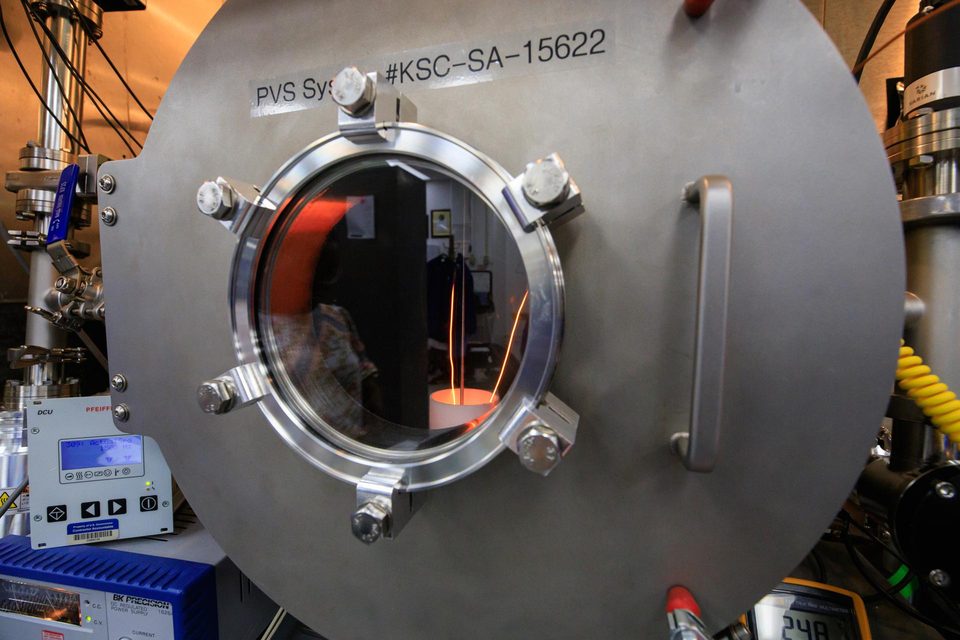
Summary
| System | Resource production |
| Phase | 1, 4 |
| Milestones | M06, M12 |
| Readiness | TRL 5 / 9 |
| Plan status | needs development |
Sources
- Blue Origin: Blue Alchemist hits major milestone (status and facts)
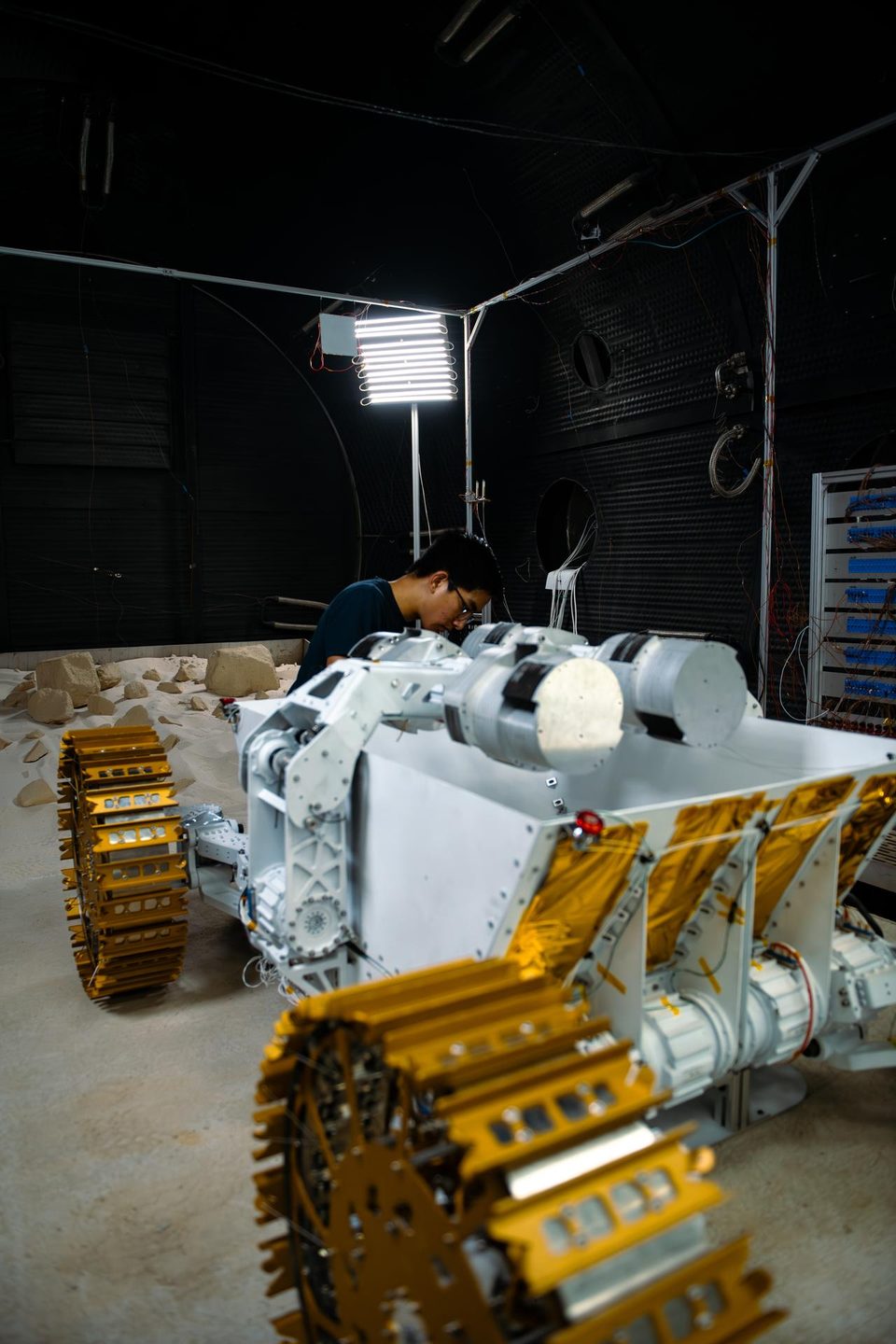
- Reference for the illustration
More sources are on each milestone page that uses this technology.