Ice excavation (NASA Break the Ice)
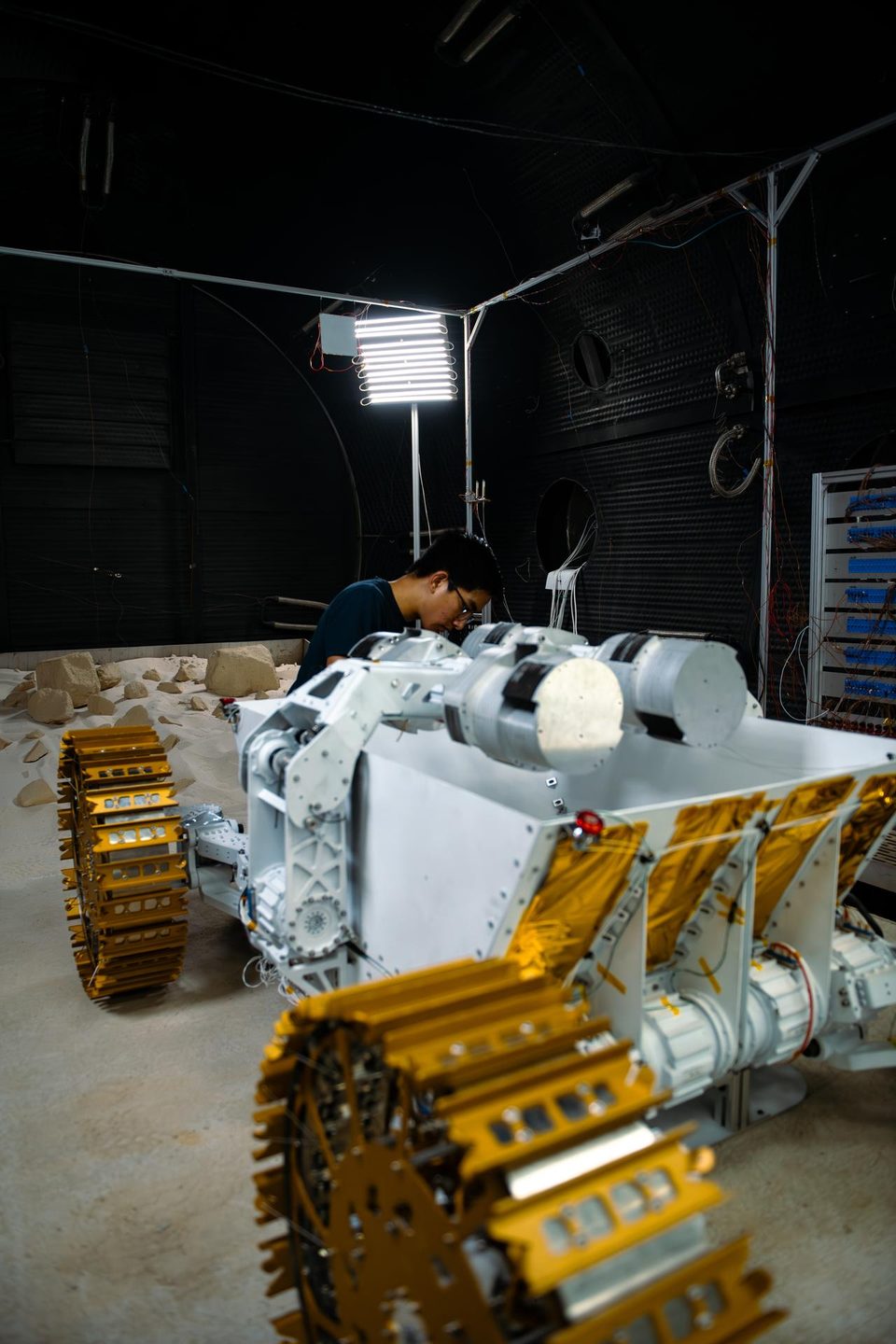
Challenge winners 2024; designs ground-tested
What it is
Break the Ice was a NASA Centennial Challenge that ran from 2020 to 2024. It asked the public to build robots that can dig hard, icy lunar soil (icy regolith) and haul it to a processing plant (NTRS results paper). It was led by NASA Marshall with support from Kennedy, and the total purse was $3.5 million (NASA).
Phase 1 was paper designs: 31 teams submitted and 13 shared $500,000 (NTRS). In Phase 2, teams built real robots and ran them for 15 days at their own sites, then six finalists competed in Huntsville, Alabama, in June 2024. Terra Engineering won $1 million with its “Fracture” rover and Starpath Robotics came second (NASA). Starpath won $500,000 at the finals (NTRS).
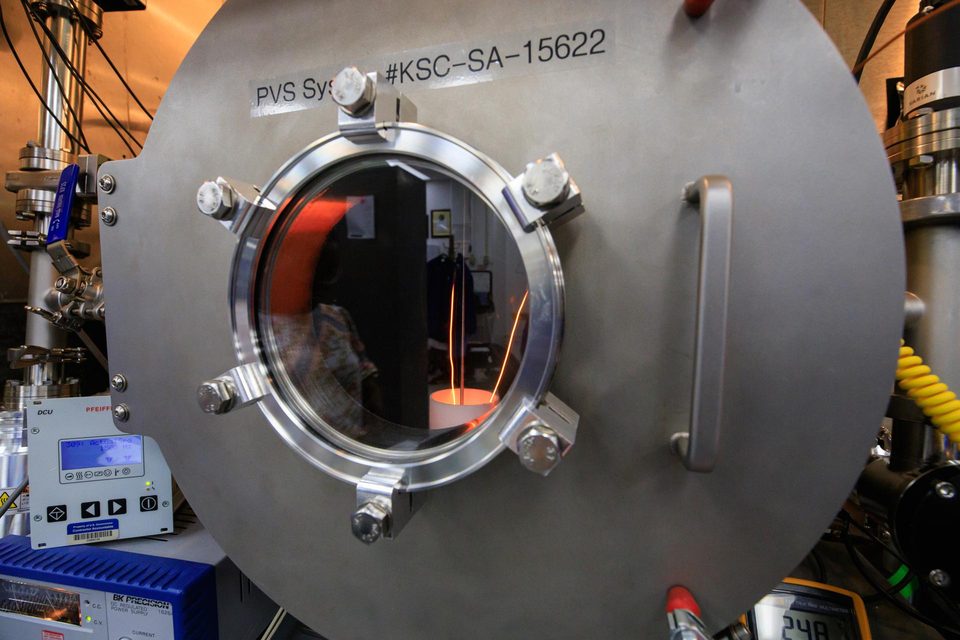
The prize included a test in a NASA thermal vacuum chamber. Starpath spent about three days in Marshall’s 20-foot V-20 chamber in August 2025, digging and driving on a concrete slab with rocky terrain (NASA, NASA images). NASA has not published numerical results from that test. None of these robots has flown.
Why Open Moon uses it
Water ice at the poles is the cheapest source of water, oxygen and propellant on the Moon. It is thought to sit in permanently shadowed craters, mixed into the soil as small grains or coatings rather than as solid sheets (Wikipedia). To use it, a base must first dig it up and move it.
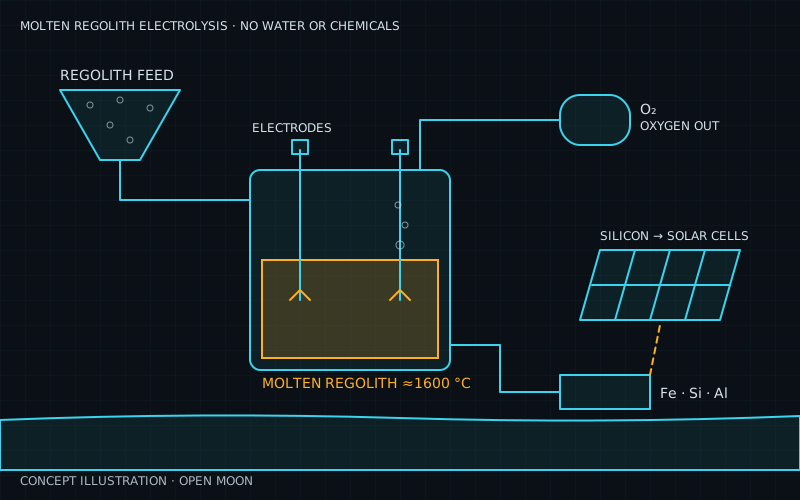
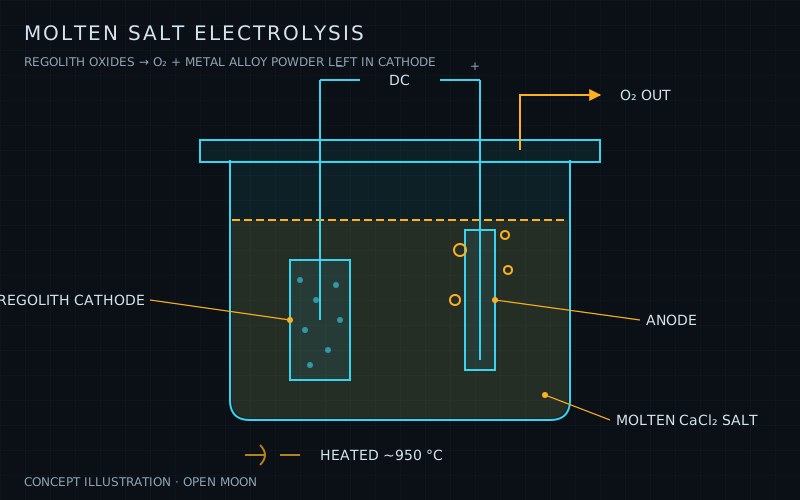
In Open Moon, this technology does that job in M06 (ISRU pilot). It feeds icy regolith to the water extraction and electrolysis plant. Without it, M06 can only make oxygen from dry regolith, and water for life support and propellant must still come from Earth. NASA lists hard icy material as a technology gap. Its target is 1,000 t of icy regolith to make 50 t of water (NTRS). The challenge robots are far smaller than that, but they are the best tested designs for this job.
How it works
The rules modelled a polar crater. In Phase 2, the “ice” was a weak concrete with a compressive strength of 1.5–2.0 MPa. That approximates icy regolith with 4% water (NTRS, rules). Each robot had to dig and deliver 800 kg a day for 15 days (12 t in total), driving 500 m each way per load, on its own batteries and radios (NTRS).
The winners took different approaches. Starpath uses a pair of opposing bucket drums, like NASA’s RASSOR and IPEx, with a lifting hopper that dumps like a dump truck (NTRS). Opposing drums cancel out digging forces, so a light robot can dig in low gravity (IPEx). Terra Engineering uses many small hardened milling bits that scrape and then crack the surface upward (NTRS).
At the finals, a crane held up 5/6 of each robot’s weight during digging to mimic lunar gravity. Scores favoured a high dig rate for the robot’s mass and for the energy used (NTRS, video).
| Finals result (NTRS) | Terra Engineering | Starpath Robotics |
|---|---|---|
| Robot mass | 325.3 kg | 253.8 kg |
| Dug and collected | 311.6 kg in 60:00 | 91.5 kg in 32:20 |
| Digging energy | 250 Wh | 219 Wh |
| Hauled on course | 300 kg in 13:39 | 80 kg in 5:54 |
| Hauling energy | 127 Wh | 100.6 Wh |
Limitations and open issues
- Not real ice. The test material was weakened concrete, not icy lunar soil. Real ice at below about 100 K may behave differently (NTRS, Wikipedia).
- Not built for space. Phase 2 did not require space-rated parts, lunar thermal protection or lighting (NTRS).
- Endurance unproven. Only 2 of 8 teams met 800 kg a day for all 15 days (NTRS). A real base needs years of operation.
- Gravity only partly simulated. Gravity offload was used for digging but not for hauling (NTRS).
- Vacuum results unpublished. NASA has not released numbers from the thermal vacuum test (NASA).
- No flight. No flight date has been announced for either winner. The closest flight test, PRIME-1, got about 10 hours of its planned 10 days of work after the IM-2 lander tipped over (NASA).
- Ice form uncertain. Nobody yet knows how much ice there is or how it is spread through the soil, so dig targets may change (Wikipedia).
| Alternative | How it compares | Status |
|---|---|---|
| NASA ISRU Pilot Excavator (IPEx) | NASA's own small excavator uses pairs of counter-rotating bucket drums, the same idea Starpath used. It is designed by NASA for a south-pole demo with dust and thermal control built in, but it targets loose regolith and its rates are design goals, not lunar measurements. | TRL-5 design described in 2024; no flight date announced |
| Percussive-rotary drill (Honeybee TRIDENT, PRIME-1) | A 1 m drill that hammers and spins to bring up samples from a set depth. It has flown to the Moon, but it is a prospecting tool that takes small samples, not a machine that moves tonnes of icy soil. | Operated on the Moon on IM-2 in March 2025, but the lander tipped over and no ice was sampled |
| In-place heating wells (WIEVR) | Uses sunlight to heat ice underground and collects the vapour at the surface, so no regolith is dug up. It needs only a drilled well and less energy than mining, but it depends on getting heat down into cold, poorly conducting soil. | Concept described in a 2013 NASA tech brief; no hardware testing found |
| Grain sorting without melting (Aqua Factorem) | Treats ice grains as just another kind of rock and sorts them out of the soil, then hauls only the ice. The authors estimate it could replace about 800 kW of thermal extraction with under 100 W, but it still needs digging and is unproven. | NASA NIAC study (2021); laboratory concept only |
- official NASA: California teams win $1.5 million in NASA's Break the Ice Lunar Challenge (Jun 2024)
- official NASA: Break the Ice Lunar Challenge (archived challenge page) (Jun 2025)
- official NASA: Six finalists named in NASA's $3.5 million Break the Ice Challenge (Dec 2023)
- official NASA: Lunar Challenge winner tests technology in NASA thermal vacuum chamber (Sep 2025)
- paper Leucht, Prater and Vetcha: Overview and results from NASA's Break The Ice Lunar Challenge (NTRS 20240015957) (Dec 2024)
- paper Overview of NASA's Break the Ice Lunar Challenge Phase 1, AIAA ASCEND 2022 (NTRS 20220013718) (Sep 2022)
- data Break the Ice Lunar Challenge Phase II competition rules (Jun 2022)
- official NASA Image Library: Starpath rover prepared for thermal vacuum testing at Marshall (Jul 2025)
- video Break the Ice Finals: Terra Engineering excavation event (video) (Jun 2024)
- wiki Wikipedia: Lunar water ()
- paper NASA NTRS: ISRU Pilot Excavator (IPEx) TRL 5 design overview (Jun 2024)
- paper NASA NTRS: RASSOR, Regolith Advanced Surface Systems Operations Robot (Nov 2015)
- official NASA: NASA's lunar drill technology passes tests on the Moon (PRIME-1) (Apr 2025)
- official NASA NTRS: Wells for In Situ Extraction of Volatiles from Regolith (WIEVR) (Jul 2013)
- official NASA NTRS: Aqua Factorem, ultra low energy lunar water extraction (NIAC) (Mar 2021)
Summary
| System | Resource production |
| Phase | 1 |
| Milestones | M06 |
| Readiness | TRL 4 / 9 |
| Plan status | needs development |
Sources
- NASA: Break the Ice Lunar Challenge winners (status and facts)
- Image: NASA/Joe Kuner
More sources are on each milestone page that uses this technology.