Carbothermal reduction (Sierra Space + NASA)
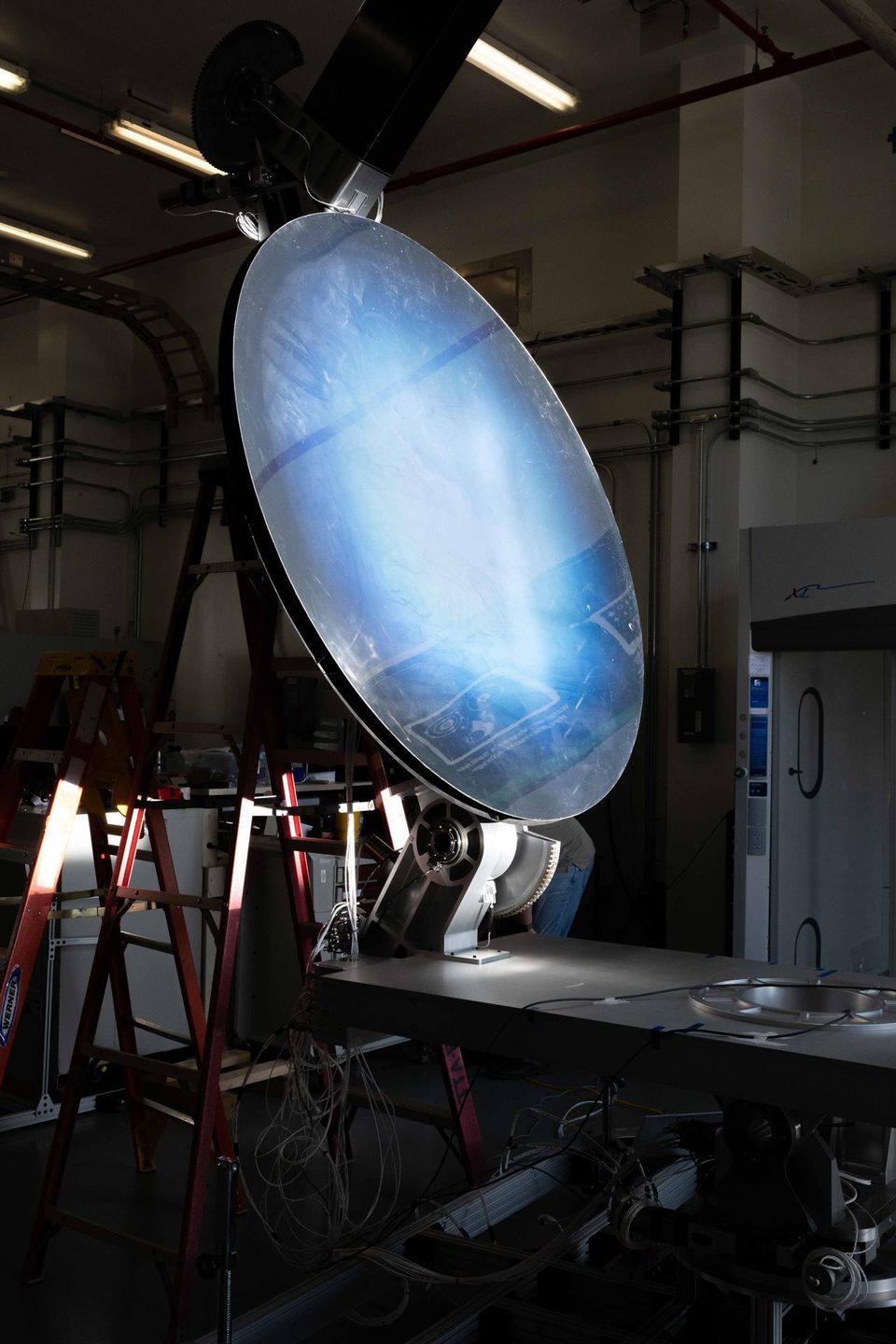
Flight-like reactor ran automated in JSC dirty thermal-vacuum chamber (2024); key hardware matured to TRL 6
What it is
Carbothermal reduction takes oxygen out of Moon rock with carbon and heat. Lunar regolith is about 45% oxygen by mass, locked in metal oxides. Heated to about 1800 °C with a carbon source, the molten oxides give up their oxygen as carbon monoxide. The same carbothermic chemistry is used on Earth to make high-purity silicon. Aerojet first tried it on lunar-type material in the 1960s. ORBITEC, later bought by Sierra Space, began NASA-funded work on it in 1993 (ICES 2025).
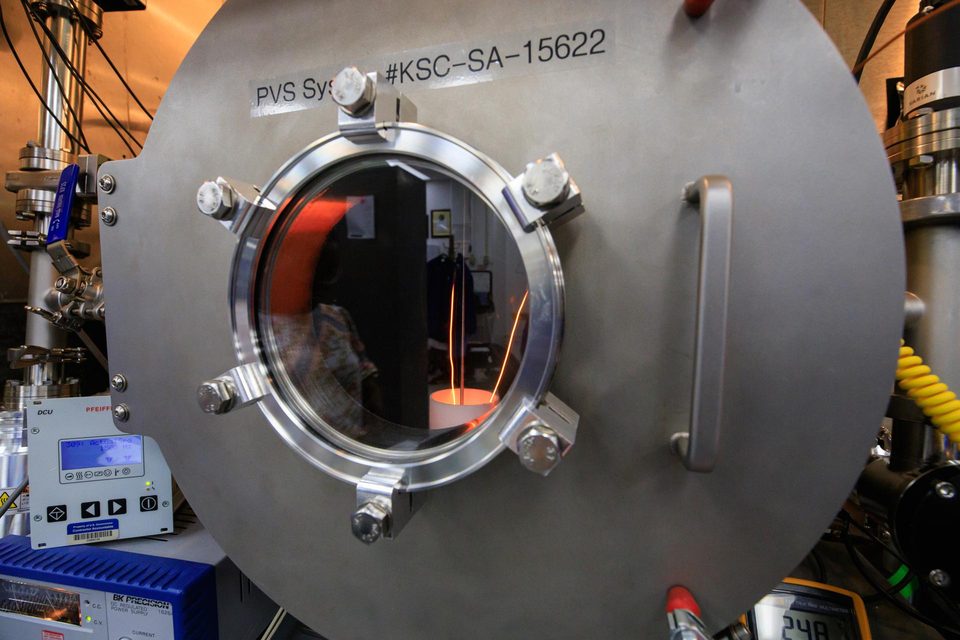
Sierra Space built the current reactor, the Carbothermal Oxygen Production Reactor (COPR), under a NASA Tipping Point contract. In summer 2024 it ran fully automated inside NASA Johnson’s B351 “dirty” thermal-vacuum chamber. That test brought key hardware to TRL 6. NASA’s Carbothermal Reduction Demonstration (CaRD) project then paired the reactor with a solar concentrator from NASA Glenn, mirrors from Composite Mirror Applications, and avionics and gas analysis from NASA Kennedy (ASCEND 2026). CaRD started in 2020 at the request of the Lunar Surface Innovation Initiative.
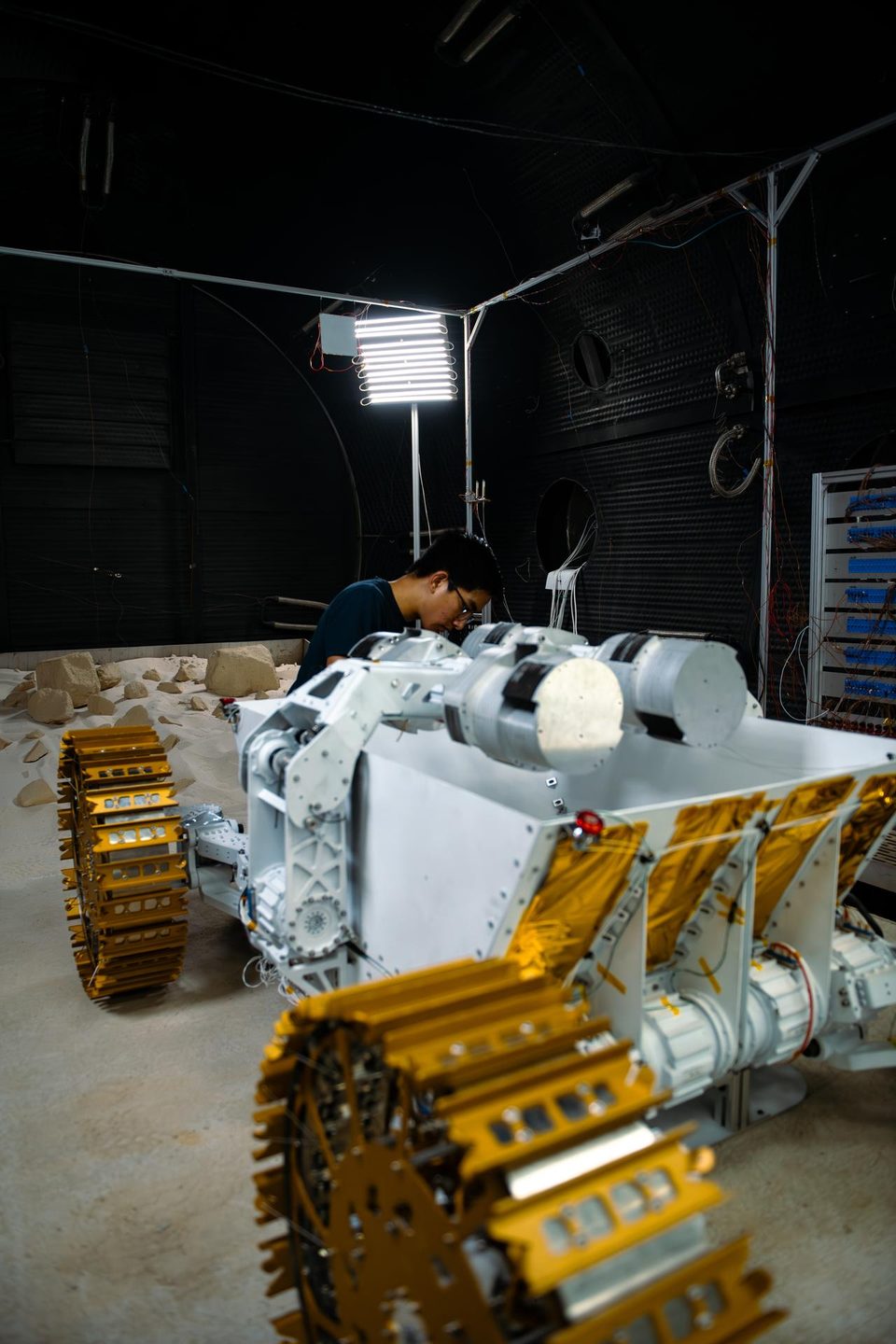
In August 2025 the integrated prototype used real sunlight at Johnson to make carbon monoxide from simulant (NASA; image). NASA’s Game Changing Development Program funded it. The reactor alone is at TRL 6. The full solar system still needs thermal-vacuum testing to reach TRL 6 (SRR 2026).
Why Open Moon uses it
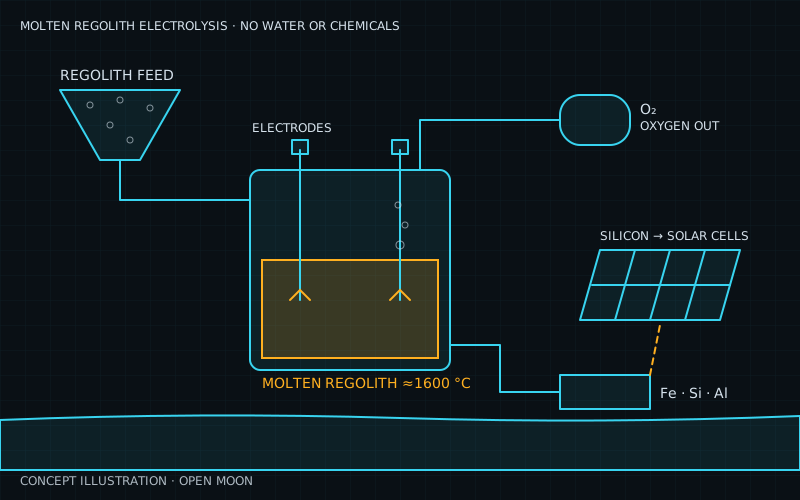
Oxygen is most of a rocket’s propellant mass, and also what crews breathe. Making it on the Moon is the main job of milestone M06 (ISRU pilot), which needs at least 10 t of oxygen a year. Carbothermal reduction is Open Moon’s backup oxygen-from-rock process, with molten regolith electrolysis as the primary choice. It is also the most mature option in that group: TRL 6, while the electrolysis options are at TRL 4 to 5.
It has two strengths for a backup. First, most of its energy is sunlight focused straight onto the rock, not electricity, so it needs much less electric power (ASCEND 2026). Second, it works on any metal oxide, so the exact mineral mix need not be known first (ICES 2025). CaRD was sized to fit a mid-class CLPS lander. It is meant to lead to a 1 t/yr pilot plant and a 10 t/yr full-scale plant (ASCEND 2026). Without a second process, M06 would depend on one immature electrolysis technology.
How it works
The full cycle has four steps (ICES 2025):
- Reduction: metal oxide + carbon → metal + carbon monoxide (CO). Methane supplies the carbon.
- Carbon recovery: a Sabatier (methanation) reactor turns CO and hydrogen back into methane and water.
- Electrolysis: water is split into hydrogen and oxygen. The oxygen is stored.
- Net result: the oxide gives up its oxygen, and carbon and hydrogen are recycled.
Sabatier reactors and water electrolysers are already at TRL 9, so Sierra Space’s work stopped at the CO and CO₂ stage. A hopper meters regolith into a pressurised chamber, where load cells weigh it. Focused light then melts only a small spot. The unmelted regolith around it acts as both crucible and insulation, so the walls stay cool with no active cooling. A rake lifts out the hard metal-bearing slag and leaves the loose regolith for the next batch. The regolith-tolerant valves have passed over 10,000 cycles (ICES 2025).
| Spec | Value |
|---|---|
| Melt temperature | ~1800 °C (1782.9 °C measured) ICES 2025 |
| TVAC conditions | down to −45 °C, <1×10⁻⁴ torr, tilted 15°; 4 reduction runs ICES 2025 |
| Yield with laser heat | over 20 g O per kWh thermal input; goal was 3.5 g/kWh ICES 2025 |
| Concentrator | 1.6 m clear aperture, 36 mm focus, concentration ratio 1975 SRR 2026 |
| Concentrator mass | ~205 kg estimated, versus 635 kg for the 2010 version ASCEND 2026 |
| Optical efficiency | 60.3% to the regolith, versus 33% for the 2010 version ASCEND 2026 |
| Solar yield, Houston 2025 | 0.28–0.51 g O per kWh of sunlight at the mirror ASCEND 2026 |
| Predicted on the Moon | ~9.53 g/kWh as CO; 7.44 g/kWh as O₂ gas after electrolysis ASCEND 2026 |
The first solar version was tested on Mauna Kea, Hawaii, in 2010 (field analogs). It made 1.1 g of oxygen as CO from 3.313 kWh of sunlight (ASCEND 2026).
Limitations and open issues
- Sun-to-oxygen yield is low so far. The best Houston result was 0.51 g/kWh, at sea level and in changing weather. The lunar figures are predictions from laser tests on simulant, not measurements (ASCEND 2026).
- The full system is not yet at TRL 6. CaRD has not had vibration or thermal-vacuum testing. Sun tracking and swinging the concentrator into the sunlight were not tested. One deployment motor must be replaced (ASCEND 2026).
- The CO-to-oxygen steps were not part of these tests. Methanation, electrolysis and liquefaction still need to be joined to the reactor. Carbon and hydrogen losses in a closed loop over long runs are not published.
- Scale and endurance are unproven. The process must run unattended for months and survive the lunar night. A large concentrator cannot be sized until the oxygen yield from real regolith at the site is known (ASCEND 2026).
- Direct sunlight versus electric heating is debated. A 2011 NASA study found electric resistance heating could process about 12 times more regolith per unit of heat, and expected solar panels to beat concentrators on mass (NTRS).
- No published size, power or cost for a 10 t/yr plant. The power and hardware mass for M06-scale output have not been published.
- Like all oxygen-from-rock methods, it has never flown. No ISRU oxygen system has yet worked on the Moon (field analogs; ISRU).
| Alternative | How it compares | Status |
|---|---|---|
| Molten regolith electrolysis (NASA + Lunar Resources) | Melts regolith and splits the oxides with electric current, giving oxygen gas directly with no carbon or hydrogen loop. Needs large electrical power and long-life electrodes; carbothermal uses sunlight as heat but outputs carbon monoxide that must still be converted. | TRL 4: 2024 ground demo processed 25 kg of simulant in vacuum at about 0.07 kg O2 per hour for 9 hours. |
| Blue Origin Blue Alchemist | A molten regolith electrolysis system aimed at making oxygen plus metals such as silicon, iron and aluminium. Commercially funded and aimed at products beyond oxygen, but runs on electric power rather than direct solar heat. | Passed critical design review Sep 2025; autonomous demo in a simulated lunar environment planned for 2026. |
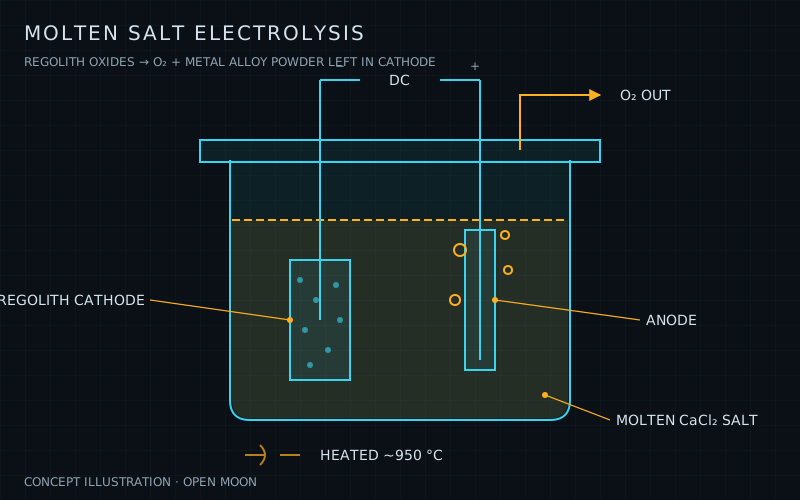
| Molten salt electrolysis (Metalysis process, ESA) | Solid regolith sits in a molten salt bath and an electric current pulls oxygen out, leaving a mix of metals. Runs at about 950 C with the regolith still solid, much cooler than a 1800 C melt, but it needs a calcium chloride salt bath and electric power. | ESA prototype oxygen plant opened in 2020 at ESTEC. |
| Hydrogen reduction (NASA RESOLVE / ROxygen) | Heats regolith in hydrogen to about 900 C so the hydrogen pulls oxygen from iron oxides as water. Lower temperature and simple chemistry, but it only reaches iron oxides, while carbothermal reduction can work on any metal oxide. | Prototype reactors run in NASA analog field tests on Mauna Kea in 2008 and 2010; no flight unit. |
- official NTRS 20250004151: Environmental Testing of a Fully Automated Carbothermal Reactor for Lunar Oxygen Production (ICES-2025-200) (Jun 2025)
- official NTRS 20260002864: Prototype Demonstration of Solar-Carbothermal System to Extract Oxygen from Regolith (ASCEND 2026 paper) (May 2026)
- official NTRS 20260004073: Prototype Demonstration of Solar Carbothermal System to Extract Oxygen from Regolith (ASCEND 2026 slides) (May 2026)
- official NTRS 20260004723: Integrated Solar Concentrator System and Carbothermal Reactor, Space Resources Roundtable 2026 (Jun 2026)
- official NTRS 20230008393: Carbothermal Reduction Demonstration (CaRD), Space Resources Roundtable 2023 (May 2023)
- official NASA: Harnessing the Sun to Extract Oxygen on the Moon (Feb 2026)
- official NASA Image Library: CaRD solar concentrator testing at Johnson Space Center (jsc2025e075711) (Aug 2025)
- official NTRS 20110004888: Comparison of Direct Solar Energy to Resistance Heating for Carbothermal Reduction of Regolith (Jan 2011)
- official NTRS 20100021362: Integration of In-Situ Resource Utilization Into Lunar/Mars Exploration Through Field Analogs (Jan 2010)
- official NTRS 20090029910: Development of a Reactor for the Extraction of Oxygen and Volatiles From Lunar Regolith (RESOLVE) (Jul 2009)
- official NTRS: Molten regolith electrolysis ground demonstration (ICES 2026) (2026)
- official NASA Game Changing Development Program ()
- wiki Wikipedia: Carbothermic reaction ()
- wiki Wikipedia: In situ resource utilization ()
Summary
| System | Resource production |
| Phase | 1 |
| Milestones | M06 |
| Readiness | TRL 6 / 9 |
| Plan status | ready to use |
Sources
- NASA NTRS 20250004151: Carbothermal oxygen production reactor testing (status and facts)
- Image: NASA/Michael Rushing
More sources are on each milestone page that uses this technology.