In-orbit LOX storage demo (LOXSAT)
Eta Space payload on Rocket Lab spacecraft; NASA (May 2026) gave launch no earlier than 17 July
What it is
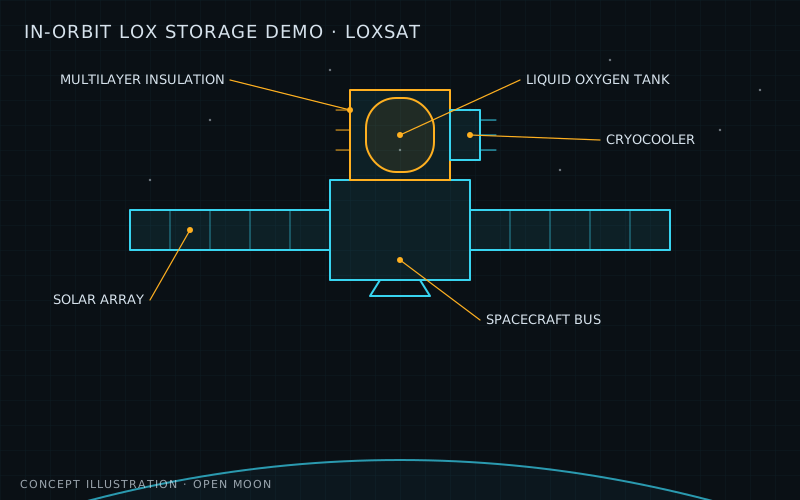
LOXSAT (the Liquid Oxygen Flight Demonstration) is a small satellite that will store and move liquid oxygen in low Earth orbit. It tests the hardware a future propellant depot needs. Over a nine-month mission it will demonstrate 11 cryogenic fluid management technologies, covering boiloff, transfer, tank pressure and gauging how much liquid is left.
The payload is built by Eta Space, a small Florida company. NASA picked it in its October 2020 Tipping Point round with an award of about $27 million. Rocket Lab supplies the Photon spacecraft bus and the Electron launch. In October 2025 Rocket Lab said it had finished the spacecraft. Engineers from NASA’s Cryogenic Fluid Management project at Marshall, Glenn and Kennedy support the mission.
In May 2026 NASA said the payload was integrated and would launch from New Zealand no earlier than 17 July 2026. That date has passed. Wikipedia now calls it the “originally scheduled” date and still lists LOXSAT as a future flight. Eta Space plans to use the results for a commercial depot called Cryo-Dock, planned for about 2030.
Why Open Moon uses it
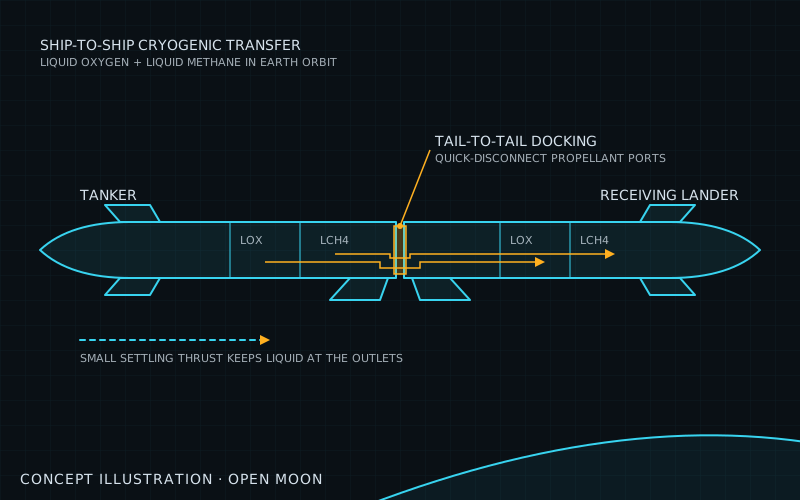
Open Moon does not fly LOXSAT. It uses LOXSAT as heritage: flight data that shows liquid oxygen can be kept cold and moved in space without big losses. Milestone M11 (Propellant and industrial-scale ISRU) needs a cryogenic depot at the landing pads, with liquefaction, storage tanks, transfer lines and boil-off control. Landers there would be refuelled with lunar oxygen.
Keeping oxygen liquid is hard. Heat leaks in, the liquid boils, and pressure rises. Insulation alone cannot stop the loss; a cryocooler that removes the heat can bring it close to zero, which NASA calls a zero-boiloff system. LOXSAT is one of the first flights built to test this with oxygen. Without such data, M11 would have to size its tanks and coolers from ground tests and models alone, or plan for extra oxygen to make up for boiloff.
How it works
The spacecraft carries a spherical liquid oxygen tank on a Photon bus. Its active thermal control system pulls liquid from the tank through a propellant management device, pumps it through a cryocooler, and sprays the chilled liquid back into the gas space. The cold droplets cool the gas and condense vapour, so pressure drops. Liquid that is not sprayed returns colder and cools the bulk. The cryocooler works much like a refrigerator.
NASA and Eta Space have modelled this because spray heat transfer in zero gravity has little test data. Their two models agree in broad terms, but one predicts more subcooled liquid and the other a better-mixed tank near boiling point.
| Item | Value |
|---|---|
| Builder | Eta Space (payload); Rocket Lab (bus, launch) |
| NASA award | ~$27 million (Tipping Point, 2020) |
| Fluid | Liquid oxygen |
| Mission length | 9 months planned |
| Technologies tested | 11 |
| Bus / launcher | Photon / Electron, Launch Complex 1, New Zealand |
| Pressure bands studied in models | 70-200 kPa |
| Tank volume, LOX mass, cryocooler power | Not published in the sources here |
Limitations and open issues
- Not flown yet. The NASA date of 17 July 2026 has slipped, and no new date is confirmed in the sources here.
- Small scale. LOXSAT is a small satellite. M11 needs storage of hundreds of tonnes; scaling up is unproven.
- Orbit, not the Moon. It tests microgravity. A lunar depot works in one-sixth gravity, with dust and big day-night temperature swings.
- Uncertain physics. Zero-g spray cooling is not well characterised; flight data is needed to anchor the models.
- Cryocooler reliability. The last flown zero-boiloff test, RRM3 on the ISS, lost its methane after a cryocooler failure about four months in.
- Key numbers missing. Tank size, cooling power and boiloff targets are not published in the sources here.
| Alternative | How it compares | Status |
|---|---|---|
| SpaceX Starship ship-to-ship propellant transfer | A far larger demonstration that moves liquid oxygen and methane between two docked Starships. It tests transfer at the scale a lander needs, which LOXSAT cannot, but it is a short test and is not built to show months of zero-boiloff storage. | Large-scale cryogenic transfer test shown on the NASA HLS schedule; not yet flown |
| ULA Vulcan Centaur cryogenic Tipping Point demo | Uses a real upper stage as the test tank, so it tests flight-scale tanks and hardware. Tests would last much less time than LOXSAT's nine months, and the stage cannot stay up as a long-lived test bed. | Selected by NASA in Oct 2020 ($86.2 million); flight results not published |
| Lockheed Martin liquid hydrogen smallsat Tipping Point demo | A sister small-satellite demo of the same 2020 round, but for liquid hydrogen. Hydrogen is harder to keep cold than oxygen, so it would teach more about the hardest case, but it says less about oxygen, which is the main product of lunar ISRU. | Selected by NASA in Oct 2020 ($89.7 million); flight status not published in the sources here |
| Robotic Refueling Mission 3 (RRM3) on the ISS | An earlier ISS payload that stored liquid methane with a cryocooler. It is the only flown zero-boiloff precedent, but it was small, used methane not oxygen, and lost its cryogen after a cryocooler failure. | Flown 2018-2019; zero-boiloff storage held for about 4 months, then the methane was vented |
| NASA CryoFILL ground tests | Ground tests at NASA Glenn of liquefying oxygen with a flight-like cryocooler, aimed at refuelling landers on the surface. It is closer to the lunar job than an orbital demo, but it runs in Earth gravity, so it cannot show how liquid behaves in microgravity. | Ground testing with flight-like hardware, 2025-2026 |
- official NASA: NASA, industry prepare cryogenic fuel technology demo (LOXSAT) (May 2026)
- official NASA: NASA announces partners to advance Tipping Point technologies for the Moon, Mars (Eta Space $27 million) (Oct 2020)
- paper Bentley et al. (NASA MSFC and Eta Space): Modeling and simulation of tank pressure control using zero-boiloff active thermal control for LOXSAT, AIAA SciTech 2023 (Jan 2023)
- official NASA Cryogenic Fluid Management (CFM) portfolio project (2026)
- official NASA Cryogenic Fluid Management fact sheet (Jan 2024)
- official Rocket Lab: LOXSAT mission page (2026)
- official Rocket Lab: Rocket Lab completes spacecraft for cryogenic fueling mission with Eta Space and NASA (Oct 2025)
- official NASA HLS IAC 2026 presentation (Starship propellant transfer test on the schedule) (Oct 2026)
- official NASA: Ice to fuel, NASA tests technology for refueling landers (CryoFILL) (Mar 2026)
- wiki Wikipedia: LOXSAT (2026)
- wiki Wikipedia: Robotic Refueling Mission (RRM3 methane storage) (2026)
- wiki Wikipedia: Propellant depot (2026)
- wiki Wikipedia: Rocket Lab Photon (2026)
- wiki Wikipedia: Cryocooler (2026)
Summary
| System | Resource production |
| Phase | 4 |
| Milestones | M11 |
| Readiness | TRL 6 / 9 |
| Plan status | ready to use |
Sources
- NASA: NASA, industry prepare cryogenic fuel technology demo (LOXSAT) (status and facts)
- Reference for the illustration
More sources are on each milestone page that uses this technology.