NASA CADRE autonomous rovers
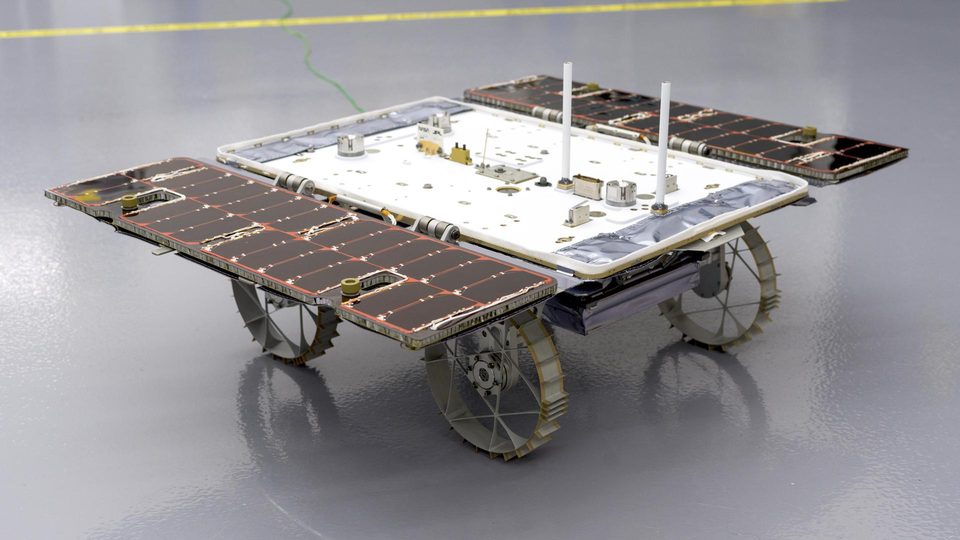
Flies on Intuitive Machines IM-3; NASA launch schedule lists IM-3 for early 2027
What it is
CADRE (Cooperative Autonomous Distributed Robotic Exploration) is a NASA technology demonstration of three small rovers that work as a team. The goal is to show that a group of robots can collaborate to gather data without direct commands from mission controllers on Earth. NASA describes the rovers as “suitcase-size”. Each has an onboard computer, a wireless radio and a stereo camera. NASA calls them the latest version of its A-PUFFER technology. NASA has not published a mass or exact dimensions on the pages cited here.
JPL manages CADRE for NASA’s Game Changing Development program. Motiv Space Systems built key hardware, Clemson University contributed research, and NASA Glenn and Ames supported the project. The rovers completed their first autonomous team drive in a JPL clean room in December 2023. Hardware build and testing ended in February 2024. The rovers were shipped to Intuitive Machines in Houston and arrived on 9 February 2025.
CADRE will fly on Intuitive Machines’ IM-3 Nova-C lander under NASA’s CLPS program. It will land at Reiner Gamma, a lunar swirl on the western near side. IM-3 has slipped several times. NASA’s launch schedule now lists it for early 2027, and Wikipedia gives NET Q1 2027 on a Falcon 9.
Why Open Moon uses it
Open Moon lists CADRE in milestone M07 (surface mobility) as heritage for multi-robot autonomy. M07 expects rovers and utility robots to keep working between crew visits. CADRE is the first flight test of robots that share maps, split up work and decide what to do as a team. NASA says success could lead to teams of robots supporting astronauts and taking distributed measurements.
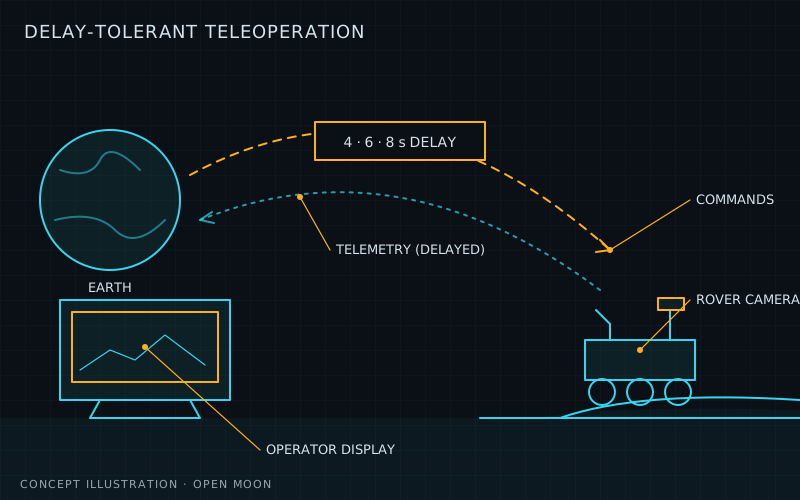
Open Moon does not plan to buy CADRE rovers. It uses the software ideas and flight data. Without CADRE, fleets of utility robots would rely on Earth teleoperation through a 4-8 second delay, with one operator per vehicle. NASA’s own project page notes that waiting for ground control “eats up precious time”.
How it works
The team is three rovers plus a base station on the lander. Each rover is lowered by tether from the lander to the surface. The base station is powered by the lander and has no battery. It acts as the link to Earth and helps with computing.
CADRE runs two experiments:
- Exploration. The leader splits an unknown area into one sub-region per rover. Each rover maps its part with its stereo cameras. The result is a digital elevation map.
- Distributed sensing. The rovers drive in formation to a waypoint tens of metres away. They take coordinated multi-static ground-penetrating radar soundings to map the subsurface.
The software plans centrally and executes in a distributed way. A leader election mechanism picks a new leader if one rover fails, and a “designated survivor” keeps a backup of every agent’s data.
| Item | Value |
|---|---|
| Robots | 3 rovers + 1 lander base station (JPL) |
| Sensors | Stereo cameras, ground-penetrating radar (JPL) |
| Power | Solar arrays and battery; minimum charge about 20% (paper) |
| Duty cycle | 25-minute work cycles; an FPGA timer shuts all agents down at 25 and 55 min past the hour (paper) |
| CPU limit | 65 °C; only a few minutes of driving near lunar noon (paper) |
| Mission length | Daylight of one lunar day, about 14 Earth days (NASA) |
| Wheels | Ultralight aluminium with grousers (NASA) |
| Mass, size, speed | Not published in the sources cited here |
Limitations and open issues
- Not flown yet. CADRE has only been tested on Earth. JPL once targeted a late 2023 launch; IM-3 is now listed for early 2027.
- Lander risk. IM-1 and IM-2 both tipped over after hard landings. CADRE depends on IM-3 landing upright and deploying it.
- Short mission. The rovers only work through one lunar day. They do not show night survival, which a base fleet would need.
- Heat limits. Near lunar noon the CPU overheats after a few minutes of driving. Larger, longer-lived robots will need better thermal design.
- Small scale. The demo covers a region near the lander, with waypoints tens of metres away. It does not prove kilometre-scale teamwork.
- Ground-tested software. Planner tests ran on stationary flight rovers in a clean room for over 9 hours, not on lunar terrain.
- Missing public specs. Mass, size, speed and radio range are not in the sources used here.
| Alternative | How it compares | Status |
|---|---|---|
| Delay-tolerant teleoperation from Earth | People on Earth drive each rover through a 4-8 second delay instead of robots planning together on the Moon. It needs no new autonomy software, but it is slower, tiring for operators and needs one driver per vehicle. | NASA simulator studies in 2023 had operators finish traverses at 0, 4, 6 and 8 s delay; not yet flown on a lunar rover. |
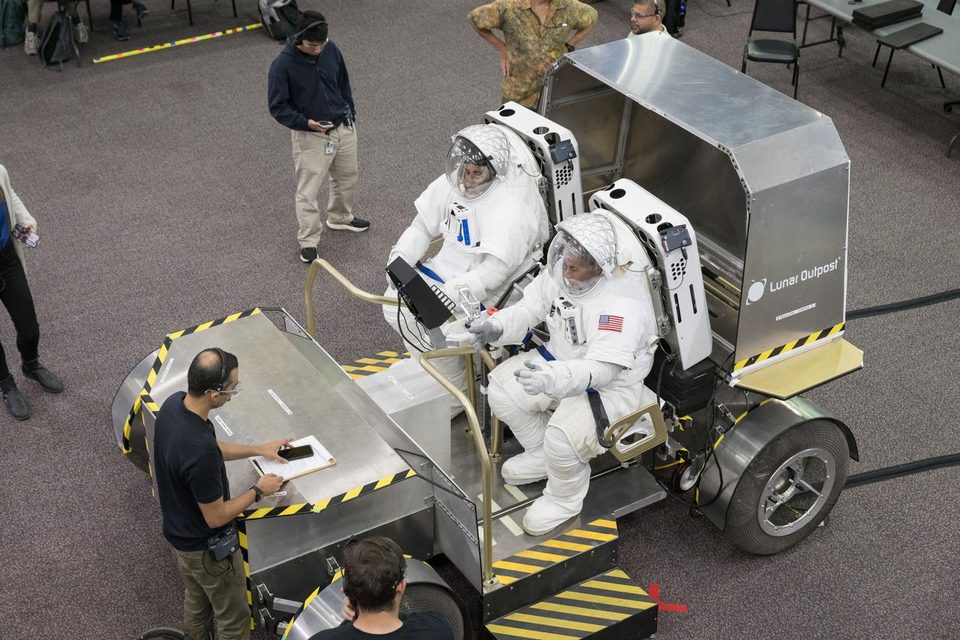
| Lunar Outpost Pegasus LTV (autonomous driving mode) | One large crew rover that can drive itself, rather than a team of small cooperating robots. It can carry people and cargo, but it does not show many robots sharing maps and splitting up tasks. | NASA LTV award in 2026; flight units to be qualified over the next 18 months. |
| NASA VIPER | A single, much larger science rover with a 1 m drill, planned for a 100-day mission. It has more capable instruments but no multi-robot teamwork, and it is operated closely from the ground. | To be delivered to Mons Mouton by a Blue Origin Blue Moon MK-1 lander (announced Sep 2025). |
| Lunar Outpost MAPP rover | A commercial small rover offered as a service to carry customer payloads. It is a single vehicle, not a cooperating team, but it can be bought rather than built. | Commercial product; a Lunar Outpost rover carries Lunar Vertex instruments on the same IM-3 flight. |
- official NASA: Cooperative Autonomous Distributed Robotic Exploration (CADRE) project page (Jul 2025)
- official NASA/JPL: NASA's mini rover team is packed for lunar journey (Feb 2025)
- official JPL Robotics: CADRE flight project page (2024)
- official JPL Robotics: CADRE mission overview (2024)
- official NASA Photojournal PIA26164: NASA's CADRE rovers take first autonomous drive (Mar 2024)
- paper Rabideau et al.: Planning, scheduling, and execution on the Moon: the CADRE technology demonstration mission (AAMAS 2025) (Feb 2025)
- paper JPL AI group: CADRE slides, MASSpace '24 workshop (2024)
- official NASA launch schedule (Moon Base: Intuitive Machines IM-3, early 2027) (Nov 2026)
- wiki Wikipedia: IM-3 (Nov 2026)
- wiki Wikipedia: Reiner Gamma (2026)
- paper NTRS 20230000531: Selection and characterization of the landing site for CLPS mission CP-11 (LPSC 2023) (Mar 2023)
- official NASA: Commercial Lunar Payload Services (CLPS) (Nov 2026)
- official NTRS 20240001217: LTV remote teleoperation studies under four lunar communication latencies (2024)
Summary
| System | Mobility and robotics |
| Phase | 2 |
| Milestones | M07 |
| Readiness | TRL 6 / 9 |
| Plan status | ready to use |
Sources
- NASA launch schedule (Moon Base: Intuitive Machines IM-3, early 2027) (status and facts)
- Image: NASA/JPL-Caltech
More sources are on each milestone page that uses this technology.