JAXA/Toyota pressurised rover (Lunar Cruiser)
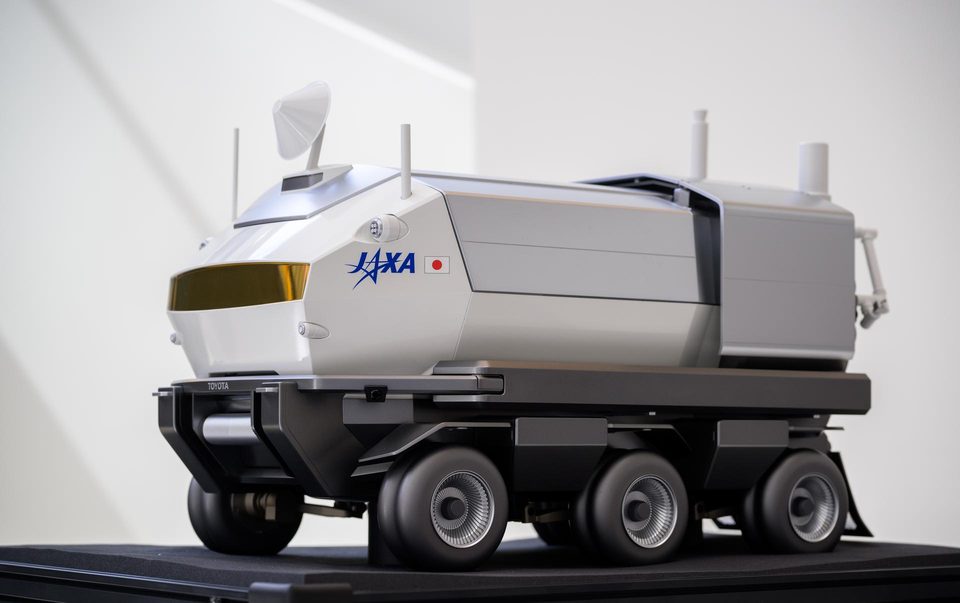
2024 agreement: 2 crew up to 30 days, ~10-year life; NASA lists 28 days; cargo delivery NET FY2032
What it is
The Lunar Cruiser is a crewed, pressurised lunar rover being developed by JAXA with Toyota. It is a mobile home and laboratory: astronauts can drive, eat, sleep and work inside it without spacesuits. Toyota and JAXA began studying the concept in May 2018 and formalised their cooperation in March 2019. The nickname comes from Toyota’s Land Cruiser off-road vehicle (Wikipedia).
In April 2024 the US and Japan signed an agreement under which Japan will design, develop and operate the rover, and NASA will launch and deliver it. In return NASA will fly two Japanese astronauts to the lunar surface. NASA said the rover will carry two astronauts for up to 30 days and serve Artemis VII and later missions over an approximate 10-year life. NASA’s 2026 Moon Base plan now places it in Phase Two (2029-2032), with missions of up to 28 days and up to 14 days between cargo resupplies. NASA intends to have SpaceX deliver it no earlier than FY2032.
The vehicle is still in development. Toyota’s 2023 roadmap showed conceptual design and component testing through about 2024, then rover development, with a tentative launch in 2029; that date has since moved right. Toyota says it is contracted by JAXA for conceptual design. Testing of its sub-systems was still under way in 2025. Its flight mass has not been published.
Why Open Moon uses it
Open Moon’s M07 (Mobility) milestone calls for one pressurised rover for multi-week trips, alongside two unpressurised rovers and utility robots. Open rovers keep crews in suits, so every trip must end back at the habitat the same day. A pressurised rover lets crews travel much farther across the south pole region and live in the vehicle for extended periods. That opens up science and resource prospecting at sites far from the base.
It also matters for M08 (First habitat). The first habitat module is sized for a small crew, so Open Moon plans to reach four-person stays by docking the pressurised rover or adding a second module. Between crew visits the rover can be driven remotely to the next landing site.
Without it, Phase 2 crews stay within LTV range of the habitat. Open Moon plans for that case, because the rover’s date is uncertain.
How it works
The rover is a sealed cabin on a large, electrically driven chassis. Toyota names four core technologies: regenerative fuel cells, off-road driving, automated off-road driving and habitability.
- Power. In daylight, solar panels power water electrolysis to make hydrogen and oxygen. Fuel cells turn them back into electricity at night, and the product water is recycled (Toyota). The aim is to get through the 14-day lunar night. Mitsubishi Heavy Industries contributes marine electrolysis know-how (Toyota).
- Driving. Toyota’s first two-tonne test vehicle used four-wheel independent in-wheel motors and steering. Bridgestone is developing metal tyres. Software adds crawl control and rollover prevention (Toyota).
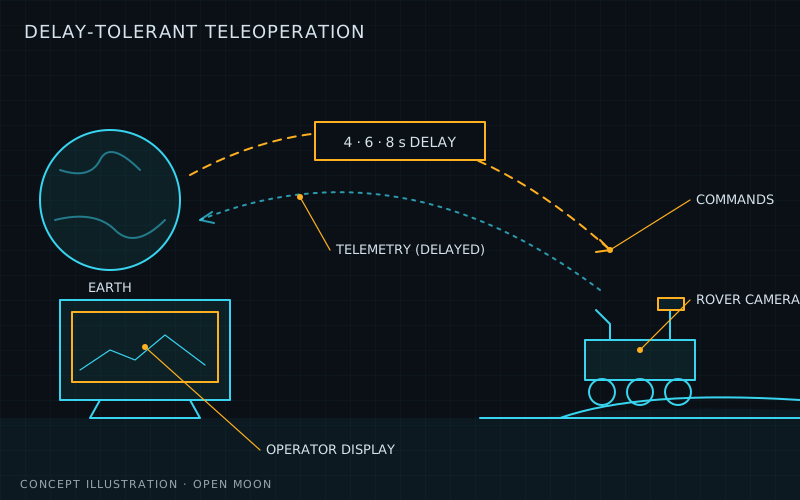
- Autonomy. The rover locates itself by radio navigation, a star tracker and inertial sensors. It uses lidar to map obstacles and plan a route (Toyota). NASA says it can be driven by one crew member in the cabin, by teleoperators on Earth, or partly autonomously (NASA).
| Item | Value | Source |
|---|---|---|
| Size (2019 concept) | 6.0 m long, 5.2 m wide, 3.8 m high | JAXA |
| Living volume (2019 concept) | 13 m³ | JAXA |
| Crew | 2 (4 in an emergency) | JAXA |
| Mission length | up to 30 days (2024); up to 28 days (2026) | NASA, NASA |
| Total range goal | more than 10,000 km | JAXA |
| Design life | about 10 years | NASA |
| Driving design case | up to 8 h/day, 6 days in a row | Toyota |
| Delivery | no earlier than FY2032 | NASA |
| Mass, power, cost | not published |
Limitations and open issues
- Late arrival. Launch was aimed at 2029 in 2019; NASA now lists delivery no earlier than FY2032, on a large cargo lander that must also be ready.
- Mission length is not settled. NASA’s 2024 figure was 30 days; its 2026 plan says 28 days with resupply every 14 days.
- Night power is unproven. Toyota’s own next step for the regenerative fuel cell is to confirm its performance in tests simulating lunar operations.
- No flight hardware yet. Testing so far uses Earth test vehicles and a full-scale habitability mockup (Toyota).
- Crew strain. Toyota lists the mental strain of a month in a confined cabin, and driving on a monochrome surface, as open challenges (Toyota).
- Missing numbers. Mass, power, cost and how crews get in and out in suits have not been published for the current design.
| Alternative | How it compares | Status |
|---|---|---|
| Unpressurised Lunar Terrain Vehicles (Astrolab CLV-1, Lunar Outpost Pegasus) | Open rovers that carry suited crew and drive themselves between visits. Much smaller and arriving years earlier, but crews must stay in spacesuits, so trips are limited to a single moonwalk and return to the base each time. | NASA task orders awarded May 2026; delivery to the south pole region planned for 2028 |
| NASA Space Exploration Vehicle (SEV / Small Pressurized Rover) | A smaller NASA pressurised rover concept for two crew for up to two weeks, with suitports and 12 wheels. It proved the idea in desert field tests, but it was a ground prototype only and was never funded for flight. | Concept and Earth prototypes, 2008-2015; no flight programme |
| Apollo-style Lunar Roving Vehicle | A light, battery-powered open buggy. Simple and flight-proven, but it had no life support or night survival and each one drove only about 30 km in total, so it cannot support multi-day trips. | Flown on Apollo 15, 16 and 17 (1971-1972); heritage only |
- official NASA RELEASE 24-052: NASA, Japan advance space cooperation, sign agreement for lunar rover (Apr 2024)
- official NASA Moon Base: Phases (Phase Two pressurised rover, 28-day missions) (2026)
- official NASA Moon Base: Pressurized Rover (Jul 2026)
- official NASA HLS IAC 2026 presentation (pressurised rover delivery NET FY2032) (Oct 2026)
- official JAXA and Toyota reach agreement on taking up the challenge of international space exploration (Mar 2019)
- official Toyota: Lunar Cruiser technology page (2026)
- official Toyota: Development status of the Lunar Cruiser and MHI's LUPEX rover (Jul 2023)
- official Toyota: Lunar Cruiser presentation by project head Ken Yamashita (PDF) (Jul 2023)
- official Toyota: Development of Lunar Cruiser, 39th Space Symposium handout (PDF) (Apr 2024)
- official Toyota Times: The karakuri taking Toyota into space (Lunar Cruiser testing) (Oct 2025)
- official NASA Image: Model of Japan's pressurized lunar rover (NHQ202404100002) (Apr 2024)
- official NASA: NASA selects companies to advance Moon mobility for Artemis missions (LTV) (Apr 2024)
- wiki Wikipedia: Lunar Cruiser (2026)
Summary
| System | Mobility and robotics |
| Phase | 2 |
| Milestones | M07 |
| Readiness | TRL 5 / 9 |
| Plan status | ready to use |
Sources
- NASA: NASA, Japan advance space cooperation, sign agreement for lunar rover (status and facts)
- Image: NASA/Bill Ingalls
More sources are on each milestone page that uses this technology.