Lunar Outpost Pegasus (LTV)
NASA task order $220M (May 2026); delivery 2028
What it is
Pegasus is an open, two-seat electric rover for astronauts at the Moon’s south pole. It is built by Lunar Outpost, a company in Golden, Colorado. NASA calls it a lighter, mission-ready evolution of the company’s Eagle rover, designed for NASA’s updated crewed lunar terrain vehicle (LTV) requirements. Lunar Outpost leads the team, with General Motors, Goodyear and Leidos as partners.
NASA started its LTV Services contract in April 2024. It picked three companies for year-long feasibility studies, and the contract has a combined maximum value of $4.6 billion. NASA does not buy the rover. It buys a service. In May 2026 NASA gave Lunar Outpost $220 million to build and deliver Pegasus, and Astrolab $219 million for its CLV-1. The goal is to have both on the surface by 2028. Blue Origin was awarded $188 million to land them.
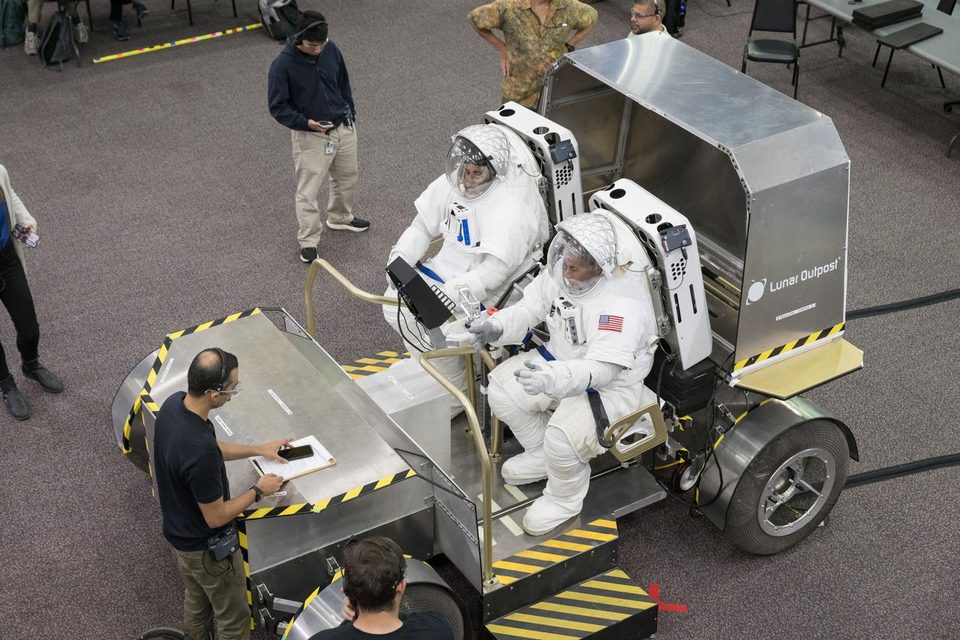
By October 2026, Lunar Outpost had built two Pegasus mockups and delivered a third to NASA Johnson. Astronauts in pressurised suits tested it there, and NASA photos show tests in September 2026. The preliminary design review was set for October 2026. Flight hardware is due to NASA at the end of 2027. The company says November 2027.
Why Open Moon uses it
Pegasus is one of the two LTV-class rovers in milestone M07 (Mobility). Open Moon does not build crew rovers. It plans to lease LTV services. Crews use the rovers to reach work and science sites. Between crew visits, people on Earth drive them to map terrain and haul loads for the road and landing pad work in M05 and M06.
M07 is complete when both LTVs have each driven at least 100 km, including driverless trips commanded from Earth. With only one LTV, the base has no backup if that rover breaks down. With no LTV, crews could only work within walking range of the lander and habitat. NASA’s LTV page gives the same reason: crews can go farther and do more science than on foot.
How it works
Pegasus is a low, open rover in the style of the Apollo Lunar Roving Vehicle. It carries two astronauts side by side and is designed so they can get in and out quickly. GM is adapting its electric vehicle technology into space-rated batteries. Pegasus has spring mesh tyres, which are being tested at NASA Glenn. A thermal control system keeps it working through the large temperature swings at the pole.
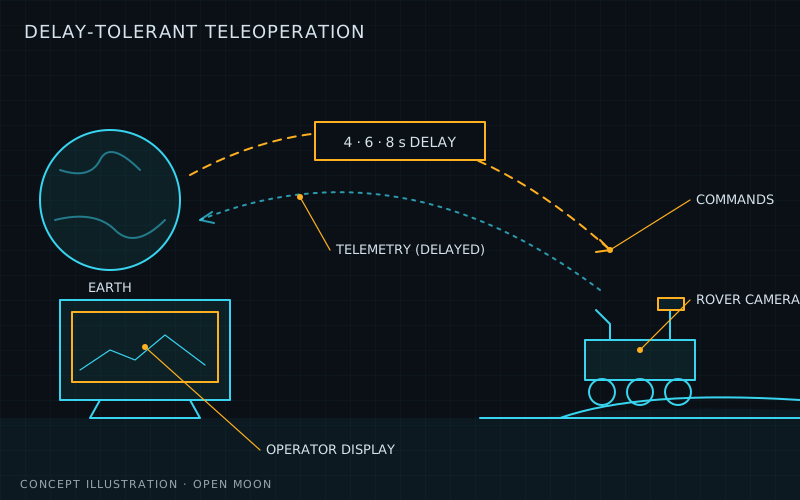
It can be driven three ways: by crew on board, by remote control from Earth, or on its own. Its thermal control, navigation cameras and mission control software were flight-proven on Lunar Outpost’s MAPP rover at the south pole in 2025. NASA tests showed that people on Earth could drive a reference LTV with 4, 6 and 8 second delays through every test terrain. They drove more slowly and found the work harder.
| Specification | Value | Source |
|---|---|---|
| Crew | 2, side by side | Lunar Outpost |
| Top speed | More than 9 mph (about 14 km/h) | NASA |
| Design life | Up to 1 year | NASA |
| Range per charge (LTV requirement) | Up to 10 km | NASA |
| Sample and tool load (LTV requirement) | Up to 80 kg | NASA |
| Remote driving (LTV requirement) | Up to 6 km per day | NASA |
| Moonwalks supported | Up to 3 per Artemis mission | NASA |
| Mass, battery size | Not published |
NASA has also chosen two science instruments to fly on an LTV: the AIRES spectrometer and the L-MAPS radar. L-MAPS can see up to 40 m below the surface.
Limitations and open issues
- No crewed rover of this type has flown yet. Pegasus is still a mockup and prototype. Its preliminary design review was due in October 2026, and drivable mockups have not yet been tested with crew.
- Its ride to the Moon has not flown. Blue Origin’s first Blue Moon Mk1 lander is now listed for launch no earlier than Q1 2027. A delay there pushes back the 2028 rover delivery.
- Tight schedule. NASA gave the companies about 18 months to finish the design, test with crew and qualify flight units.
- Cold and dark. The rovers will drive in and out of permanently shadowed regions that can reach -203°C. How well they save energy there is still one of the things NASA wants to learn.
- Remote driving is slow and tiring. In NASA tests, drivers on Earth braked more and reported higher workload when there was a time delay.
- Missing numbers. Lunar Outpost has not published Pegasus’s mass, battery capacity, payload limit or tyre life.
- One-year life. The design life is up to a year. A base that runs for many years will need replacements or a longer-lived successor.
| Alternative | How it compares | Status |
|---|---|---|
| Astrolab CLV-1 (LTV) | The other crewed rover NASA picked in May 2026. It is adapted from Astrolab's FLEX design, has a mass of about 2,000 lb and a top speed above 6 mph, slower than the 9+ mph quoted for Pegasus. Flying both gives a backup if one rover fails. | NASA task order $219M (May 2026); delivery to the Moon by 2028 |
| Lunar Outpost Eagle LTV | The company's larger crewed and cargo rover, which Pegasus was slimmed down from. Lunar Outpost pitches Eagle for infrastructure and resource extraction, but it is not the version NASA ordered for the first phase. | Seven full-scale prototypes built; no flight order announced |
| Intuitive Machines Moon RACER | A third LTV design that NASA funded for a feasibility study in 2024. It was not chosen for the 2026 build-and-deliver orders, so it would need a later on-ramp competition to fly. | Funded for a feasibility study in 2024; not selected in May 2026 |
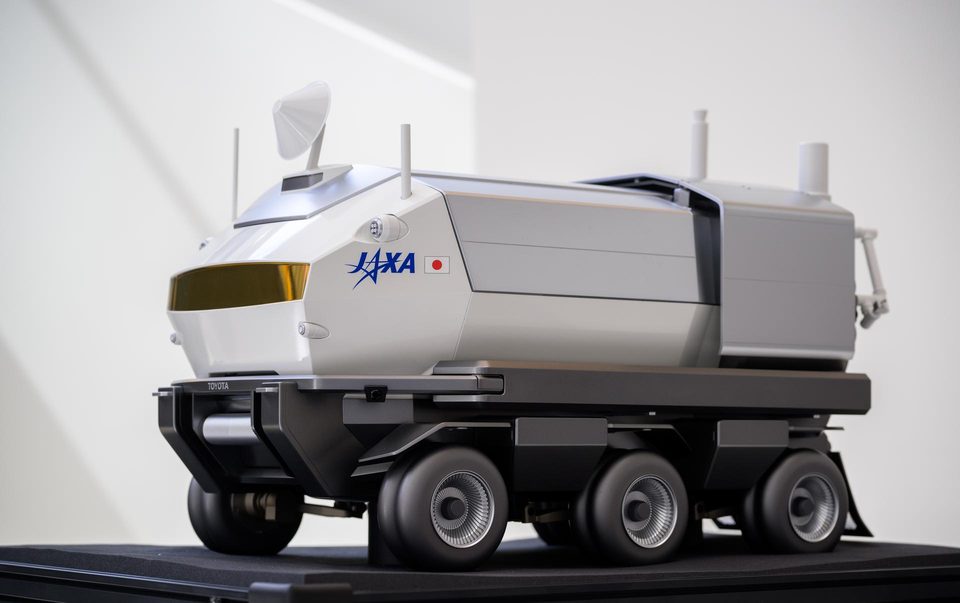
| JAXA/Toyota pressurised rover (Lunar Cruiser) | A closed, pressurised rover that two astronauts can live in for up to 30 days. It covers far longer trips than an open LTV, but NASA plans to use it only from Artemis VII onward. | 2024 NASA-Japan agreement; planned for Artemis VII and later missions |
| Apollo Lunar Roving Vehicle (heritage design) | The 1971-72 Boeing rover that inspired Pegasus's low, two-seat layout. It was light (210 kg) but could only be driven by crew on board, with no remote or autonomous driving. | Flew on Apollo 15, 16 and 17; out of production |
- official NASA RELEASE 26-046: NASA provides update on Moon Base rovers, landers, missions (May 2026)
- official NASA: NASA provides progress update on Moon Base rovers (Oct 2026)
- official Lunar Outpost: Pegasus LTV (Nov 2026)
- official Lunar Outpost: NASA selects Lunar Outpost to deliver next-gen crewed lunar terrain vehicle (May 2026)
- official Lunar Outpost: Eagle LTV (Nov 2026)
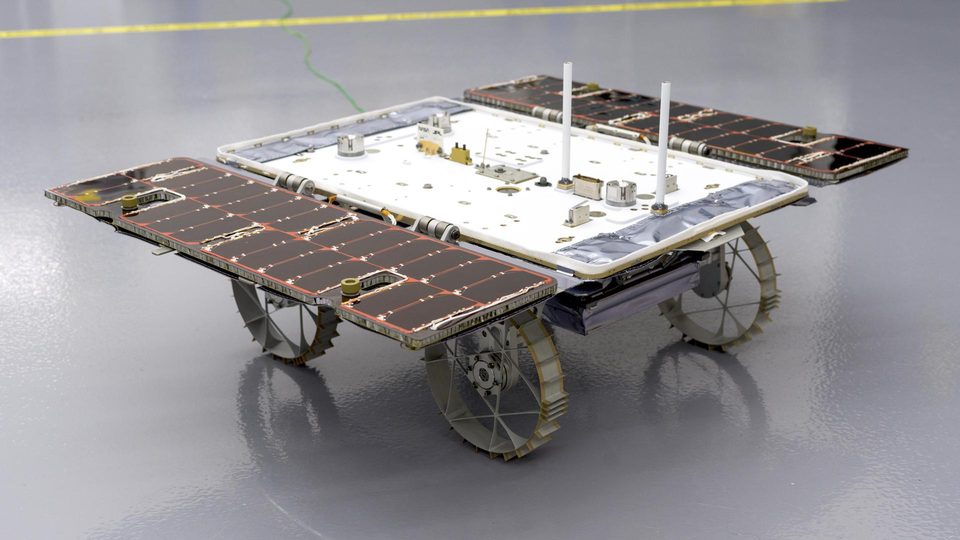
- official Lunar Outpost: MAPP rover (Nov 2026)
- official NASA Moon Base: Lunar Terrain Vehicle (Nov 2026)
- official NASA RELEASE 24-049: NASA selects companies to advance Moon mobility for Artemis missions (Apr 2024)
- official NASA RELEASE 25-044: NASA selects instruments for Artemis Lunar Terrain Vehicle (Jul 2025)
- official NASA NTRS 20240001217: LTV remote teleoperation studies under four lunar communication latencies (Jan 2024)
- official NASA image JSC2026E417620: astronauts test the Pegasus prototype at Johnson (Sep 2026)
- video NASA video: Moon Base update, lunar rovers (Oct 2026)
- wiki Wikipedia: Lunar Terrain Vehicle (Nov 2026)
- wiki Wikipedia: Blue Moon Pathfinder Mission 1 (Nov 2026)
- wiki Wikipedia: Lunar Roving Vehicle (Nov 2026)
Summary
| System | Mobility and robotics |
| Phase | 2 |
| Milestones | M07 |
| Readiness | TRL 6 / 9 |
| Plan status | ready to use |
Sources
- NASA RELEASE26-046: NASA provides update on Moon Base rovers, landers, missions (status and facts)
- Image: NASA/Bill Stafford
More sources are on each milestone page that uses this technology.