Yuegong-1 (Lunar Palace 1) bioregenerative system
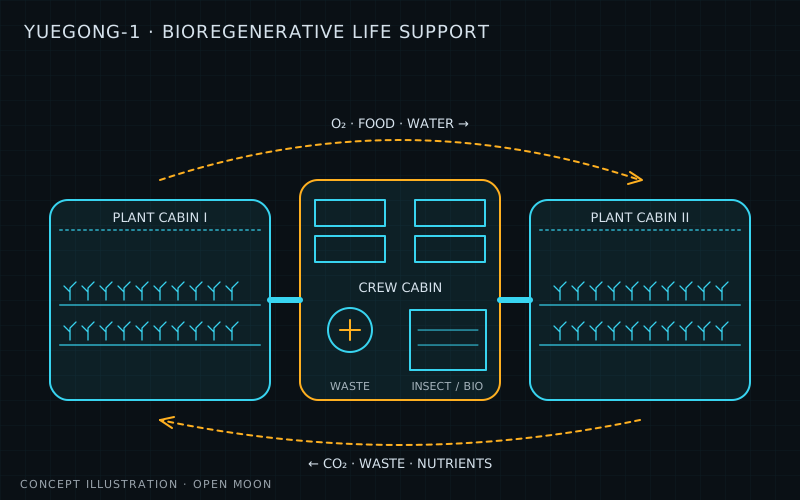
370 days, 8 crew in two groups of four (2017–18); 98.2% material closure on the ground
What it is
Yuegong-1, or Lunar Palace 1, is a sealed test habitat in Beijing. It was built by Beihang University (formerly BUAA), with a lab designed by Professor Liu Hong. Construction began in March 2013 and it opened in January 2014 (Wikipedia). It is a bioregenerative life support system (BLSS): people, crop plants, mealworms and microbes recycle oxygen, water and food between them (Beihang).
The first test, in 2014, kept three crew inside for 105 days. Oxygen and water were recycled and 55% of the food was grown inside (Fu et al. 2016). Beihang gives the material closure of that test as 97% (Beihang).
The facility was then upgraded for “Lunar Palace 365”. It ran 370 days, from 10 May 2017 to 15 May 2018 (ECNS). Eight student volunteers worked in two groups of four, in three phases: 60, 200 and 105 days. Material closure reached 98.2% (Fu et al. 2021). The full results were published in a peer-reviewed journal in 2024 (Fu et al. 2024). It has not flown in space. Beihang says the team plans experiments in space station and lunar environments (Beihang).
Why Open Moon uses it
Food is the hardest supply to close. NASA’s reference diet is 12.8 MJ and 0.8 kg of food solids per person per day (NASA BVAD). Machines on the ISS already recover 98% of water (NASA), but they grow no food.
Lunar Palace 1 is the best evidence that a small crew can live for a year inside a loop that also makes food. It is Open Moon’s reference design for closed-loop life support with crops in milestone M10 (Food, phase 4). Without it, the base would depend on food shipped from Earth for as long as people live there. It would also lack a tested example of how crops, waste treatment and crew can be run together.
How it works
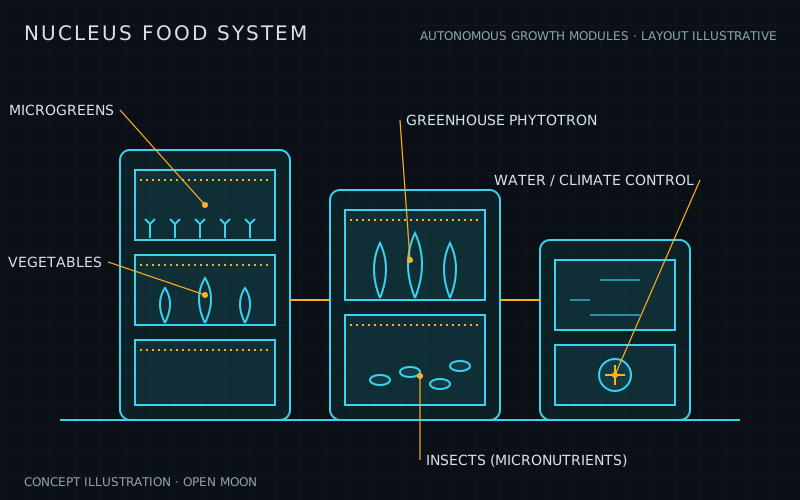
The habitat has one crew cabin and two plant cabins (ECNS). The system links crop growing, animal protein production, urine nitrogen recycling and conversion of solid waste (Fu et al. 2016). Plants regenerate the oxygen. Mealworms eat leftover and inedible plant parts and supply protein (Wikipedia).
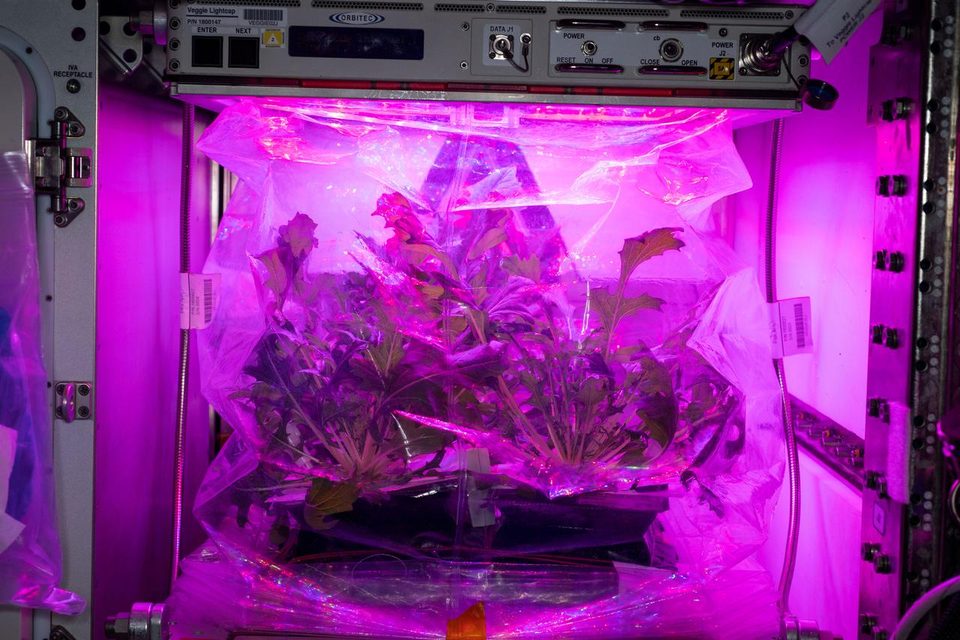
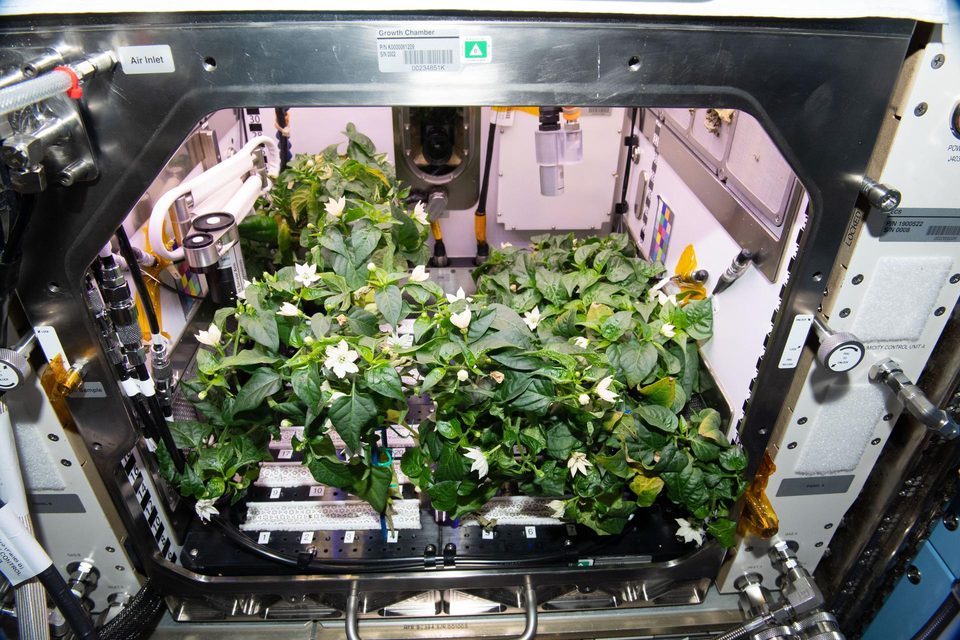
The 2014 test grew 21 plant species (Fu et al. 2016), including wheat as the main calorie and oxygen source, plus vegetables and strawberries (Wikipedia). In Lunar Palace 365, O2, CO2 and trace gases stayed in safe ranges. The system recovered quickly from disturbances such as crew changes (Fu et al. 2021).
| Item | 2014 test | Lunar Palace 365 (2017-18) |
|---|---|---|
| Duration | 105 days | 370 days (ECNS) |
| Crew inside at once | 3 | 4 (8 in total) |
| Material closure | 97% (Beihang) | 98.2% (Fu et al. 2021) |
| Food grown inside | 55% (Fu et al. 2016) | All plant food; about 80% of total food (ECNS) |
| Urine recovery | 20.5% of nitrogen | 99.7% (Fu et al. 2021) |
| Solid waste recovery | 41% degraded | 67% |
| Floor area | 160 m², with 58 m² of plant area (Wikipedia) | 150 m² (ECNS) |
Electrical power for crop lighting has not been published in the sources above.
Limitations and open issues
- Ground only. All tests ran in Earth gravity, under Earth’s atmosphere and radiation shielding. Partial gravity, lunar dust and radiation have not been tested.
- Not fully closed. At 98.2% closure, some mass still had to come in from outside. Only 67% of solid waste was recovered (Fu et al. 2021). Plant food was fully grown inside, but about 20% of total food still came from outside (ECNS).
- Power and mass not public. We found no published figures for lighting power, total mass or flight-ready volume. These drive the cost of a lunar version.
- Small crew. At most four people lived inside at once. Scaling to a larger base is unproven.
- Biological risk. Microbe levels stayed low and safe across 370 days (Fu et al. 2025). But Biosphere 2 showed that large closed systems can drift: oxygen fell from 20.9% to 14.5% and food ran short (Wikipedia).
- Crew psychology. Long isolation affects mood. The team has studied links between gut microbes and mood (Hao et al. 2023), but this remains a risk.
- Access. This is a Chinese university facility. Its detailed design data are not openly available for Open Moon to reuse.
| Alternative | How it compares | Status |
|---|---|---|
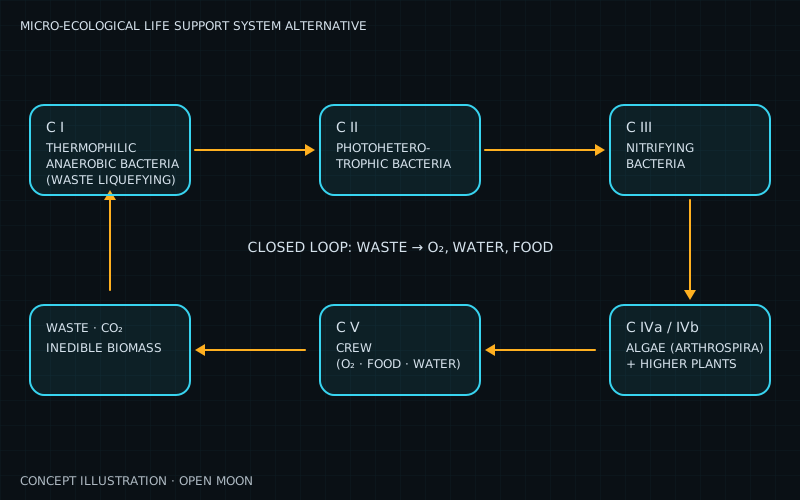
| ESA MELiSSA | A European loop with four compartments of microbes, algae and higher plants around the crew. It is more engineered and controlled step by step, but it has not yet kept a human crew alive. | ESA-led consortium of about 30 organisations; pilot plant at Universitat Autònoma de Barcelona since 2009 |
| ISS physicochemical life support (ECLSS) | Machines, not plants, recycle water and air. It is flight-proven and compact, but grows no food, so all food must be shipped from Earth. | Operating on the ISS; reached 98% water recovery in 2023 |
| BIOS-3 (Krasnoyarsk) | Soviet closed system using algae and crops in 315 m3. It pioneered crewed closure, but recycled less (dried meat was imported) and drew a lot of power for lamps. | Historic; crewed tests from 1972, longest 180 days with three people |
| Biosphere 2 | A huge (about 12,700 m2) multi-biome closed ecosystem. It showed how hard large natural-style systems are to balance: oxygen fell and food ran short. | Historic; one two-year crewed closure in 1991-1993, now a research facility |
- paper Fu et al.: Establishment of a closed artificial ecosystem to ensure human long-term survival on the Moon (Lunar Palace 365, bioRxiv preprint) (Jan 2021)
- paper Fu et al.: A case for supporting human long-term survival on the Moon: Lunar Palace 365 mission (Acta Astronautica) (Dec 2024)
- paper Fu et al.: How to establish a bioregenerative life support system for long-term crewed missions to the Moon or Mars (Astrobiology, 105-day test) (Dec 2016)
- official Beihang University: Lunar Palace 1 team profile (97% and 98.2% closure, plans for space station and lunar tests) (2026)
- wiki Lunar Palace 1, Wikipedia (accessed Nov 2026)
- press CGTN/ECNS: Chinese students end 370-day stay in Yuegong-1 (May 2018)
- paper Fu et al.: Bacterial population dynamics and biosafety in Lunar Palace 365 (Sci China Life Sci) (May 2025)
- paper Hao et al.: Positive mood-related gut microbiota in a long-term closed environment, Lunar Palace 365 (Microbiome) (Apr 2023)
- wiki Bioregenerative life support system, Wikipedia (accessed Nov 2026)
- official NASA: NASA achieves water recovery milestone on International Space Station (Jun 2023)
- official NASA BVAD Rev2: food energy and mass per crew-day (Feb 2022)
- wiki Biosphere 2, Wikipedia (accessed Nov 2026)
Summary
| System | Food |
| Phase | 4 |
| Milestones | M10 |
| Readiness | TRL 6 / 9 |
| Plan status | ready to use |
Sources
- Fu et al.: Establishment of a closed artificial ecosystem to ensure human long-term survival on the Moon (bioRxiv preprint, Lunar Palace 365) (status and facts)
- Reference for the illustration
More sources are on each milestone page that uses this technology.