ESA MELiSSA
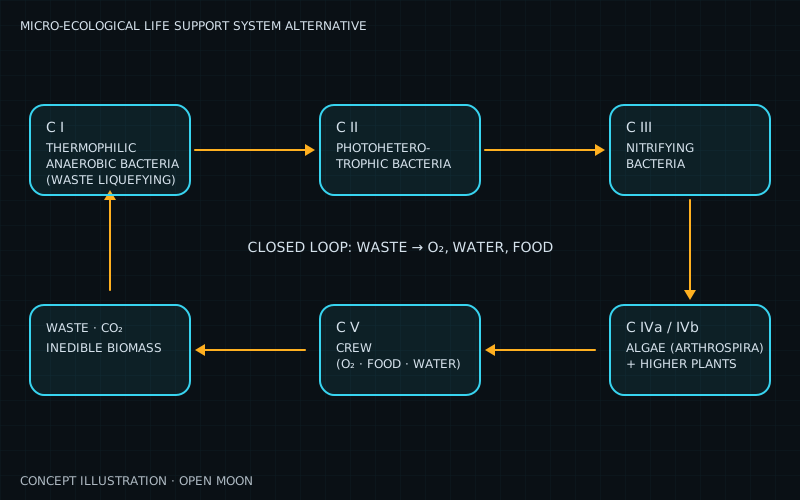
Pilot plant at Universitat Autònoma de Barcelona since 2009
What it is
MELiSSA, the Micro-Ecological Life Support System Alternative, is a European Space Agency project to build a closed-loop life support system. It aims to turn crew waste (faeces, urine), carbon dioxide and minerals back into food, water and oxygen (ESA). The design copies an aquatic ecosystem, split into separate compartments that each do one job (Hendrickx et al.).
The idea came from engineer Claude Chipaux at MATRA around 1987. The first ESA contract was signed in March 1989 (MELiSSA Foundation). Today the consortium has 16 formal partners in Belgium, Spain, France, Switzerland, Italy, the Netherlands and Norway, plus ESA (MELiSSA Foundation).
The second-generation MELiSSA Pilot Plant opened at the Universitat Autònoma de Barcelona on 4 June 2009 (ESA). It uses laboratory rats as a stand-in crew. Nine MELiSSA experiments have flown on the ISS and the Foton capsule since 2002 (MELiSSA Foundation).
Why Open Moon uses it
Open Moon lists MELiSSA under milestone M10 (Growing food). That milestone needs inedible plant mass and crew waste returned to the loop, with crew CO₂ feeding the plants. MELiSSA is the most developed research programme on exactly that recycling chain. Physico-chemical systems like the ISS ECLSS recycle water and air but make no food.
Open Moon treats MELiSSA as a research partner and design reference, not as ready hardware. Without it, the base would rely on plant growth plus machines, and waste nutrients would be stored or lost instead of fed back to crops.
How it works
The loop has five compartments with the crew at the centre (MELiSSA Foundation):
- Compartment 1, liquefying. Thermophilic bacteria break down waste at 55 °C without oxygen. Outputs are ammonium, volatile fatty acids, CO₂ and minerals (Wikipedia).
- Compartment 2, photoheterotrophic. Light-using bacteria remove the fatty acids (Wikipedia).
- Compartment 3, nitrifying. Nitrosomonas and Nitrobacter turn ammonium into nitrate, which plants can use (Garcia-Gragera et al.).
- Compartment 4a and 4b, photosynthetic. An air-lift photobioreactor grows the edible cyanobacterium Limnospira indica (spirulina) and makes oxygen. A plant chamber grows lettuce, wheat and red beet (Garcia-Gragera et al.).
- Compartment 5, crew. Rats in the Pilot Plant, astronauts on a real mission.
Each compartment runs under computer control based on mathematical models (Garcia-Gragera et al.). If oxygen in the crew compartment drops, the control system turns up the light in the photobioreactor (Alemany et al.).
Key Pilot Plant numbers from the 2021 integration test (Garcia-Gragera et al.):
| Item | Value |
|---|---|
| Nitrifying bioreactor (C3) | 7 L packed bed |
| Photobioreactor (C4a) | 83 L air-lift |
| Animal isolator (C5) | 1,550 L |
| Oxygen need of one rat | 0.48-0.7 g/h |
| Max photobioreactor O₂ output | 2.76 g/h (at 30 L/day liquid flow) |
| Mock crew | 3 rats |
| Closed gas loop run | 110 days, rats’ oxygen needs met |
| C3 to C4a liquid connection | 276 days |
In space, the Artemiss experiment (launched December 2017) ran four spirulina photobioreactors on the ISS. Oxygen came out at the same rate as on Earth (ESA). A follow-on flew in 2024, and plant (WAPS) and urine (URINIS) experiments are being prepared (MELiSSA Foundation). A grey-water system derived from MELiSSA has recovered more than 90% of grey water at Antarctica’s Concordia station (MELiSSA Foundation).
Limitations and open issues
- The full loop has not been closed. The 2021 Pilot Plant work integrated three compartments (C3, C4a and C5), not all five (Garcia-Gragera et al.).
- Schedules have slipped. In 2009 ESA planned a full-scale loop demonstration in 2014 (ESA) and a human crew by 2020-2025 (ESA). Neither has been reported.
- Scale is small. The 2021 test supported 3 rats (Garcia-Gragera et al.). ESA has said 40 rats use as much oxygen as one person (ESA).
- Sensitive biology. Nitrite above about 40 N-ppm slowed the spirulina’s photosynthesis (Garcia-Gragera et al.).
- Low and partial gravity are untested for the full system. Gravity changes how fluids, microbes and plants behave, so each process must be re-checked for spaceflight (MELiSSA Foundation). No tests at lunar gravity have been published.
- Mass, power and crew time for a lunar-scale MELiSSA loop have not been published.
| Alternative | How it compares | Status |
|---|---|---|
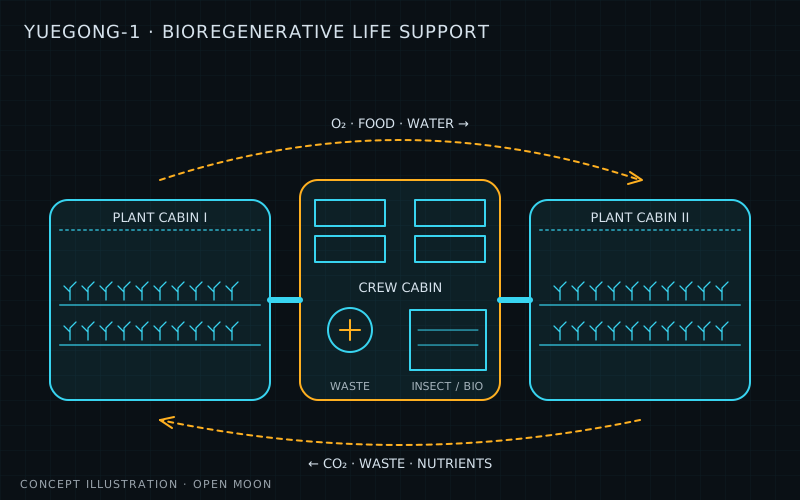
| Yuegong-1 (Lunar Palace 1) | China's ground bioregenerative habitat grows crops and mealworms around a human crew. It has run far longer crewed tests than MELiSSA, but it leans on higher plants and insects rather than MELiSSA's chain of tightly controlled microbial bioreactors. | Lunar Palace 365: two teams of four spent 370 days inside (2017-18); ground only |
| ISS physico-chemical life support (ECLSS) | Machines, not organisms, recycle water and air on the ISS. It is flight-proven and compact, but it does not turn waste into food, so all food must still be shipped. | Flying on the ISS; 98% water recovery reached in 2023 |
| Sabatier reactor | A catalytic reactor turns CO2 and hydrogen into water and methane. It is fast and well understood but needs high temperature, recovers only part of the oxygen when methane is vented, and makes no food. | Flown on the ISS |
| BIOS-3 | A Soviet closed ecosystem that used Chlorella algae and wheat phytotrons to support up to three people. It proved crewed closure decades ago, but it stored rather than recycled urine and faeces and used about 400 kW of power. | Historic: 10 crewed tests, longest 180 days (1972-73) |
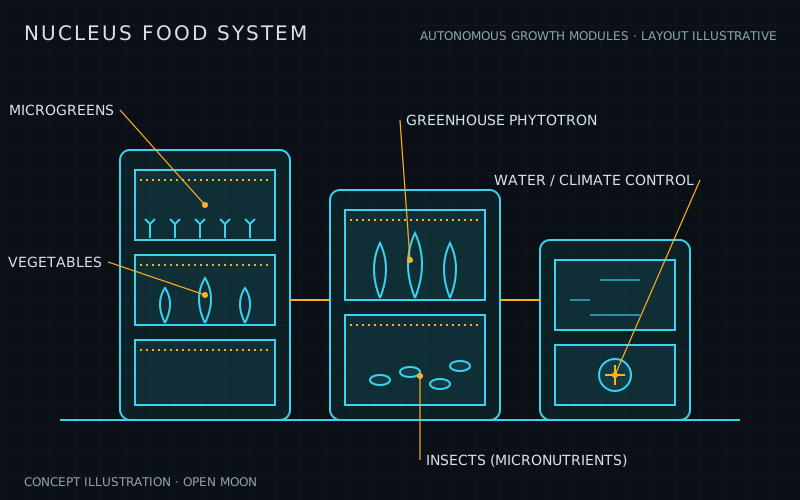
| Interstellar Lab NUCLEUS | A modular food-growing system of phytotrons and greenhouses for vegetables, microgreens and insects. It is aimed only at food, not at closing the air, water and waste loop as MELiSSA is. | Won the NASA Deep Space Food Challenge grand prize in 2024 |
- official ESA: Life support pilot plant paves the way to Moon and beyond (Jun 2009)
- official ESA: MELiSSA life support project, an innovation network in support to space exploration (Jul 2009)
- official ESA: Green smoothies in space (Artemiss spirulina experiment on ISS) (Oct 2018)
- official ESA: Wanted: recycling methods to keep astronauts alive (Jan 2022)
- official MELiSSA Foundation: Scientific concept and the five compartments (accessed Nov 2026)
- official MELiSSA Foundation: How it all began (accessed Nov 2026)
- official MELiSSA Foundation: Consortium partners (accessed Nov 2026)
- official MELiSSA Foundation: Flight experiments (ISS and Foton) (accessed Nov 2026)
- official MELiSSA Foundation: Ground demonstration (Pilot Plant and Concordia) (accessed Nov 2026)
- paper Garcia-Gragera et al.: Integration of nitrifying, photosynthetic and animal compartments at the MELiSSA Pilot Plant (Frontiers in Astronomy and Space Sciences) (Oct 2021)
- paper Alemany et al.: Continuous controlled long-term operation and modeling of a closed loop connecting an air-lift photobioreactor and an animal compartment (HAL record) (2019)
- paper Hendrickx et al.: Microbial ecology of the closed artificial ecosystem MELiSSA (Research in Microbiology) (2006)
- wiki MELiSSA, Wikipedia (accessed Nov 2026)
Summary
| System | Food |
| Phase | 4 |
| Milestones | M10 |
| Readiness | TRL 4 / 9 |
| Plan status | needs development |
Sources
- MELiSSA, Wikipedia (status and facts)
- Reference for the illustration
More sources are on each milestone page that uses this technology.