Interstellar Lab NUCLEUS
Won NASA Deep Space Food Challenge grand prize 2024
What it is
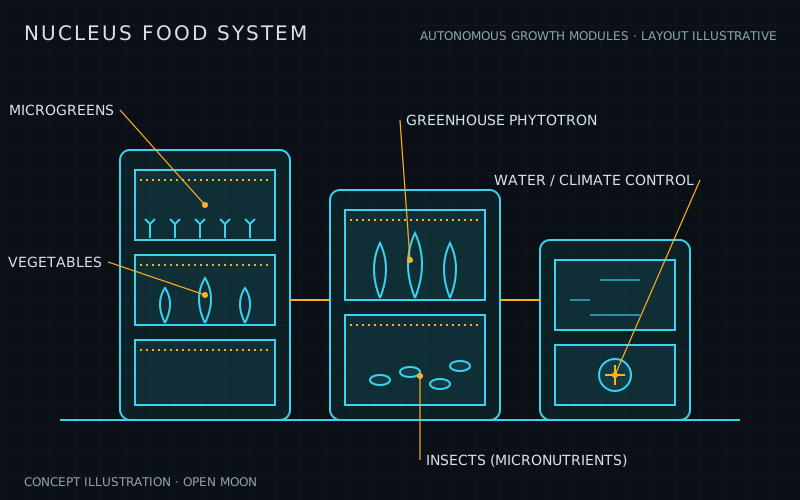
NUCLEUS (Nutritional Closed-Loop Eco-Unit System) is a modular food production system built by Interstellar Lab, a small company based in Merritt Island, Florida, and led by Barbara Belvisi. It grows fresh microgreens, vegetables, mushrooms and insects to give a space crew fresh food and micronutrients (NASA, Phase 2). The company was founded in 2018 and first became known for its inflatable BioPod growing pods and the EBIOS station concept (STIR).
NUCLEUS was developed for NASA’s Deep Space Food Challenge, a Centennial Challenge run with the Canadian Space Agency from 2021 to 2024. Interstellar Lab was a Phase 1 winner in 2021 (NASA), a Phase 2 winner in May 2023 with $150,000 (NASA), and won the $750,000 grand prize in August 2024. More than 300 teams from 32 countries took part (NASA).
After the challenge, Interstellar Lab partnered with Vast. A NUCLEUS spinoff, Eden 1.0, is a plant research unit meant to fly on the Haven-1 commercial station (NASA). Haven-1 is now targeted for 2027 (Vast; Wikipedia). NUCLEUS itself has not flown.
Why Open Moon uses it
Open Moon’s M10 Growing food milestone needs fresh food grown at the base. NUCLEUS is a candidate for the compact, early part of that job: a set of ready-made modules that give the crew greens, mushrooms and insect protein while the larger buried greenhouses for staple crops are built up.
The challenge it won was set up for exactly this kind of mission: feeding a crew of four on a three-year round trip with no resupply (NASA). Without a system like it, the first crews would depend fully on stored food from Earth, which loses nutrients over time and gives little variety.
How it works
NUCLEUS combines several autonomous phytotrons (sealed plant growth chambers) with environment-controlled greenhouses into one self-sustaining food system (NASA). Each module controls its own climate and lighting, so different crops and organisms can each get the conditions they need. Waste and inputs move between modules in a closed loop.
| Item | Value |
|---|---|
| Modules | 9 interconnected: 6 for food, 3 for system support (Payload) |
| Outputs | Microgreens, vegetables, mushrooms, insects (NASA) |
| Automation | Designed to be 90% automated; crew inspect and maintain (Payload) |
| Final test | 8 weeks at Ohio State University, run by 4 student “Simunauts” (NASA) |
| Mass, volume, power, yield | Not published |
In the final phase, judges scored food safety and acceptability, output compared with inputs (food quantity, nutrition and water use), reliability, and the stability of inputs and food (NASA). Teams had to pass milestones for safety, sensory testing, palatability and harvest volume (NASA).
Limitations and open issues
- No public specifications. Mass, volume, power draw, water use and yields are not published, so its share of a crew’s diet cannot be checked.
- Short ground test only. The longest public test was eight weeks on Earth (NASA), far short of a multi-year mission.
- Not flown. The only space-bound piece is the smaller Eden 1.0 research unit, waiting on Haven-1’s launch (Wikipedia). Behaviour in 1/6 g and in lunar dust is untested.
- Micronutrients, not calories. Its outputs are greens, mushrooms and insects for micronutrients (NASA); staple calories must come from other systems.
- Small company risk. Long-term support depends on one small firm; the automation level of 90% comes from press coverage, not a published test report.
| Alternative | How it compares | Status |
|---|---|---|
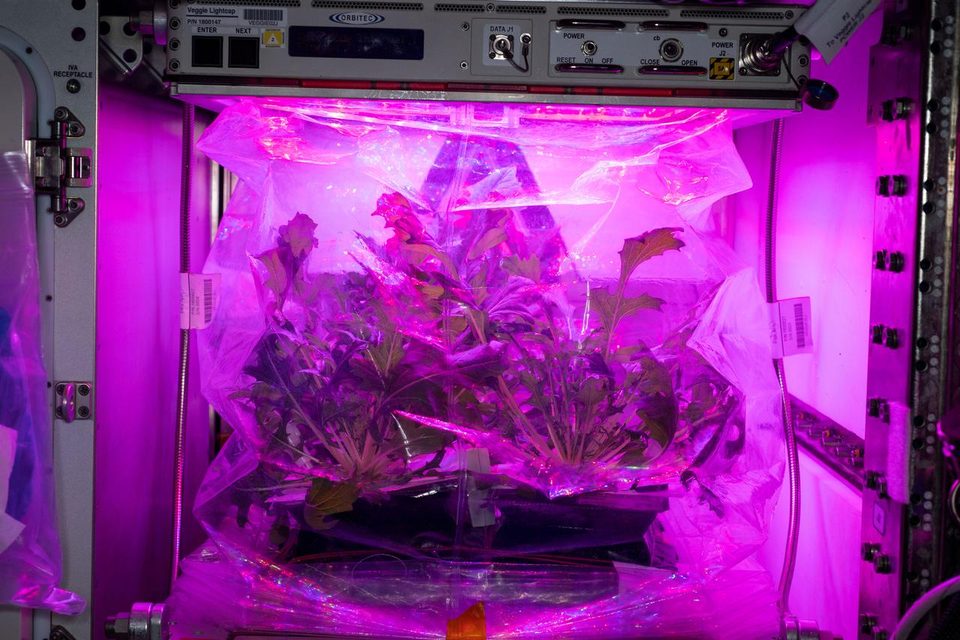
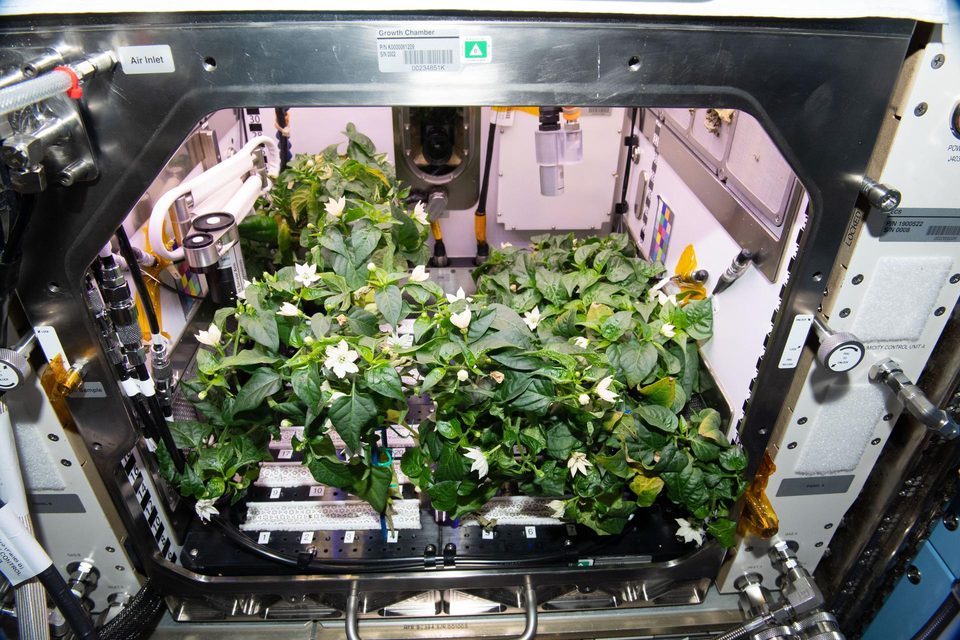
| NASA Veggie | A small, flight-proven plant chamber on the ISS. Far simpler and lighter than NUCLEUS (under 8 kg, 90 W per module), but it only grows small batches of leafy crops and does not produce protein such as mushrooms or insects. | Operational on the ISS since 2014; a second module was added in 2017. |
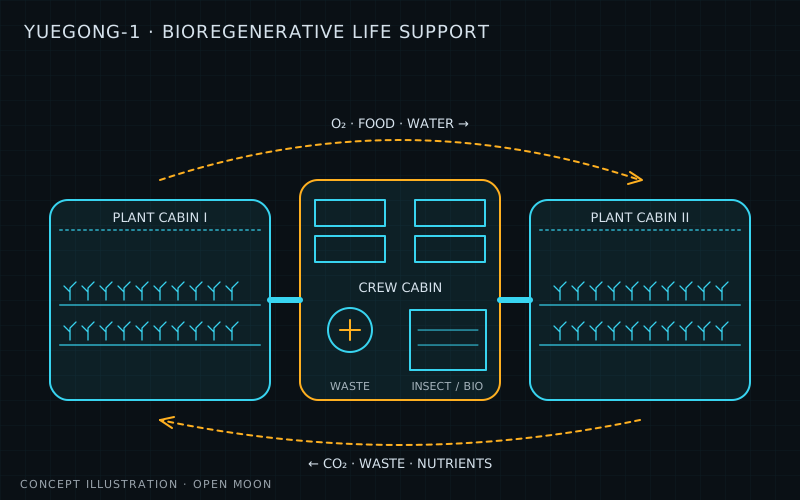
| Yuegong-1 (Lunar Palace 1) | A full ground bioregenerative habitat with crops, living space and recycling, far larger than NUCLEUS. It has proven long crewed runs, but it is a fixed 160 m2 building, not a set of deployable modules. | Lunar Palace 365 kept two teams of four volunteers sealed in for 370 days on the ground. |
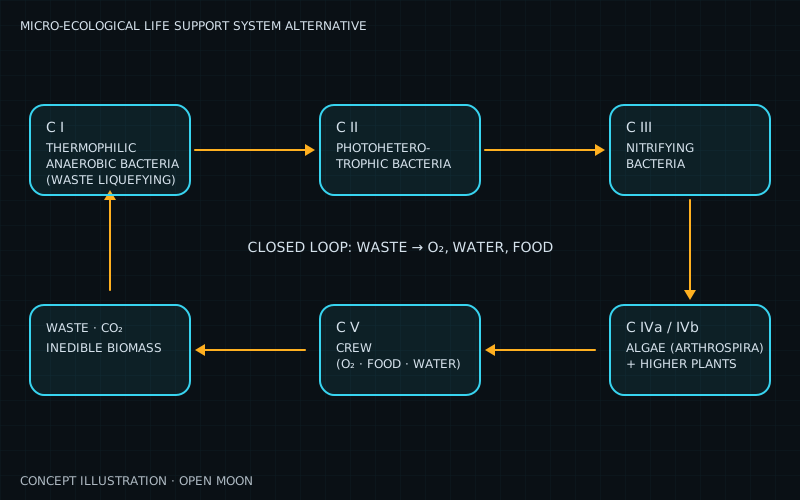
| ESA MELiSSA | A complete closed loop that turns crew waste into oxygen, water and food through bacterial, algal and plant compartments. It closes more of the loop than NUCLEUS, but it is still a research system rather than a ready product. | Pilot plant at the Universitat Autonoma de Barcelona since 2009; ESA-led consortium of about 30 organisations. |
| Solar Foods Solein (gas fermentation) | Makes a protein powder from microbes fed hydrogen and carbon dioxide, with no plants or lighting racks. It gives calories and protein that greens cannot, but no fresh vegetables, and it needs hydrogen from electrolysis. | Commercial factory in Finland producing since 2024; international Phase 3 winner of the Deep Space Food Challenge. |
- official NASA: NASA awards $1.25 million to three teams at Deep Space Food finale (Aug 2024)
- official NASA: NASA selects winners, announces final phase of Space Food Challenge (Phase 2) (May 2023)
- official NASA: NASA begins final phase of $3 million Deep Space Food Challenge (Sep 2023)
- official NASA: Meet the Simunauts, Ohio State students to test space food solutions (Jun 2024)
- official NASA: Deep Space Food Challenge (Centennial Challenges page) (accessed Nov 2026)
- official NASA: NASA announces winners of Deep Space Food Challenge (Phase 1) (Oct 2021)
- official NASA: NASA announces finalists in challenge to design future astronaut food (Phase 2) (Jan 2023)
- official NASA: NASA challenge winners cook up new industry developments (Aug 2025)
- official Vast: Haven-1 commercial space station (accessed Nov 2026)
- wiki Haven-1, Wikipedia (accessed Nov 2026)
- press Payload: Interstellar Lab wins Deep Space Food Challenge (May 2023)
- press Space.com: NASA challenged the public to make deep space food, here are the winners (Aug 2024)
- press STIR: Interstellar Lab's BioPod prepares for plant cultivation on the Moon (Jan 2021)
Summary
| System | Food |
| Phase | 4 |
| Milestones | M10 |
| Readiness | TRL 5 / 9 |
| Plan status | ready to use |
Sources
- NASA: NASA awards $1.25 million to three teams at Deep Space Food finale (status and facts)
- Reference for the illustration
More sources are on each milestone page that uses this technology.