NASA Veggie
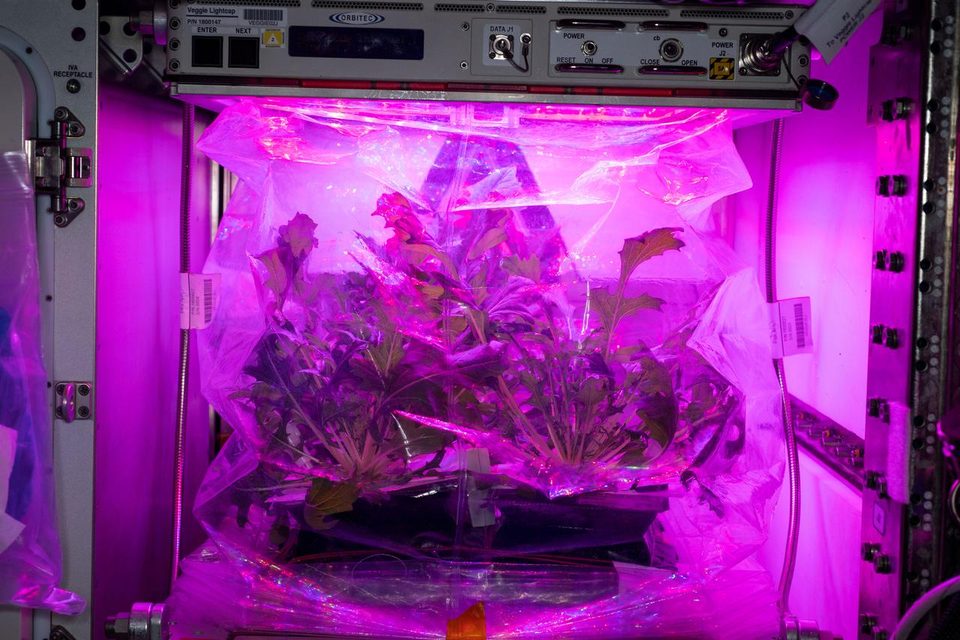
ISS plant facilities (Veggie and APH) have grown lettuces, Chinese cabbage, mustard greens, kale
What it is
The Vegetable Production System, called Veggie, is a small plant growth chamber on the International Space Station (ISS). It was built by ORBITEC of Madison, Wisconsin, under NASA’s Small Business Innovation Research program, and tested at Kennedy Space Center (NASA fact sheet). An early version was tested in 2010 in a NASA desert analog habitat, where the crew grew and ate lettuce after a 14-day field test (Stutte et al.).
Veggie flew on SpaceX CRS-3 in April 2014 and was installed in the Columbus module on 7 May 2014 (NASA fact sheet). On 10 August 2015 crew members ate red romaine lettuce grown in it, the first crop grown and eaten in NASA hardware (NASA fact sheet). There are now two Veggie units on the station, alongside the larger Advanced Plant Habitat (NASA fact sheet).
Astronauts have grown eight kinds of leafy greens in Veggie to eat, and 15 plant types overall (NASA fact sheet). Together, Veggie and APH have grown lettuces, Chinese cabbage, mustard greens, kale, tomatoes, radishes and chile peppers (NASA). In 2022-23 the VEG-05 run grew ‘Red Robin’ dwarf tomatoes (NTRS). Veggie is still in use: NASA lists it among current station plant research (NASA Science), and the Veg-06 study plans to grow alfalfa in it (NASA Science).
Why Open Moon uses it
Veggie supplies fresh leafy greens in milestone M10 (Food). It is step one of that milestone: a Veggie-class unit inside the M09 habitat gives fresh greens before the larger greenhouses are built. Fresh crops add nutrients and variety to a packaged diet whose vitamins degrade over long missions, and caring for plants may help crew morale (NASA fact sheet). Early analog crews were uniformly positive about having the plants (Stutte et al.).
It is the only crop unit in the plan with years of flight use, low power and simple operation. Without it, the first crews would rely only on stored food until the greenhouses work. Lessons from Veggie on watering, food safety and crew time also shape the later, larger systems.
How it works
Veggie has three parts: an LED light cap, a clear, extendable bellows that encloses the plants, and a reservoir that feeds small grow bags called plant pillows (Massa et al.). Each pillow holds calcined clay, slow-release fertilizer and two or three seeds glued into wicks with guar gum (NASA fact sheet). A root mat beneath wicks water up into the pillows, so watering is passive (NASA fact sheet). A fan draws in cabin air, and temperature, humidity and CO2 follow the cabin, not the unit (NASA fact sheet, Massa et al.).
| Specification | Value |
|---|---|
| Baseplate / growing area | 29.2 x 36.8 cm, 0.11 m² (Massa et al.) |
| Usable volume | up to 0.48 m³ (Massa et al.) |
| Bellows height | 5 to 45 cm below the light cap (Massa et al.) |
| LEDs | red 630 nm, blue 455 nm, green 530 nm (Massa et al.) |
| Preset light (red / blue) | 120/30, 240/60, 360/90 µmol m⁻² s⁻¹; green 30 (Massa et al.) |
| Power | about 70 W for lights, fans and electronics (NASA fact sheet) |
| Mass | under 8 kg (Wikipedia) |
| Plants per run | six plant pillows (NASA) |
The bellows packs flat for launch and stretches to about a foot and a half as plants grow (NASA). Lettuce runs have lasted 33 days (NASA fact sheet). Crews clean produce with citric-acid wipes before eating it, and a matching ground unit at Kennedy grows the same crop as a control (NASA fact sheet).
Limitations and open issues
- Tiny output. One unit has 0.11 m² of growing area (Massa et al.). It supplements the diet; NASA has not published a per-crew yield, and it cannot supply meaningful calories.
- No climate control. Plants share cabin air, temperature and humidity (Massa et al.). An unexpected humidity drop on the ISS dried the seed wicks during VEG-05 (NASA).
- Watering is hard. Too much or too little water stresses plants in microgravity (NASA fact sheet). In VEG-05 extra water caused leaks and fungus, and later wilting (NTRS).
- Fruiting crops are unproven. VEG-05 gave only 12 ripe tomatoes on orbit, against more than 100 in ground tests, and fungal concerns stopped the crew tasting them (NASA).
- Crew time. Astronauts plant, water with syringes and harvest by hand (NASA), although the unit was designed for minimal crew time (Massa et al.).
- Never tested in lunar gravity. All flight use is in ISS microgravity. NASA plans a separate experiment, LEAF, for the lunar surface on Artemis III (NASA Science). Behaviour in one-sixth gravity, lunar dust and a lunar habitat’s power budget still needs proving.
- Psychological benefit is anecdotal. NASA still seeks data on crew morale effects (NASA fact sheet).
| Alternative | How it compares | Status |
|---|---|---|
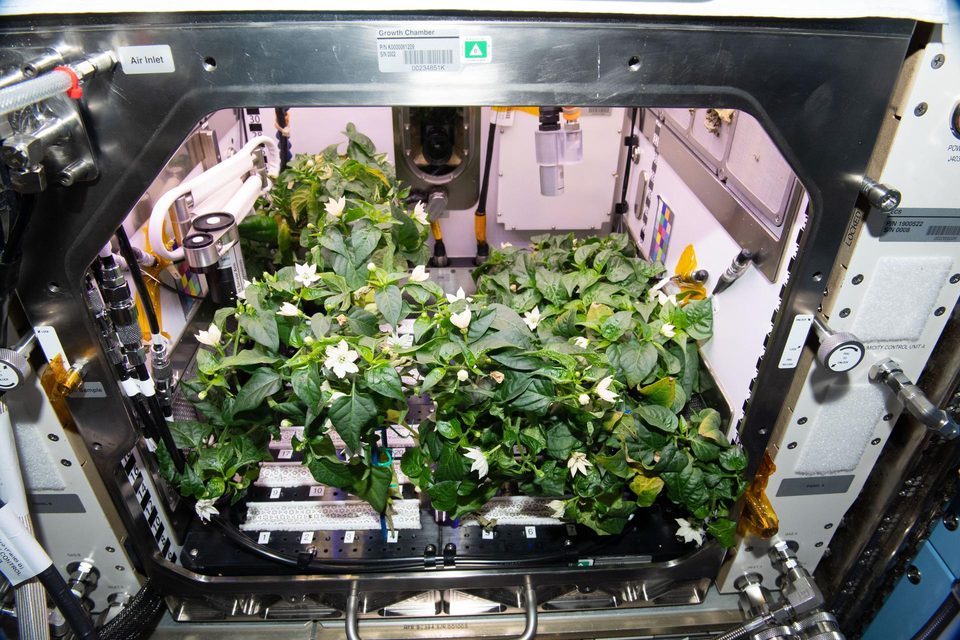
| NASA Advanced Plant Habitat (APH) | A fully controlled growth chamber on the ISS that sets light, temperature, CO2, humidity and watering and carries cameras and sensors. It gives much better control and has grown chile peppers to fruit, but it is more complex than Veggie, which only adds lights, a fan and passive watering. | Operating on the ISS since 2017; chile peppers bore fruit in 2021 |
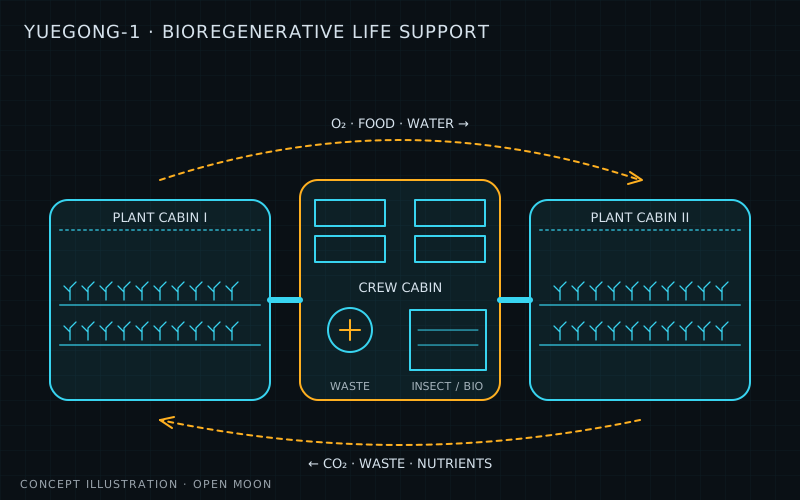
| Lunar Palace 1 (Yuegong-1) bioregenerative system | A ground-based closed habitat in Beijing where plants and mealworms fed the crew and oxygen and water were recycled. It works at a far larger scale than one Veggie unit, but it has never flown and needs much more volume and power. | Ran a 370-day crewed test on the ground in 2017-18 |
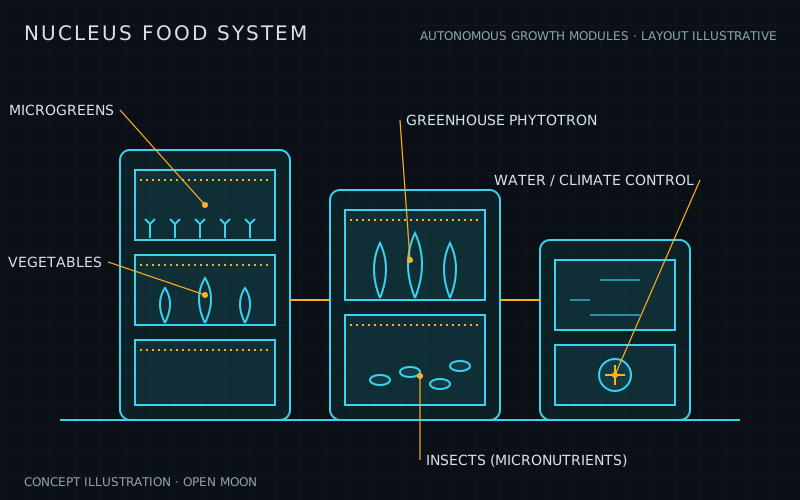
| Interstellar Lab NUCLEUS | A modular food system that won NASA's Deep Space Food Challenge. It aims to grow and harvest several food outputs, so it targets more of the diet than Veggie's salad greens, but it has not flown in space. | Won the 750,000 dollar grand prize of the Deep Space Food Challenge in 2024; ground prototype |
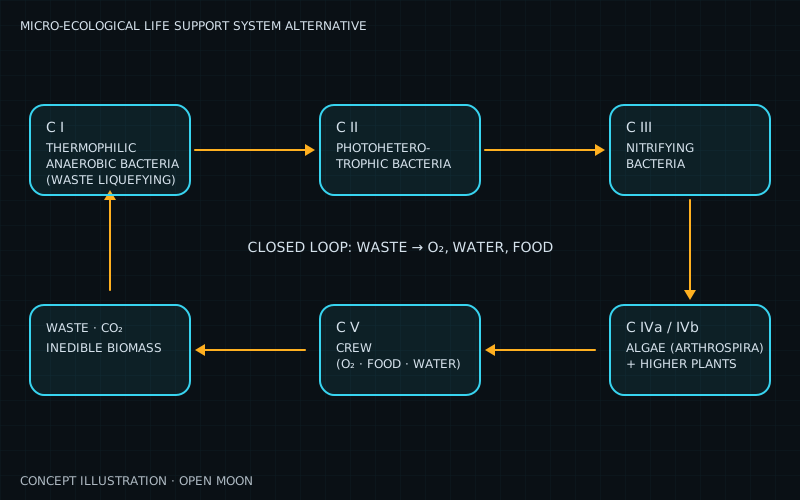
| ESA MELiSSA | A European closed-loop life support concept that links microbes, higher plants and crew to recycle waste, air and water. It addresses the whole loop rather than just fresh food, but it is still a research programme on the ground. | Ground pilot plant research; not flown as a full system |
- official NASA Facts: Veggie (fact sheet FS-2020-01-007-KSC) (Jan 2020)
- official NASA: Veggie will expand fresh food production on space station (Apr 2014)
- official NASA: Veggie plant growth system activated on International Space Station (May 2014)
- paper Massa et al.: Growth chambers on the International Space Station for large plants (NTRS) (May 2016)
- paper Stutte et al.: Operational evaluation of VEGGIE food production system in the Habitat Demonstration Unit (NTRS) (Jul 2011)
- paper Zabel et al.: Review and analysis of over 40 years of space plant growth systems, Life Sciences in Space Research (Aug 2016)
- official NASA: Science in space, plant science (Veggie and APH) (Jul 2023)
- official NASA: NASA teams persevere through plant challenges in space (VEG-05) (Apr 2023)
- paper Massa et al.: Verification testing and VEG-05 tomato crop production on the ISS (NTRS) (Nov 2023)
- official NASA Science: Veg-06, plants and beneficial bacteria in microgravity (Apr 2026)
- official NASA Science: Space Crops (May 2026)
- wiki Vegetable Production System, Wikipedia (accessed Nov 2026)
- data NASA Image Library: Veg-04A mizuna in Veggie (iss060e006116) (Jul 2019)
Summary
| System | Food |
| Phase | 4 |
| Milestones | M10 |
| Readiness | TRL 9 / 9 |
| Plan status | ready to use |
Sources
- NASA: Science in space, plant science (Veggie) (status and facts)
- Image: NASA
More sources are on each milestone page that uses this technology.