ShadowCam on KPLO/Danuri
Operating in extended mission; expected to end in early 2028 when its battery runs out in a lunar eclipse
What it is
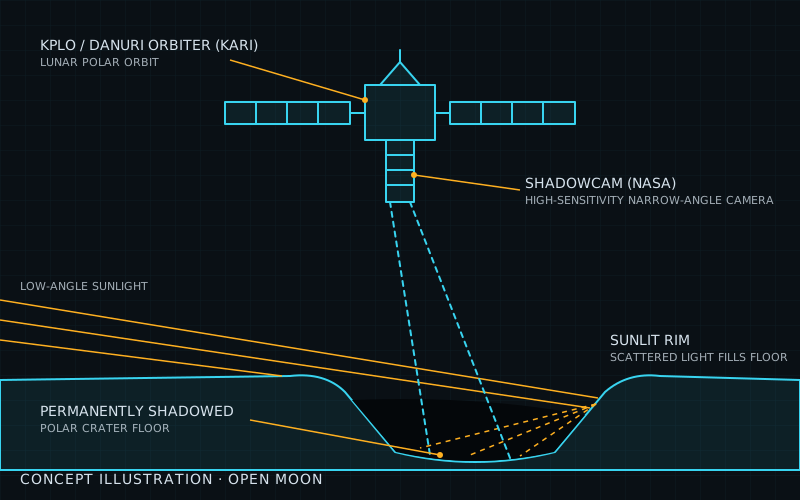
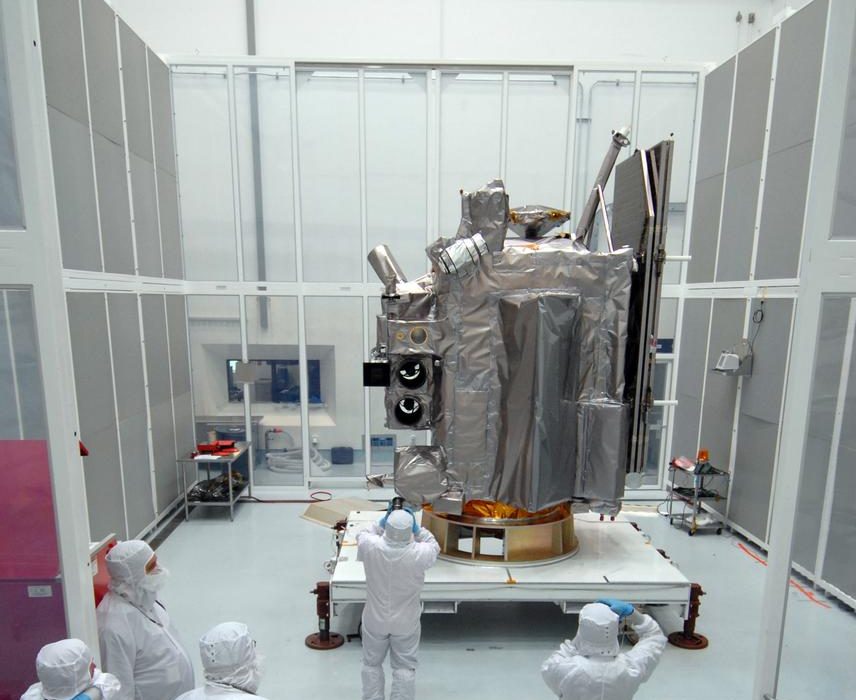
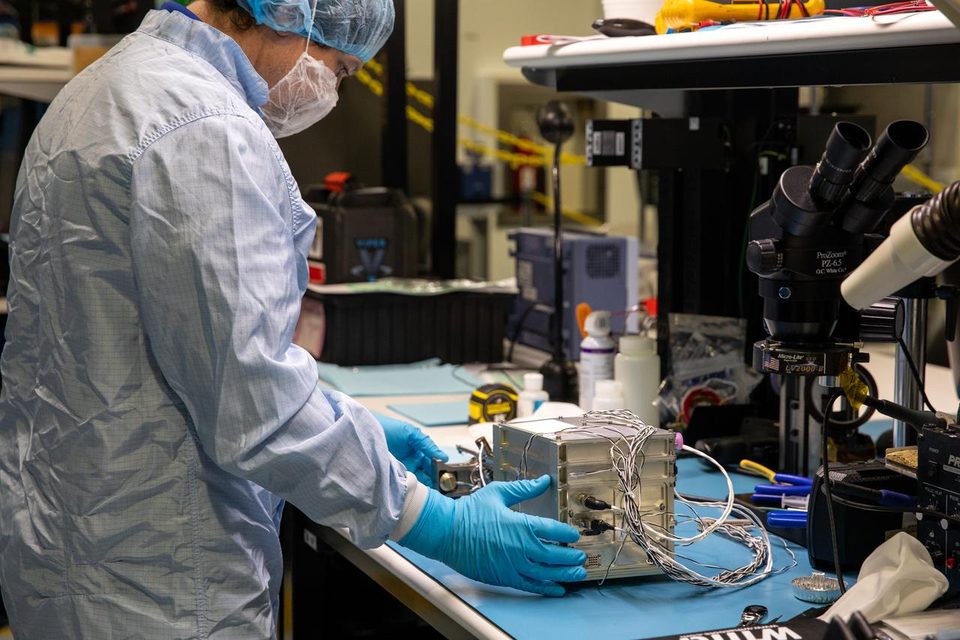
ShadowCam is a NASA-funded camera that photographs the floors of the Moon’s permanently shadowed regions (PSRs), the cold crater floors near the poles that never see direct sunlight. It flies on the Korea Pathfinder Lunar Orbiter (KPLO), also called Danuri, which is South Korea’s first lunar mission and is run by the Korea Aerospace Research Institute (KARI) (ShadowCam). NASA’s Advanced Exploration Systems programme paid for it. Malin Space Science Systems designed and built it, and Arizona State University led the investigation (Robinson et al. 2023). The science team is now led by Prasun Mahanti of Intuitive Machines (ShadowCam).
Danuri launched on a Falcon 9 on 4 August 2022. It entered lunar orbit on 16 December 2022 and flies in a 100 km polar orbit (Wikipedia). The camera is based on the LRO Camera’s Narrow Angle Camera (NAC) but is more than 200 times more sensitive. It takes images at 1.7 m per pixel inside the shadows (ShadowCam).
ShadowCam is now in an extended mission. The team expects it to run until early 2028. At that point the spacecraft’s battery will run out during a lunar eclipse and it will crash onto the Moon (UH SOEST). Its data are public. The August 2026 release alone added 5,247 observations from July to September 2025, a total of 5.61 TiB. It also included mosaics and terrain models (ShadowCam, PDS archive).
Why Open Moon uses it
Open Moon needs water ice, and the best places to look for it are the PSRs. ShadowCam is the only working instrument that gives metre-scale pictures inside them. In M00 Site selection, its images go into the open south-pole map, and its bright patches help rank which craters to prospect. M01 Prospecting builds on its most important result. In 2026, ShadowCam found no widespread surface ice above about 20-30% by weight. It found only a few patches 20-50 m across, with light-scattering behaviour that fits more than 10% ice, often near young craters (UH SOEST, Li et al. 2026). That is why Open Moon plans to drill many points across several craters instead of one deep hole.
ShadowCam also shows terrain hazards and how much reflected light and warmth reach the shadows. One of its science goals is to provide hazard and trafficability information for future landers and rovers (ShadowCam). A 2024 study paired its images with models at four PSRs that overlap five Artemis III candidate regions. It found that light and temperature inside the shadows can change quickly, which matters when planning sampling sorties (Mahanti et al. 2024). Other teams use it as context too. ISRO’s 2026 radar ice study was shown on a ShadowCam mosaic of Faustini crater (ISRO). Without ShadowCam, Open Moon would have to use LROC NAC images of the shadows, with pixels 10-40 m long and signal-to-noise below 20 (Robinson et al. 2023).
How it works
Crater floors in permanent shadow are lit only by sunlight reflected off nearby sunlit ridges and crater walls. This light is very dim (ShadowCam). ShadowCam collects enough of it using a time delay integration (TDI) detector. As the spacecraft moves, the charge from each line of the image is passed to the next line at the same speed as the ground moves below. The detector adds 32 looks at the same spot together. This raises the signal-to-noise ratio to typically above 100 in high-priority PSRs (Robinson et al. 2023). It is a pushbroom camera: one image is a long strip 5.2 km wide and up to 144 km long (ShadowCam).
To look for ice, the team compares how bright the ground is and how it scatters light. Rock and dust send more light back toward where it came from. Ice scatters light forward. During the extended mission, ShadowCam imaged the same places from different angles. This let the team look for forward scattering for the first time (UH SOEST). Modelling the reflected light, as was done for Shackleton crater, helps separate true bright material from lighting effects (Mahanti et al. 2023).
| Specification | Value |
|---|---|
| Detector | TDI pushbroom CCD, 32 TDI lines, 12 µm pixels |
| Image scale | 1.7 m/pixel from 100 km |
| Image footprint | 5.2 km × 144 km |
| Optics | f/3.6 Ritchey-Chrétien, 699.28 mm focal length, 194.4 mm aperture |
| Signal-to-noise | >90 (specification) |
| Spectral response | 410-780 nm |
| Sensitivity | >200 × LROC NAC |
| Mass | 8.75 kg |
| Power | 6.4 W average, 9.3 W peak |
Source: ShadowCam camera characteristics and factsheet.
Limitations and open issues
- The end date is fixed. New images will stop in early 2028, when the battery fails in a lunar eclipse (UH SOEST). Open Moon must request and archive the targets it needs before then.
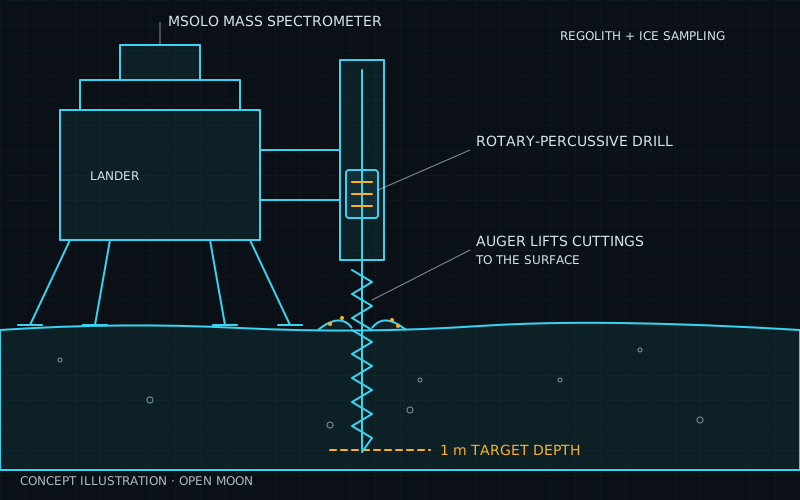
- It only sees the surface. A visible camera cannot see ice buried under dust. Many ice-bearing spots lie near young craters, which hints that more ice may be buried just below the surface (UH SOEST). Radar and drilling are still needed.
- It is not sensitive enough to map low ice levels. The ShadowCam study says future detectors able to map ice below 1% will be needed to fully map the Moon’s water (UH SOEST).
- Brightness is not proof of ice. The patches are “consistent with” ice. They are not a chemical measurement (UH SOEST). Lighting inside the shadows also changes quickly, which makes comparisons harder (Mahanti et al. 2024).
- Stereo coverage is thin. When the 2026 study was prepared, multi-angle observations existed for only six locations (UH SOEST).
- It saturates in sunlight. It is built for dim light, so it cannot image sunlit ground. Rims and access routes need LROC NAC images (ShadowCam).
- Public data lag behind. The August 2026 release covered images taken in July-September 2025 (ShadowCam). Open Moon’s site work therefore runs about a year behind the newest images.
| Alternative | How it compares | Status |
|---|---|---|
| LRO Camera Narrow Angle Camera (LROC NAC) long exposures | Same camera family and still flying, with 0.5 m pixels in sunlight. But inside shadowed craters it needs 20-80 times longer exposures, giving smeared 10-40 m pixels with signal-to-noise below 20, so it cannot see the detail ShadowCam sees. | Operating on NASA's Lunar Reconnaissance Orbiter since 2009 |
| LRO Lyman Alpha Mapping Project (LAMP) | Far-ultraviolet instrument that sees shadowed craters by starlight and sky glow. It found evidence of surface frost and high porosity, but at much coarser scale than ShadowCam's 1.7 m pixels. | Flying on LRO; results published |
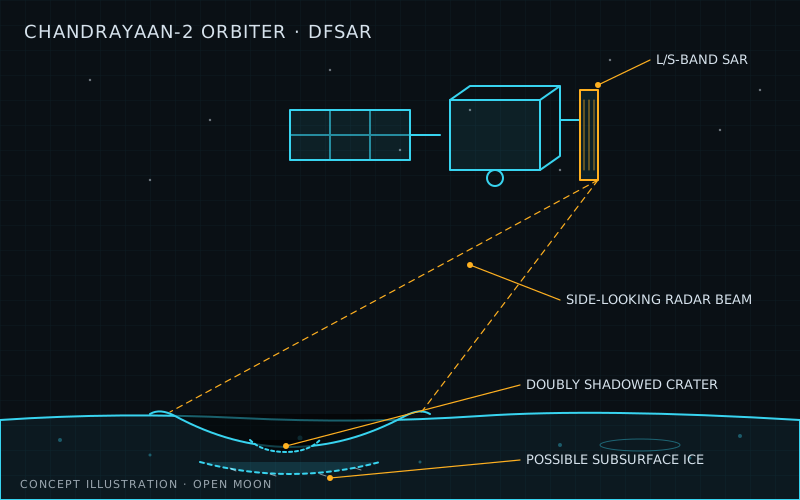
| Chandrayaan-2 orbiter DFSAR radar | L- and S-band radar that looks below the surface, which a visible camera cannot do. Radar ice signatures are easily confused with rough rock, and ISRO's own 2026 analysis used a ShadowCam mosaic as context, so the two complement each other. | Operating; May 2026 results show possible subsurface ice under four doubly shadowed craters |
| Lunar Trailblazer (HVM3 imaging spectrometer) | Small NASA orbiter built to map the form and amount of water, including in shadowed regions, using infrared spectra rather than brightness. It would have told water apart from bright rock, but it was lost soon after launch. | Failed: launched 27 Feb 2025, contact lost, mission ended July 2025 |
- official ShadowCam: About the project, science objectives and camera characteristics (accessed Nov 2026)
- official ShadowCam instrument factsheet (PDF) (accessed Nov 2026)
- official ShadowCam PDS Release - September 2026 (Aug 2026)
- data ShadowCam PDS archive (raw, calibrated and derived products) (Oct 2026)
- official Univ. of Hawaii SOEST: Scarce ice in Moon's darkest regions (ShadowCam) (Mar 2026)
- paper Li et al., Searching for surficial water ice in lunar PSRs with ShadowCam, Science Advances 12, eaec8211 (2026)
- paper Robinson et al., ShadowCam instrument and investigation overview, J. Astron. Space Sci. 40(4) (Dec 2023)
- paper Mahanti et al., Dynamic secondary illumination in permanent shadows within Artemis III candidate landing regions, Planetary Science Journal 5, 62 (2024)
- paper Mahanti et al., Secondary illumination at Shackleton crater PSR from ShadowCam observations and modeling, J. Astron. Space Sci. 40(4) (Dec 2023)
- official ShadowCam team publications list (accessed Nov 2026)
- wiki Danuri (Korea Pathfinder Lunar Orbiter), Wikipedia (accessed Nov 2026)
- official ISRO: Chandrayaan-2 DFSAR observations reveal subsurface ice in lunar south polar regions (May 2026)
- official LROC: About LROC and LRO (accessed Nov 2026)
- wiki Lunar Trailblazer, Wikipedia (accessed Nov 2026)
Summary
| System | Science and survey |
| Phase | 0 |
| Milestones | M00 |
| Readiness | TRL 9 / 9 |
| Plan status | ready to use |
Sources
- Univ. of Hawaii SOEST: Scarce ice in Moon's darkest regions (ShadowCam) (status and facts)
- Reference for the illustration
More sources are on each milestone page that uses this technology.