Lava tubes
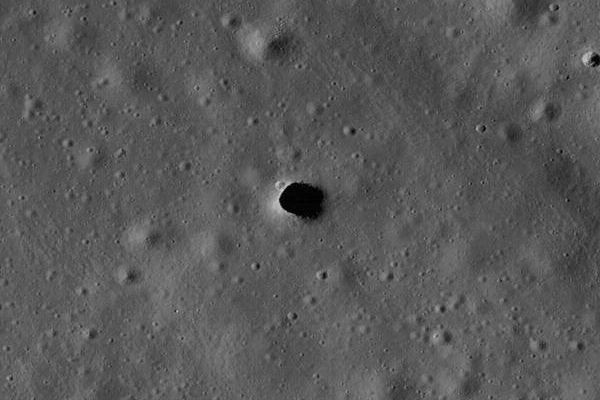
Radar evidence of a cave under the Mare Tranquillitatis pit (2024); Marius Hills pit ~40 m deep
What it is
A lava tube is a tunnel left behind when flowing lava hardens on the outside and the molten interior drains away (Wikipedia, ESA). On the Moon, the long winding channels called sinuous rilles formed as open lava channels or as lava tubes, many of which later collapsed (LROC). Where part of a roof has fallen in, a “skylight” pit can open into the tube below. Lava tubes are not a machine anyone builds. They are natural caves that a future base could move into.
The first strong candidate was the Marius Hills pit, found by a Japanese team led by Junichi Haruyama in images from JAXA’s SELENE/Kaguya orbiter (LROC). NASA’s Lunar Reconnaissance Orbiter (LRO) later imaged it at 0.5 m per pixel. A 2017 LROC update measured it at 58 x 49 m across and 40 m deep (LROC). A 2022 NASA article gives different figures: 65 x 90 m wide and about 34 m deep (NASA). More than 200 pits are now known, and about 16 of them are probably collapsed lava tubes (NASA).
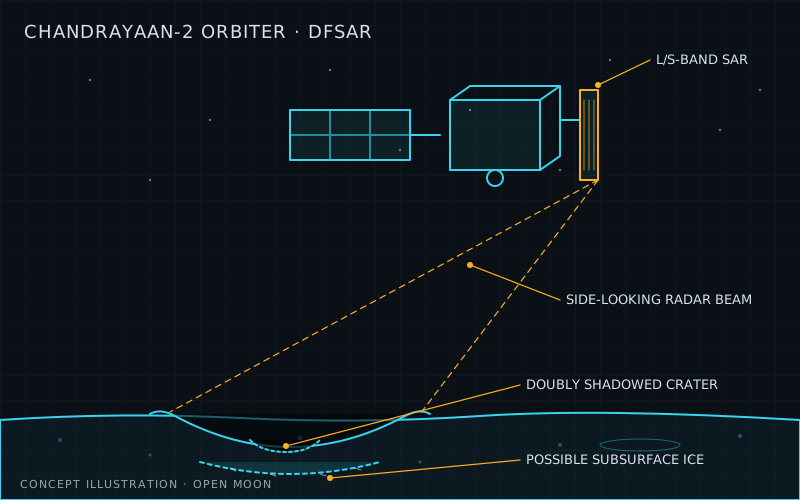
The best evidence so far is at the Mare Tranquillitatis pit. In 2024, Carrer and colleagues re-analysed 2010 radar images from LRO’s Mini-RF instrument. They found reflections from a cave conduit tens of metres long running beneath the pit (Nature Astronomy). NASA describes it as a cave more than 200 feet from the base of the pit, whose full extent is unknown (NASA). Open Moon rates the technology at TRL 2: it has been seen from orbit, but nobody has entered a lunar lava tube.
Why Open Moon uses it
Lava tubes appear only in M13, the self-sustaining colony, as a “future growth” option beyond 2050 for large, shielded volumes. No earlier milestone depends on them.
The appeal is protection for free. The rock roof shields against cosmic and solar radiation and small meteorite impacts, and temperatures inside stay stable (ESA). Shaded parts of the Mare Tranquillitatis pit stay near 17 C (63 F), while the surface swings from about 127 C by day to about -173 C at night (NASA). A colony that could use such caves would need far less built shielding per person.
Without lava tubes, the plan still works. Growth would rely on surface habitats shielded with local regolith, built by the construction systems in earlier milestones (see the alternatives below).
How it works
A usable lava tube needs three things: a skylight to get in, a stable roof, and enough open floor behind the pit. Orbiters find skylights in images. Radar and thermal data hint at what lies beyond them. Lunar gravity is about one sixth of Earth’s, which allows larger caves with fewer collapses (ESA). Gravity data from NASA’s GRAIL mission has been read as a sign of lava tubes more than 1 km wide (Wikipedia).
| Feature | Mare Tranquillitatis pit | Marius Hills pit |
|---|---|---|
| First seen | 2009, SELENE/Kaguya (NASA) | SELENE/Kaguya (LROC) |
| Width | 100–115 m (NASA Photojournal) | 58 x 49 m (LROC) |
| Depth | a bit over 100 m (NASA Photojournal); 133 m (NASA NIAC) | 40 m (LROC) |
| Cave evidence | Radar: conduit tens of metres long (Nature Astronomy) | Lies in a sinuous rille (LROC) |
| Location | 8.3° N, 33.2° E, about 400 km from Apollo 11 (Wikipedia) | Marius Hills volcanic region |
Getting inside needs robots that can descend a vertical wall. JPL’s Moon Diver concept would land within a 100 m ellipse and send a two-wheeled Axel rover down the Tranquillitatis pit wall on a 300 m tether during one lunar day (Nesnas et al.). In 2026, NASA’s NIAC programme funded a study of LUX, a vehicle powered by laser light sent down an optical fibre to explore and map the tunnels (NASA NIAC).
Limitations and open issues
- No one has been inside. All evidence comes from orbit. The length, floor and roof condition of any lunar lava tube are unknown (NASA).
- Sources disagree on sizes. Published depths for the Marius Hills pit are 34 m and 40 m, and for the Tranquillitatis pit “a bit over 100 m” and 133 m (see table).
- Wrong place for the base. The best-studied pit is at 8.3° N (Wikipedia), far from Open Moon’s south-pole site. No confirmed lava tube near the south pole has been published.
- Access is hard. Entry means a vertical drop of tens to over 100 m. Exploration robots are still concepts: Moon Diver is pre-decisional (Nesnas et al.) and LUX is a feasibility study (NASA NIAC).
- Roof stability is unproven. Low gravity helps, but no roof has been tested or surveyed up close. Engineering numbers for safe occupancy are not published.
- Power and communications. Sunlight and radio do not reach inside, so tethers or relays are needed, as both robot concepts show.
- No ice benefit assumed. Ice in lunar caves is likely to sublimate unless temperatures stay below about 120 K (Wikipedia), and shaded pit areas are far warmer than that.
- Cost. No cost estimate for outfitting a lava tube habitat has been published.
| Alternative | How it compares | Status |
|---|---|---|
| 3D-printed regolith shell over an inflatable (ESA / Foster + Partners) | Robots print a cellular regolith shield over an inflatable module, so you can build it at a site you choose, such as the south pole. It needs printers, binders and a lot of robot time, and the shield is much thinner than the rock roof of a lava tube. | Concept with ground tests: a 1.5-tonne demonstration block printed from simulated regolith in 2013 |
| ICON Olympus laser-melted regolith structures | A laser melts local regolith into ceramic-like shells, radiation shielding and landing pads at the base site. It is buildable where the base already is, but the shielded volume grows only as fast as the machines can build. | In development with NASA SBIR support; Duneflow regolith test flew on a suborbital rocket in February 2025 |
| Shaded pit overhangs (without entering a tube) | Use the shaded floor under a pit overhang, which stays near 17 C, without relying on a long tube behind it. It is simpler to reach than a deep conduit, but the volume is small and still needs a vertical descent. | Known only from orbital thermal data (LRO Diviner); no lander has visited a pit |
- paper Carrer et al.: Radar evidence of an accessible cave conduit on the Moon below the Mare Tranquillitatis pit (Nature Astronomy) (Jul 2024)
- official ESA CAVES and PANGAEA blog: A shelter on the Moon (Dec 2024)
- official NASA Science: New evidence adds to findings hinting at network of caves on Moon (Jul 2024)
- official NASA: LRO finds lunar pits harbor comfortable temperatures (Jul 2022)
- official LROC: Marius Hills pit, lava tube skylight? ()
- official NASA Photojournal PIA13518: New views of lunar pits (Mare Tranquillitatis pit) (Sep 2010)
- data NASA Image Library PIA12954: Marius Hills pit ()
- paper Nesnas et al.: Moon Diver, exploring a pit's exposed strata to understand lunar volcanism (Acta Astronautica) (Jun 2023)
- official NASA NIAC: Power over fiber to enable a Lunar Underground eXplorer (LUX) (Jul 2026)
- wiki Wikipedia: Lunar lava tube ()
- wiki Wikipedia: Mare Tranquillitatis pit ()
- wiki Wikipedia: Lava tube ()
- press phys.org: Lunar lava tube cave (Carrer et al., Nature Astronomy) (Jul 2024)
- official ESA: Building a lunar base with 3D printing (Jan 2013)
- official NASA: NASA enables construction technology for Moon and Mars exploration (May 2025)
Summary
| System | Science and survey |
| Phase | 5 |
| Milestones | M13 |
| Readiness | TRL 2 / 9 |
| Plan status | needs development |
Sources
- phys.org: Lunar lava tube cave (Carrer et al., Nature Astronomy) (status and facts)
- Image: NASA/GSFC/Arizona State University
More sources are on each milestone page that uses this technology.