TRIDENT drill (Honeybee Robotics)
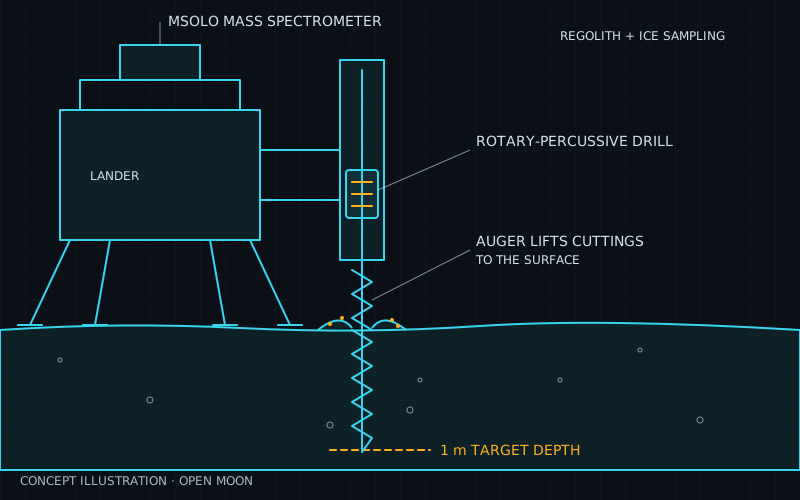
Flew on IM-2 (2025). Powered up and extended to its full range; lander ended on its side and the mission ended early
What it is
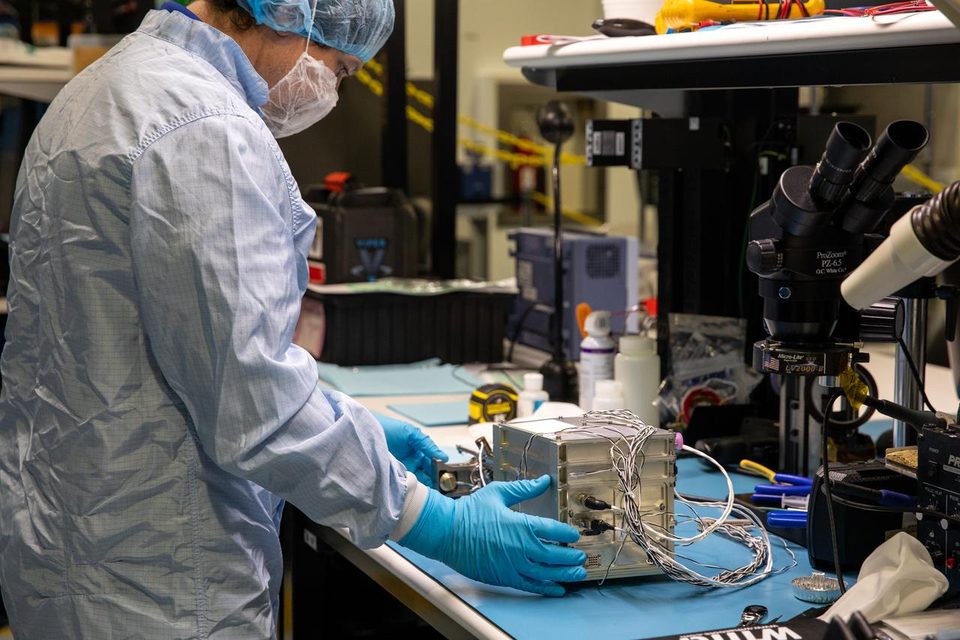
TRIDENT (The Regolith and Ice Drill for Exploring New Terrain) is a 1 m rotary-percussive drill built by Honeybee Robotics of Altadena, California. It spins to cut and hammers to break hard material. Its job is to bring soil from below the lunar surface up to where other instruments can sniff it for water and other volatiles (NASA). Honeybee is now a subsidiary of Blue Origin.
The design comes from two decades of Honeybee drill work. Earlier versions included the Icebreaker drill (over 50 kg) and the lighter LITA drill (15 kg), which was tested on a rover in the Atacama Desert. Two flight units were built: one for NASA’s PRIME-1 lander payload and one for the VIPER rover (Zacny et al. 2025).
PRIME-1 flew on Intuitive Machines’ IM-2 lander, Athena, which launched in February 2025 and landed on 6 March about 400 m from its target near Mons Mouton. The lander came to rest on its side in a crater, and the mission lasted about 10 hours instead of 10 days (NASA). Even so, TRIDENT powered up, rotated, hammered, cycled its heater and extended to its full range. Because the lander was on its side, the drill deployed horizontally and never penetrated regolith. The VIPER unit was installed in the rover in February 2024. After VIPER’s cancellation and revival, NASA picked Blue Origin to deliver it in late 2027 on a Blue Moon MK1 lander.
Why Open Moon uses it
Milestone M01 (prospecting) needs ice measured by drilling, not only from orbit. Its exit criteria call for holes at least 1 m deep at several points in at least two permanently shadowed regions. The planned prospector rovers carry a “TRIDENT-heritage” 1 m drill alongside an MSolo-class mass spectrometer. That pairing is exactly what PRIME-1 flew and what VIPER will carry (NASA).
TRIDENT is the closest thing to a flight-qualified, rover-ready US ice drill. It has worked on the Moon, if only in a partial test, and a second unit is fully integrated in a qualified rover. Its drilling telemetry also gives regolith strength, which M01 needs for siting landing pads and habitats (NASA). Without it, Open Moon would have to wait for ESA’s or JAXA’s drills (see alternatives) or fund a new drill. The water and propellant plants in later milestones would then be sized on less certain ice numbers.
How it works
TRIDENT has six subsystems: a drill head with separate rotary and percussive motors; a deployment stage that lowers the drill and presses it to the ground; a feed stage that drives the drill string up to 1 m down; the drill string, with a carbide bit, two temperature sensors and a heater; a brushing station; and an avionics box.
It samples in 10 cm “bites”. The drill cuts 10 cm, the spiral flutes hold the cuttings, the drill pulls up, and a rotating brush sweeps them into a neat pile on the ground. Instruments then analyse the pile. Repeating this gives a rough depth profile. The bit sensor measures subsurface temperature, and the heater, 35 cm above the bit, supports thermal conductivity measurements and can free a drill that freezes in (Zacny et al. 2025). Each hammer blow also makes a seismic signal that a lander or rover motion sensor can pick up.
| Specification | Value |
|---|---|
| Overall mass | 26.5 kg (drill 19.5 kg, avionics 7 kg) |
| Bit diameter | 25.4 mm |
| Reach | 1 m |
| Percussion | 2 J per blow, up to 972 blows/min |
| Rotary power | 50 W nominal |
| Auger speed | 90–100 rpm nominal, up to 120 rpm |
| Typical weight on bit | 100 N |
Source for the table: Zacny et al. 2025. An earlier NASA abstract gives the rotary and percussive actuators as 200 W each and a maximum weight on bit of 200 N; these appear to be limits rather than typical operating values.
Limitations and open issues
- No hole drilled on the Moon yet. On PRIME-1 all mechanisms worked, but the drill did not penetrate regolith. Drilling into polar ice is still unproven in flight.
- Lander dependence. PRIME-1 was lost to a tipped lander, and VIPER’s ride is still in the future. Open Moon plans two landers for this reason.
- Binding in cemented soil. Ground tests in cemented lunar simulant saw cuttings build up and the drill choke and bind. Field tests at Haughton Crater, the Bishop Tuff and Antarctica are working on fault detection.
- Cold testing limits. Vacuum tests ran below −100 °C with simulant holding up to 8.5 wt% water (Zacny et al. 2025). Performance at the much colder floors of shadowed craters, and in real lunar ice, is not published.
- Ice loss and contamination. Cuttings sit on the surface before analysis, so some ice may sublimate. On PRIME-1, the gases MSolo saw were from spacecraft propellant and traces of Earth water, and a follow-up NASA review covers those results.
- Cost not published. No unit price for TRIDENT is public.
| Alternative | How it compares | Status |
|---|---|---|
| ProSEED drill (ESA Prospect, Leonardo) | Also a 1 m-class lunar drill aimed at polar ice, but it hands sealed samples to an on-board mini lab (ProSPA) that heats them in ovens, instead of leaving a cuttings pile on the surface. Better for quantitative volatile analysis; heavier and more complex, and it has not flown yet. | Development model tested cold, in vacuum and in icy simulant in Italy; manifested on an Intuitive Machines CLPS flight targeted for 2027. |
| LUPEX rover drill (JAXA/ISRO) | Rover-mounted drill that samples from the surface to about 1.5 m, deeper than TRIDENT, feeding the REIWA water analysers on a 350 kg rover. Deeper reach and a fuller lab, but it is tied to a much larger rover and a later mission. | In development; launch no earlier than 2028 on H3. |
| LISTER pneumatic excavator (Honeybee Robotics / Texas Tech) | Clears the hole with jets of nitrogen gas instead of an auger, and pushes a thermal probe down. Proven to 1 m on the Moon, but it is built for heat-flow measurements and does not return cuttings for gas analysis, and it consumes stored gas. | Flew on Blue Ghost Mission 1 (March 2025) and reached 1 m in Mare Crisium. |
| Chang'e 5 lander drill (China) | Robotic drill that took a core from about 1 m deep and returned it to Earth with the scooped samples. Flight-proven at depth, but it is part of a sample-return lander, not a small prospecting tool, and it worked at mid-latitude, not in polar ice. | Flown successfully in December 2020; samples returned to Earth. |
- official NASA: Lunar drill technology passes tests on the Moon (PRIME-1) (Apr 2025)
- paper Zacny et al.: TRIDENT ice mining drill for lunar volatile prospecting for PRIME-1 and VIPER (Planetary Science Journal) (Dec 2025)
- official NASA Science: VIPER rover and instruments (TRIDENT section) ()
- official NASA: Into the belly of the rover, VIPER's final science instrument installed (Feb 2024)
- official NASA: All together now, drill joins other Moon rover science instruments (Oct 2023)
- official NASA: NASA selects Blue Origin to deliver VIPER rover to Moon's south pole (Sep 2025)
- official NASA NTRS: TRIDENT drill validation at Mars and lunar analog field sites (LPSC 2024) (2024)
- official NASA NTRS: TRIDENT drill performance and subsurface fault and anomaly detection in Antarctic environments (2026)
- paper Chu et al.: TRIDENT drill for VIPER and PRIME-1 missions (LSIC poster) (Oct 2020)
- official NASA NTRS: MSolo PRIME-1 overview and results (2026)
- wiki Wikipedia: VIPER (rover) ()
- wiki Wikipedia: Honeybee Robotics ()
Summary
| System | Science and survey |
| Phase | 0 |
| Milestones | M01 |
| Readiness | TRL 7 / 9 |
| Plan status | ready to use |
Sources
- NASA: Lunar drill technology passes tests on the Moon (PRIME-1) (status and facts)
- Reference for the illustration
More sources are on each milestone page that uses this technology.