Redwire Regolith Print
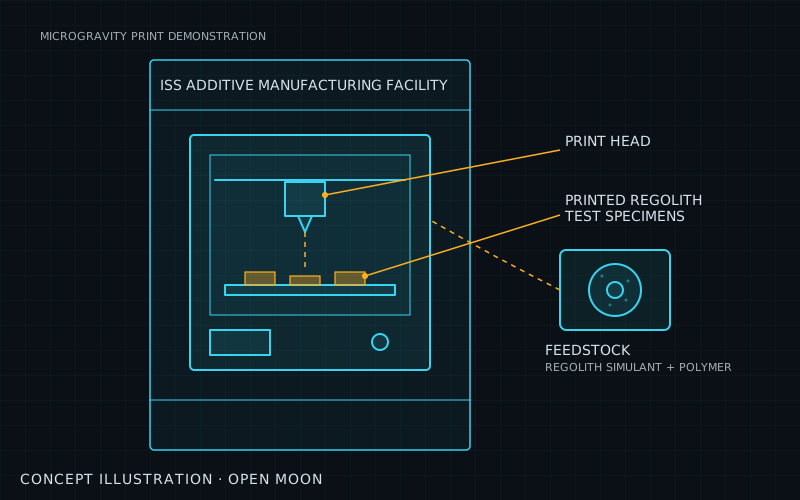
Printed with regolith simulant on ISS (launched Aug 2021)
What it is
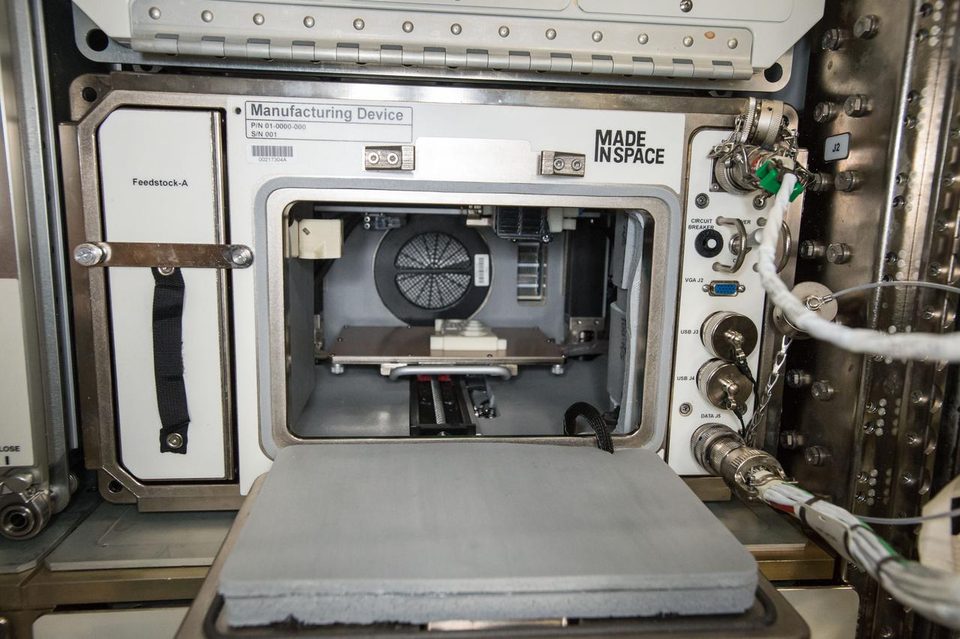
Redwire Regolith Print (RRP) was a small technology demonstration on the International Space Station. It tested 3D printing with a feedstock made from simulated lunar soil. Redwire developed it with NASA’s Marshall Space Flight Center. It ran on Redwire’s Additive Manufacturing Facility (AMF), a commercial printer built by Made In Space. That printer was installed on the ISS in April 2016. Redwire bought Made In Space in June 2020.
The hardware flew on Northrop Grumman’s 16th cargo mission. That mission launched on an Antares rocket on 10 August 2021. Redwire says this was the first time lunar regolith simulant was used for 3D printing in space. By December 2021, the printed samples had returned to Earth for scientific analysis. The project won a 2021 Popular Science “Best of What’s New” award.
NASA lists RRP among its ISS manufacturing studies. NASA says it tested simulated regolith as a feedstock for 3D manufacturing in orbit. We could not find any published results from the returned samples, such as strength or density. This page does not give numbers for them.
Why Open Moon uses it
Milestone M12 aims to make most new construction mass and many spare parts from lunar materials. It is the first space test of printing with regolith simulant, according to Redwire. Redwire framed the goal as building landing pads, foundations, roads, habitats and furnishings from local material, so that Artemis missions launch less mass.
In Open Moon, RRP is a pathfinder, not the main construction tool. It shows that a regolith-filled feedstock can be extruded in low gravity. That gives confidence for printing small regolith parts inside the base, such as tiles, brackets and furnishings. Large structures depend on bigger systems such as ICON’s Olympus. Without this kind of work, every small non-critical part would still have to come from Earth.
How it works
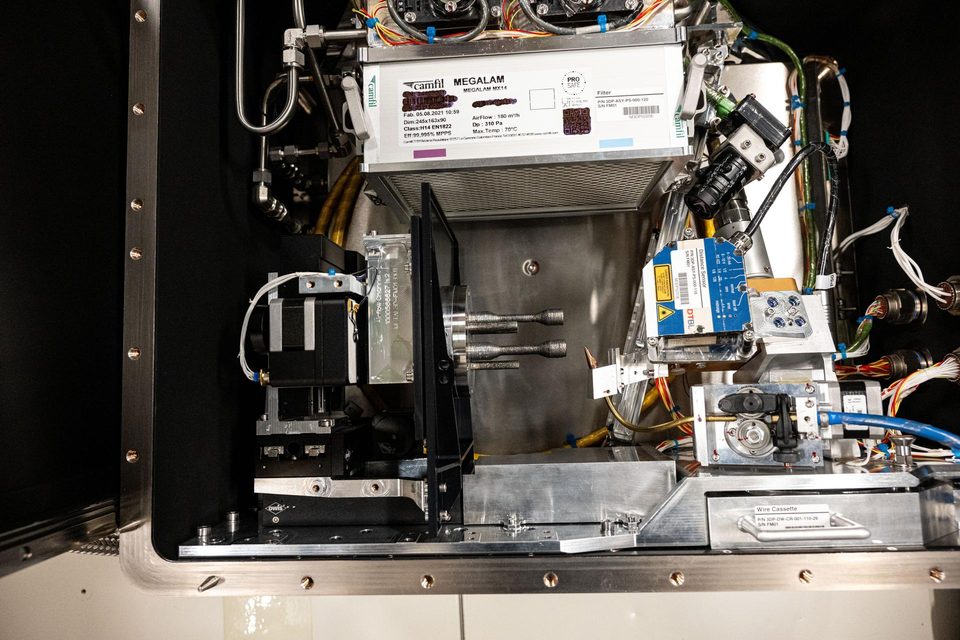
The AMF is a fused filament fabrication (FFF) printer. A heated nozzle lays down molten thermoplastic in layers on a moving bed. On the ISS it normally prints ABS, ULTEM 9085 and HDPE. For RRP, Redwire flew three custom print heads and three print bed surfaces designed for regolith-filled material, to fit the existing printer.
The feedstock was a polymer binder mixed with the lunar simulant JSC-1A. NASA chose and supplied the simulant. Redwire called it a feedstock “optimized for compressive strength”. JSC-1A is made from a basaltic ash with high glass content, meant to resemble mare soil. The plan was three prints, each a solid slab. These were to be returned to NASA scientists for testing.
| Item | Value |
|---|---|
| Host printer | Redwire AMF on ISS (installed Apr 2016) |
| Process | Fused filament fabrication (Redwire) |
| Feedstock | Polymer binder + JSC-1A simulant (Nextgov) |
| Flight hardware | 3 print heads, 3 print beds (Redwire) |
| Planned output | 3 solid slabs (Nextgov) |
| Launch | 10 Aug 2021, Cygnus NG-16 (Wikipedia) |
| Binder type, regolith fraction, slab size | Not published |
Limitations and open issues
- No published results. Redwire said the samples were undergoing analysis in late 2021. We found no public strength or quality data since.
- Wrong environment. The ISS is microgravity inside a pressurised cabin. The Moon has one-sixth gravity, hard vacuum and extreme cold. Ground tests of a similar regolith-plastic process had to be run in dirty thermal vacuum near -190 C to learn how it behaves there.
- The binder comes from Earth. The plastic share must be shipped. Work on plastics that could be grown in space is only at the lab stage.
- Simulant, not real soil. JSC-1A imitates mare soil. The south polar base sits in highlands terrain, which is chemically different.
- Very small scale. RRP planned three slabs in a station printer. Scaling to pads or walls is a different engineering problem.
| Alternative | How it compares | Status |
|---|---|---|
| Regolith-polymer FFF in lunar vacuum (NASA KSC Swamp Works / AI SpaceFactory LINA) | Uses the same idea, extruding a regolith-plastic mix (70-85% simulant by weight in PLA), but at construction scale and in dirty thermal vacuum near -190 C. It has stronger evidence for surface conditions than Regolith Print, but it was tested on the ground, not in reduced gravity, and it still needs plastic brought from Earth. | Ground tests in a vacuum chamber; authors rate it TRL 5 (2024) |
| ICON Project Olympus | A large construction system meant to build pads, blast shields and roads mainly from local regolith. It aims at much bigger structures than Regolith Print's small slabs, but few details of its lunar printing process are public. | $57.2M NASA SBIR Phase III award (Nov 2022); ground and reduced-gravity flight testing planned |
| D-Shape binder-jet regolith printing (ESA / Monolite / Foster + Partners) | Sprays a binding salt onto simulant mixed with magnesium oxide, building stone-like blocks without plastic. Needs less carried-in polymer, but the binder and magnesium oxide must still come from Earth, and it was shown only on the ground. | 1.5-tonne demonstration block printed on Earth (2013) |
| Sintered basalt pavers (NASA KSC LPAD) | Fuses rock by heat instead of binding it with plastic, so no binder is needed and the result survives rocket exhaust. Good for pads and roads, not for small detailed parts. | Hot-fire tested with a rocket engine on Earth (tests late 2020, reported Oct 2021) |
| Bio-derived PHB / regolith composites (NASA) | Mixes regolith with PHB, a plastic that could in principle be grown in space from organic waste or CO2. This would close the loop on the binder that Regolith Print imports, but it is early laboratory work. | Laboratory materials research presented 2026 |
- official Redwire: Redwire to demonstrate in-space additive manufacturing for lunar surface on the ISS (Jul 2021)
- official Redwire: Regolith manufacturing technology wins Popular Science 2021 Best of What's New award (Dec 2021)
- official NASA: 3D printing, saving weight and space at launch (ISS manufacturing research overview) (Mar 2025)
- official NASA NTRS 20190030402: In-space manufacturing on ISS (AMF materials) (2019)
- press Nextgov: How 3D printing with moonrock-like material could lead to new space habitats (Jul 2021)
- wiki Cygnus NG-16, Wikipedia (accessed Nov 2026)
- wiki Made In Space, Wikipedia (accessed Nov 2026)
- wiki Lunar regolith simulant (JSC-1A), Wikipedia (accessed Nov 2026)
- paper NASA NTRS 20230015024: Selection, production, and properties of regolith polymer composites for lunar construction (Mar 2024)
- paper NASA NTRS 20230011075: Application of regolith polymer composite FFF construction in simulated lunar conditions (Apr 2024)
- official NASA NTRS 20260003641: Polymer/regolith composites for in-space manufacturing on the Moon and Mars (Jun 2026)
- official ESA: Building a lunar base with 3D printing (Jan 2013)
- official ICON: Lunar surface construction system with $57.2 million NASA award (Nov 2022)
- data NASA M2M-30044 Lunar Surface Data Book (south pole is highlands terrain) (Mar 2025)
- official NASA: NASA tests landing pad materials for future lunar missions (Oct 2021)
Summary
| System | Manufacturing |
| Phase | 4 |
| Milestones | M12 |
| Readiness | TRL 5 / 9 |
| Plan status | ready to use |
Sources
- Redwire: Regolith manufacturing technology (status and facts)
- Reference for the illustration
More sources are on each milestone page that uses this technology.