ESA metal 3D printer on ISS
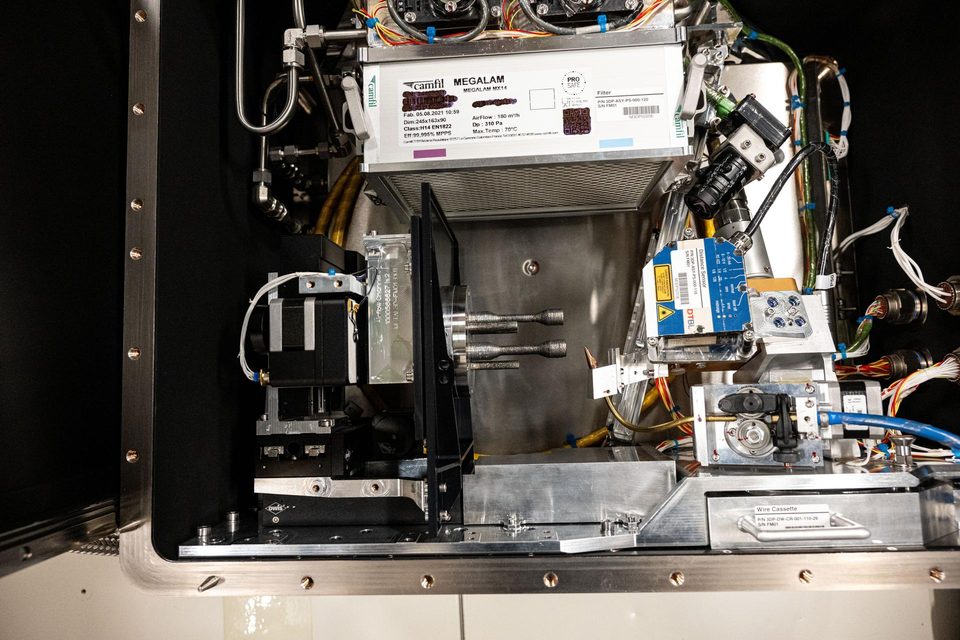
First metal part printed in space, Aug 2024
What it is
The Metal 3D Printer is a technology demonstrator that made the first metal part ever printed in space. It was built for ESA by an industrial team led by Airbus Defence and Space, which also co-funded the project (ESA). Airbus names AddUp, Cranfield University and Highftech Engineering as consortium partners (Airbus). Cranfield worked on the laser, optics and wire feeding (ESA). Earlier ISS printers only made plastic parts (ESA).
The printer launched on the Cygnus NG-20 cargo mission in January 2024 (ESA). ESA astronaut Andreas Mogensen installed it in the European Drawer Rack Mark II in the Columbus module. It printed a small S-shaped test line to finish commissioning in late May 2024 (ESA) and completed its first full part in August 2024 (ESA). The French space agency CNES runs the prints from its CADMOS centre (ESA).
By July 2026 the printer had made five samples. Three had been analysed at ESTEC and DTU. ESA astronaut Sophie Adenot retrieved the fifth during the εpsilon mission (ESA). Trade press reports that this sample included two small thrusters designed by the German Aerospace Center (DLR), which DLR plans to hot-fire test (VoxelMatters).
Why Open Moon uses it
Milestone M12 aims to make at least half of all spare-part mass at the base. Metal printing is one of its parts-manufacturing workstreams, building on this printer’s heritage. NASA notes that about 95% of carried spares are never used, and nobody can know in advance which ones will be needed (NASA NTRS). Printing parts on demand cuts that stockpile. ESA makes the same case: deep-space missions cannot rely on resupply (ESA).
It was the first metal printer to work in orbit (ESA), so it is key evidence that wire-fed laser printing works without gravity. Airbus suggests a future version could use recycled metal or processed regolith for a lunar base (Airbus). Without metal printing, every broken metal part, tool or bracket would have to come from Earth or be stockpiled in advance.
How it works
The process is laser-wire directed energy deposition. A near-infrared laser melts a stainless-steel baseplate and a wire fed into the melt pool, building the part layer by layer (ESA; Wikipedia). The team chose wire because loose powder behaves badly in weightlessness (Airbus). The printer is a fully sealed box. Before printing, its air is vented to space and replaced with nitrogen so the hot steel does not oxidise (ESA). Filters capture fumes (Airbus). The crew only opens a nitrogen and venting valve; the ground runs the print (ESA).
Each flight part is compared with an identical part made by the same printer on the ground before launch (ESA). An engineering model stays on Earth (Airbus).
| Specification | Value |
|---|---|
| Mass | About 180 kg (ESA) |
| Size | 80 × 70 × 40 cm (Airbus) |
| Material | Stainless-steel wire (ESA) |
| Melting point of steel | About 1400 °C (ESA) |
| Laser | About a million times a laser pointer; exact power not published (ESA) |
| Part size | 9 cm high, 5 cm wide (Airbus) |
| Part mass | Under 250 g each (ESA) |
| Print time | About 40 hours per part (Airbus) |
Limitations and open issues
- No published results yet. ESA has CT-scanned and tensile- and bend-tested returned samples, but had published no strength numbers as of its November 2025 update (ESA). In July 2026 it said results were due “in the coming weeks” (ESA).
- Defects. Microscopy of the first part showed ridges and surface flaws, and CT scans were used to map pores (ESA).
- Anomalies. The fifth print was stopped after an anomaly with an element only partly printed; a recovery procedure is still to be tested (ESA).
- Tiny output. Parts are small and slow: about 40 hours for a part 9 cm high (Airbus). A base needs far larger, faster machines.
- One material. Only stainless steel has flown. Printing with lunar-made metal is an idea, not a test (Airbus).
- Finishing. Parts need post-processing; ESA lists better pre- and post-processing as lessons for a future spare-parts printer (ESA).
- Untested environment. All printing has been in microgravity. Lunar gravity, dust and power limits have not been tested. Power draw of the printer is not published.
- Few backups. NASA cancelled its own metal printing project (FabLab) in May 2023 for funding reasons (Roberts et al.), so few flight-proven options exist.
| Alternative | How it compares | Status |
|---|---|---|
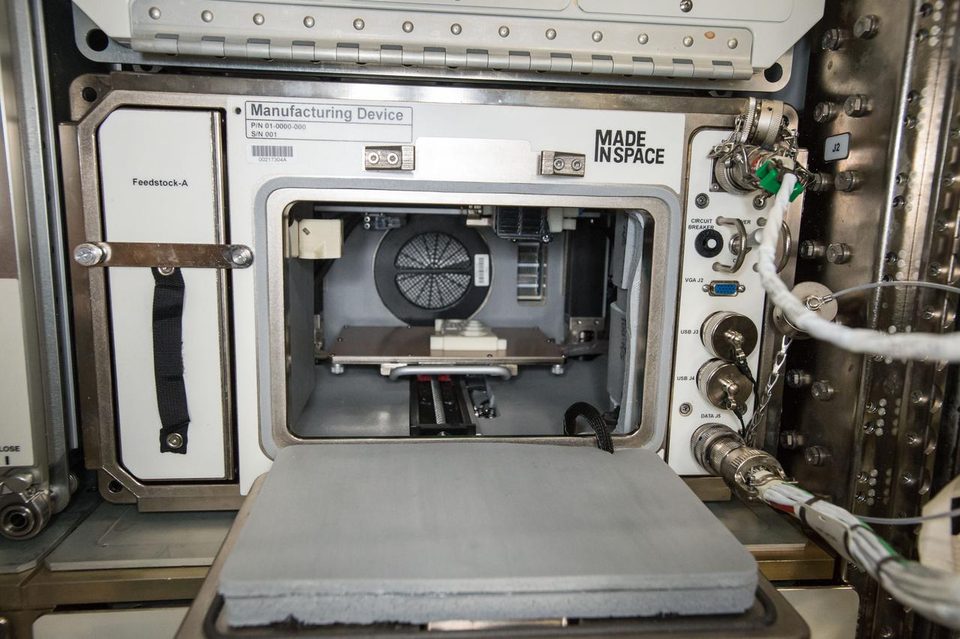
| Redwire (Made In Space) Additive Manufacturing Facility | Prints plastic parts (ABS, ULTEM 9085, HDPE) instead of metal. Far more flight experience and lower power, but plastic parts cannot replace hot, load-bearing or pressure parts. | Commercial facility in use on the ISS; NASA used it for materials studies by 2019 |
| Techshot / Redwire FabLab (bound metal deposition) | Prints metal-filled filament or paste, then sinters it in a furnace; aimed at Ti-6Al-4V and also polymers and electronic inks, with in-process defect checks and milling. Wider feature set, but the furnace drew about 2250 W against a 2000 W target. | Passed preliminary design review April 2023; furnace and gas drawer development cancelled May 2023; never flew |
| Made In Space Vulcan (wire + arc with CNC) | Uses an electric arc instead of a laser to melt wire, and adds 5-axis machining to finish parts in the same unit. Could make finished parts without a separate machine shop, but it never reached orbit. | NASA SBIR Phase II ground prototype (titanium, aluminium ER4043 demonstrated); planned as an ISS payload, no flight reported |
| Ultrasonic additive manufacturing (Ultratech Machinery) | Joins metal layers by ultrasonic welding at low temperature, combined with CNC machining. Avoids melting and hot fumes, but is limited in the shapes it can make. | NASA SBIR Phase II ground prototype (2019); NASA later down-selected bound metal deposition instead |
- official ESA: ESA 3D prints first metal part on the International Space Station (press release N° 49-2024) (Sep 2024)
- official ESA: ESA launches first metal 3D printer to ISS (Jan 2024)
- official ESA: First metal 3D printing on Space Station (commissioning S-curve) (Jun 2024)
- official ESA: A close-up look at the first metal part made in space (Nov 2025)
- official ESA: 3D-printed metal: unlocking crew autonomy (fifth sample, epsilon mission) (Jul 2026)
- official Airbus: The world's first metal 3D printer for space is on its way to the ISS (Jan 2024)
- official NASA Image and Video Library: Metal 3D printer in the Columbus module (iss071e522120) (Aug 2024)
- official NASA NTRS 20190030402: Overview of the In-Space Manufacturing technology portfolio (Jul 2019)
- paper Prater et al., Adaptation of Metal Additive Manufacturing Processes for the ISS (SAMPE 2021, NTRS 20205011519) (2021)
- paper Roberts et al., NASA Technology Maturation Plan for In-space Manufacturing of Metals (SFF Symposium 2023) (2023)
- wiki Wikipedia: Space manufacturing (accessed Nov 2026)
- wiki Wikipedia: Laser metal deposition (directed energy deposition) (accessed Nov 2026)
- wiki Wikipedia: Columbus (ISS module) (accessed Nov 2026)
- press 3D Printing Industry: ESA's orbital metal printer produces its fifth sample (Jul 2026)
- press VoxelMatters: ESA's ISS metal printer produces further thrusters made in space (Oct 2026)
Summary
| System | Manufacturing |
| Phase | 4 |
| Milestones | M12 |
| Readiness | TRL 7 / 9 |
| Plan status | ready to use |
Sources
- ESA: ESA 3D prints first metal part on the ISS (status and facts)
- Image: NASA
More sources are on each milestone page that uses this technology.