Redwire / Made In Space AMF on ISS
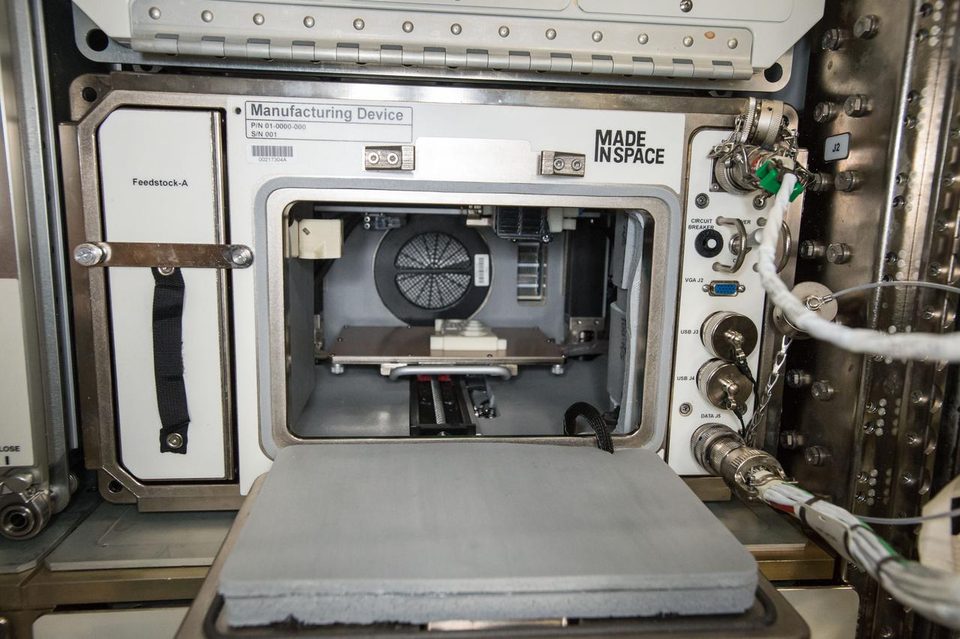
Commercial polymer printer on ISS (ABS, ULTEM, HDPE); parts printed since at least Feb 2017
What it is
The Additive Manufacturing Facility (AMF) is a plastic 3D printer that lives permanently on the International Space Station. It was built by Made In Space, Inc. under a NASA small business (SBIR) contract and installed in April 2016 (NASA NTRS). It is the company’s second-generation printer. The first, a NASA technology demonstrator that flew in 2014, made 55 ABS parts in orbit (NASA NTRS). Redwire acquired Made In Space in June 2020 (Wikipedia), so AMF is now a Redwire product.
Unlike the demonstrator, AMF is owned by the company and sold as a service (Space.com). Customers reach it through the ISS National Laboratory, and NASA buys prints through an IDIQ contract (NASA NTRS). Its first commercial part was a Kobalt wrench in June 2016. It printed a finger splint in January 2017, the first medical item made in orbit (Redwire). By March 2018 it had made nearly 100 parts and was printing for customers almost every week (Redwire).
NASA parts include a tow hitch for the SPHERES free-flying satellites (printed 21 Feb 2017), an enclosure for radiation monitors in the BEAM module, an antenna feed horn and an air-flow probe adapter (NASA NTRS). In 2022 it printed an insert for StemRad’s AstroRad radiation vest from low-density polyethylene (Redwire). Redwire still lists AMF as an operating platform (Redwire). We found no dated public statement of its status in 2025 or 2026.
Why Open Moon uses it
Open Moon’s manufacturing milestone (M12) aims to “print what breaks”, using polymer printing and recycling alongside metal printing. AMF is the heritage for the polymer side. It is the longest-running commercial printer in space, and it has made real station hardware rather than only test coupons.
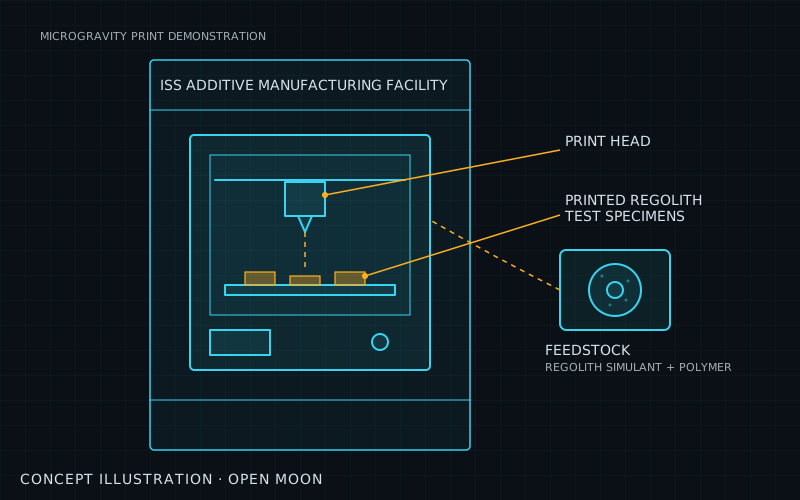
The case is about logistics. NASA says the current approach of launching spares will not work for deep space missions. It says in-space manufacturing could greatly cut the mass of maintenance spares, especially with recycling and local resources (NASA NTRS). AMF has also printed with lunar regolith simulant through the Redwire Regolith Print payload, the first time regolith simulant was used for 3D printing in space (Redwire). Without a printer like this, every broken plastic part on the base would need a spare carried from Earth.
How it works
AMF uses fused filament fabrication. A heated nozzle melts a plastic filament and lays it down layer by layer on a moving bed (NASA NTRS). It sits in an EXPRESS rack on the station. For hard materials like LDPE, Redwire fitted a custom extruder and print bed (Redwire). The hardware is modular, so it can be upgraded in orbit (Redwire). Part files are sent up from the ground and printed in hours, instead of waiting for a cargo flight (Redwire).
| Specification | Value |
|---|---|
| Process | Fused filament fabrication |
| Build volume | 10 x 10 x 14 cm (Wikipedia) |
| Flown materials | ABS, PEI/PC (ULTEM 9085), HDPE / Green PE, LDPE |
| Materials it is designed for | “20+” (2019) or “over 30” (current page) polymers (Redwire, Redwire) |
| Location | EXPRESS rack, ISS |
| In service since | 2016 |
| Mass, power, print speed | Not published in sources we could find |
The material dates are: ABS from spring 2016, Green PE from October 2016 and PEI/PC from July 2017 (Redwire).
Limitations and open issues
- Plastic only. AMF prints thermoplastics. Load-bearing or hot parts need metal printing, which is only at demonstration level (ESA).
- Small parts. The 10 x 10 x 14 cm build volume limits it to small tools, brackets and covers.
- Feedstock comes from Earth. AMF does not recycle by itself. Closing the loop needs a separate recycler, such as the Refabricator demonstration (NASA).
- Regolith printing is early. The regolith simulant prints proved the process steps, not useful structural parts.
- Material qualification. NASA was still running materials studies of AMF-printed ABS in 2019 (NASA NTRS). Flight-critical use needs certified properties.
- Gaps in public data. Mass, power use, total parts printed after 2018 and current operating status are not published.
- Never run on the Moon. AMF works inside a pressurised module in microgravity. Lunar gravity, dust and a surface habitat’s power budget are untested.
| Alternative | How it compares | Status |
|---|---|---|
| ESA / Airbus Metal 3D Printer on ISS | Prints metal parts, which are stronger and handle heat better than AMF plastics. It is a single technology demonstrator. It has made a handful of sample shapes, not regular service parts. | First metal part printed in space, Aug 2024; four samples planned for return and testing |
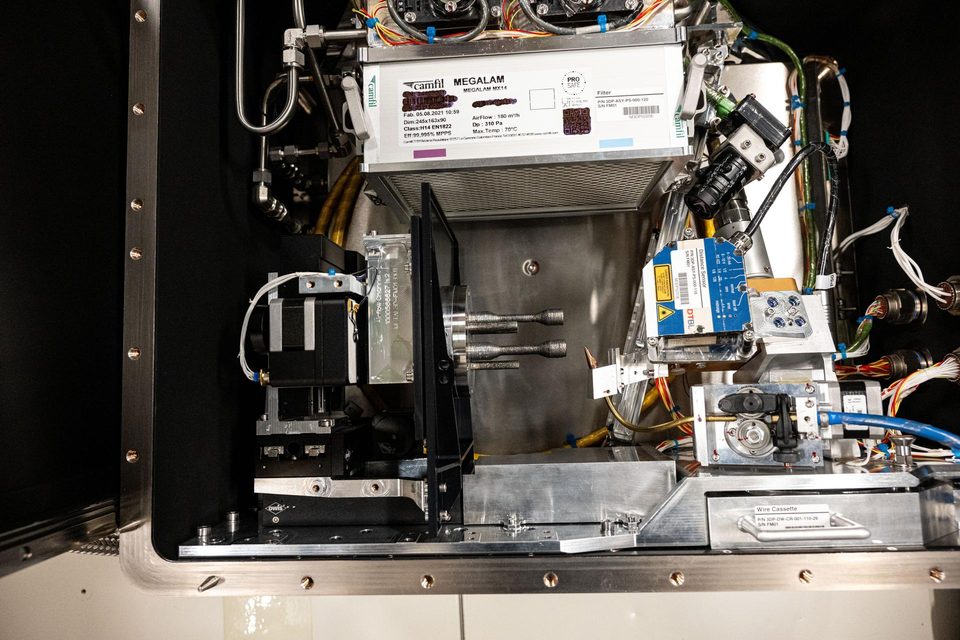
| Tethers Unlimited Refabricator | Recycles plastic and prints in one automated unit, so it closes the material loop that AMF depends on resupply for. It flew as a NASA technology demonstration, not a commercial service. | Installed on ISS Feb 2019 as a technology demonstration |
| NASA Multi-Material Fabrication Laboratory (FabLab) | Planned as a larger station facility that combines metal and polymer printing, machining and inspection. NASA describes its polymer head as based on AMF. It would do far more than AMF, but it is not yet built. | NASA development project; no flight unit announced |
| Launching spares from Earth | The current station approach. It needs no new hardware, but NASA says this maintenance logistics strategy will not work for deep space missions because of the mass of spares it needs. | Standard practice on ISS today |
- official NASA NTRS 20190030402: In-space manufacturing on ISS (2019)
- official NASA NTRS 20190030367: Additive Manufacturing for Human Space Exploration (IEEE SoutheastCon) (Apr 2019)
- official NASA NTRS 20190033503: In-Space Manufacturing technology and material development (2019)
- official Redwire: Additive Manufacturing Facility, 3D printing the future in space (Mar 2019)
- official Redwire: Made In Space celebrates two years printing in space with AMF (Mar 2018)
- official Redwire: Research and manufacturing in microgravity (accessed Nov 2026)
- official Redwire: Team completes successful 3D print for radiation shielding on orbit (Dec 2022)
- official Redwire: Regolith manufacturing technology wins Popular Science award (Dec 2021)
- official NASA Image Library: The Additive Manufacturing Facility aboard the ISS (iss047e152500) (Jun 2016)
- official NASA: Refabricator to recycle, reuse plastic installed on space station (Feb 2019)
- official ESA: ESA 3D prints first metal part on the ISS (Sep 2024)
- wiki Made In Space, Wikipedia (accessed Nov 2026)
- press Space.com: Space station's commercial 3D printer makes its first tool (Jun 2016)
Summary
| System | Manufacturing |
| Phase | 4 |
| Milestones | M12 |
| Readiness | TRL 9 / 9 |
| Plan status | ready to use |
Sources
- NASA NTRS 20190030402: In-space manufacturing on ISS (status and facts)
- Image: NASA
More sources are on each milestone page that uses this technology.