ICON Project Olympus
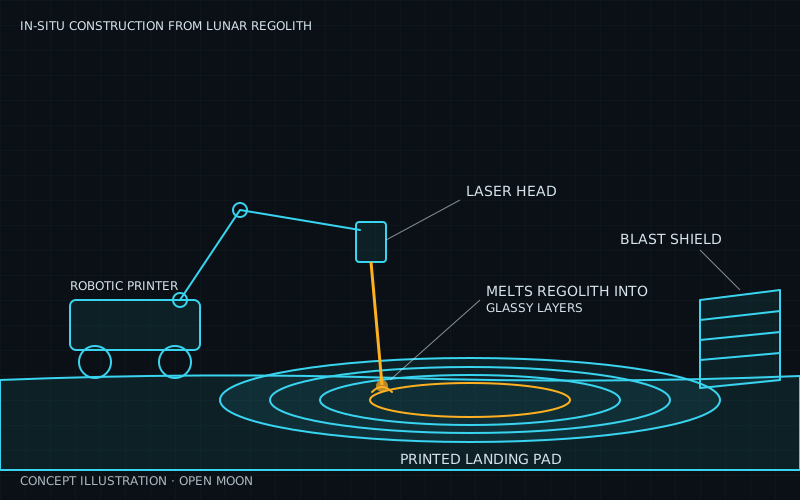
$57.2M NASA SBIR Phase III contract (2022) for landing pads, blast shields and roads
What it is
Project Olympus is ICON’s effort to build a construction system for the Moon that uses local soil (regolith) as its main building material. ICON is an Austin, Texas company known for 3D-printed houses. It launched Olympus in October 2020 with a government SBIR contract that included NASA funding, working with NASA Marshall Space Flight Center. Architecture firms BIG-Bjarke Ingels Group and SEArch+ joined as design partners.
In November 2022 NASA gave ICON a $57.2 million SBIR Phase III contract to keep developing Olympus. ICON says the work will inform construction of landing pads, blast shields and roads, and that the contract’s final deliverable is meant to be the first construction on another world. ICON works inside NASA’s Moon to Mars Planetary Autonomous Construction Technology (MMPACT) project, led from Marshall.
In February 2025, ICON’s Olympus team flew its first space payload, Duneflow, on Blue Origin’s New Shepard. The capsule simulated lunar gravity for about two minutes. No Olympus hardware has yet worked on the Moon.
Why Open Moon uses it
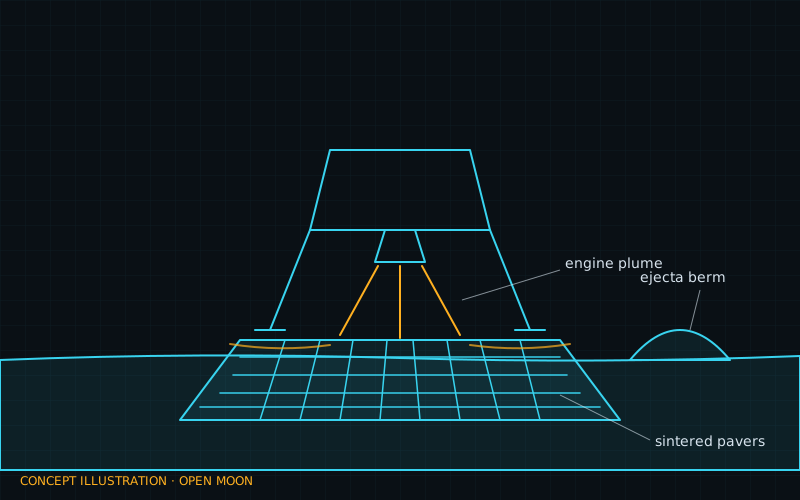
Open Moon needs hard surfaces early. Landing pads, blast shields and roads are part of site preparation in M05, and regolith construction of berms, pads and shells continues in M12 manufacturing. Olympus is the most advanced US-funded system aiming to make these from local material rather than shipped concrete or metal. NASA notes the melted regolith is meant to withstand lunar dust, radiation and temperature extremes.
Without a system like this, landers would keep blasting dust and rock across the site, and every pad would need imported material. The plan would fall back on pavers, blankets or binders shipped from Earth (see alternatives).
How it works
ICON’s process is called Laser Vitreous Material Transformation (VMX). High-powered lasers melt regolith, which then cools into a strong, ceramic-like, glassy solid. A robot lays it down layer by layer. ICON has also tested extruding molten regolith.
In a 2022-2023 NASA landing pad down-select, multi-layer samples were made at 10^-3 torr vacuum and tested for compression at -192 °C and 57 °C, adhesion, thermal cycling and plasma-torch ablation. Only VMX and a cement mortar finished the full test matrix, and NASA judged VMX the best candidate.
| Item | Value |
|---|---|
| Process | Laser melting of 100% regolith (VMX) |
| Vacuum sample tests | Succeeded with simulant (NASA, 2022) |
| Example sample | 1.3 kg laser-melted simulant, “size of a soda can” (NASA, 2022) |
| NASA funding | $57.2M SBIR Phase III (ICON, 2022) |
| Laser power, build rate, robot mass | Not published |
Duneflow supports the work by measuring how regolith simulants flow through orifices and down slopes in lunar gravity, to improve the simulants used to test excavation and construction robots on Earth.
Limitations and open issues
- No lunar test yet. MMPACT’s first demonstration mission (DM-1) was meant to build small horizontal and vertical “proof of concept” pieces from a lander. A 2021 plan dated it 2026; a 2024 NASA roadmap starts at 2027. No flight date is announced in the sources here.
- Key numbers unpublished. Laser power, energy per square metre, print speed and system mass are not public, so power and delivery needs cannot be sized from data.
- Simulant gap. Ground tests use simulants. NASA’s own requirements include validating that Earth testing is a good enough analog for lunar operations.
- Material refinement. NASA listed refinement of VMX material properties and pad design optimization as upcoming work.
- Autonomy and dust. MMPACT requires autonomous and remote operation on the surface; this has not been shown on the Moon.
- Single-supplier risk. The plan leans on one company’s proprietary process. Pavers and other in-situ methods are backups.
| Alternative | How it compares | Status |
|---|---|---|
| Sintered basalt pavers and regolith-filled blankets (NASA LPAD) | Prefabricated or simple pad surfaces rather than a large printing robot. Simpler to place, but pavers may need to be made on Earth or by a separate kiln, and coverage per kilogram shipped is lower. | Hot-fire tested on the ground at NASA Kennedy with SpaceX under the LPAD project |
| Molten regolith tiles (Astroport / NASA Marshall) | Melts regolith in a furnace and casts tiles to lay as paving, instead of melting the ground in place with a laser. Tiles can be inspected before use, but need a bricklaying robot. | Listed among MMPACT candidate materials; not chosen in the 2022-2023 landing pad down-select |
| Solar sintering (EU RegoLight, DLR) | Uses concentrated sunlight instead of electric lasers, so it needs no consumables and less electrical power, but only works in sunlight and builds slowly. | Lab bricks made in a solar furnace; the project described itself as TRL 3 at the start |
| Binder-jet printing (ESA / Foster + Partners, D-Shape) | Sprays a binding salt onto regolith mixed with magnesium oxide. Lower energy than melting, but the binder chemicals must be shipped from Earth and liquids must be protected from vacuum. | 1.5-tonne demonstration block printed on Earth with simulant (2013) |
| Contour Crafting (USC / Khoshnevis) | Extrudes regolith with a binder from a nozzle, layer by layer, like ICON's Earth printers. Good for walls and pads, but depends on binders and has no flight hardware. | NIAC-funded concept and Earth prototypes |
- official ICON: ICON to develop lunar surface construction system with $57.2 million NASA award (Nov 2022)
- official ICON: ICON receives funding from NASA and launches Project Olympus (Oct 2020)
- official ICON: Project Duneflow completes successful space flight with Blue Origin (Feb 2025)
- official NASA: NASA enables construction technology for Moon and Mars exploration (Jun 2026)
- official NASA Flight Opportunities: Lunar gravity simulation via suborbital rocket (Feb 2025)
- official NASA NTRS: MMPACT, ISRU technology review (Edmunson) (Aug 2022)
- official NASA NTRS: MMPACT material screening poster (landing pad down-select) (2023)
- official NASA NTRS: MMPACT presentation to JAXA (Apr 2024)
- paper NASA NTRS: MMPACT, ASCEND 2021 planetary construction technologies (Nov 2021)
- official NASA: NASA tests landing pad materials for future lunar missions ()
- wiki Lunar regolith simulant, Wikipedia (accessed Nov 2026)
- wiki In situ resource utilization, Wikipedia (accessed Nov 2026)
Site preparation, landing pads and roads
2028–2032PH 4M12Manufacturing and construction from regolith
2037–2044
Summary
| System | Construction |
| Phase | 1, 4 |
| Milestones | M05, M12 |
| Readiness | TRL 4 / 9 |
| Plan status | needs development |
Sources
- ICON: ICON to develop lunar surface construction system with $57.2M NASA award (status and facts)
- Reference for the illustration
More sources are on each milestone page that uses this technology.