Sintered basalt pavers / regolith-polymer pads
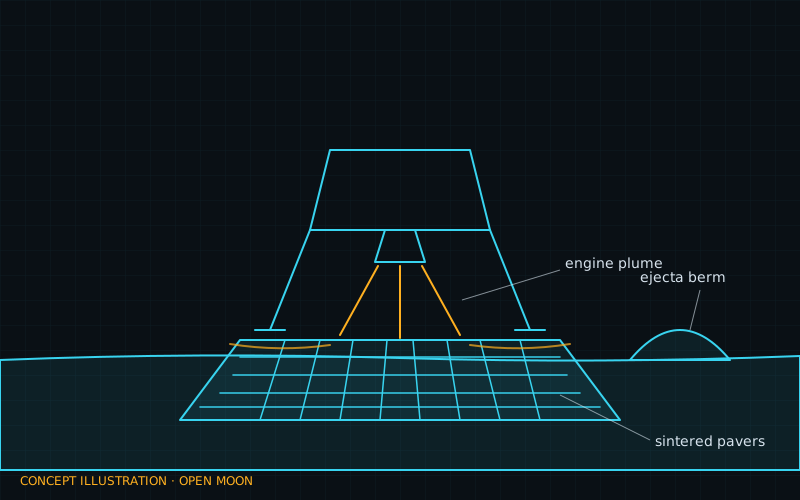
Hot-fire tested on the ground by NASA KSC
What it is
This is a family of landing-pad surfaces made mostly from local rock dust. One version uses sintered basalt pavers: tiles made by heating basalt grains until they fuse, without fully melting them (Wikipedia). The other uses regolith-polymer pads: regolith bound with a silicone rubber (RTV) that cures at room temperature. The two can be combined, with polymer grout filling the seams between sintered pavers (NASA NTRS).
The paver idea was first tried at full scale in Hawaii. The Pacific International Space Center for Exploration Systems (PISCES) and NASA Kennedy’s Swamp Works planned a 9 m² pad of basalt pavers in 2015 (PISCES). The Helelani rover placed the pavers; about 100 were needed (PISCES). In March 2016 a four-second rocket burn on the pad displaced some of the interlocking pavers (PISCES).
In 2020-2021 NASA Kennedy’s “LPAD” project, a partnership with SpaceX, hot-fire tested pad materials with Masten Space Systems in the Mojave Desert (NASA). Fifteen tests were run. Grouted sintered basalt pavers and polymer-regolith materials were among the most promising (NASA NTRS). Nothing has yet been built or tested on the Moon.
Why Open Moon uses it
Rocket exhaust on bare regolith throws particles at over 2,000 m/s for kilometres (NASA NTRS). Apollo 12 sandblasted the Surveyor 3 probe from about 180 m away (ESA). Artemis-class landers have more thrust, so the risk to nearby equipment is larger (NASA NTRS).
Milestone M05 (site preparation) needs at least two hardened pads before regular cargo and crew landings. Sintered pavers are the main option there; a regolith-polymer pad is the fallback. Without a pad, every landing would sandblast the solar towers, reactor and habitats, and the base would have to spread out much further.
How it works
Sintered pavers. Basalt fines are heated in moulds into tiles. PISCES reports sintered basalt is stronger than commercial concrete, but the process needs a lot of power (PISCES). Tiles interlock, and the seams can be grouted. A PISCES tile held up well against a Masten plume at about 25% of the Apollo landing heat flux (PISCES).
Regolith-polymer pads. Regolith simulant is mixed with RTV-655 silicone. No bulk heating is needed and mineralogy matters little. A twin-screw extruder mixed and laid the material at up to 90% regolith by mass (NASA NTRS).
| Item | Value | Source |
|---|---|---|
| Test engine | 444 N gaseous O₂/CH₄, 2 s burns | NTRS |
| Engine height (2021 campaign) | 1.02 m descending to 0.6 m | NTRS |
| Polymer pavers tested | 20% and 11% RTV by mass | NTRS |
| Sintered paver test article | Nine ~30 cm tiles, 3x3, ~1.3 cm grouted gaps | NTRS |
| Lowest RTV that consolidated | 9% by mass | NTRS |
| RTV for 100 m pad, 25 mm thick | 70 t | NTRS |
| RTV for 15 m pad, 50 mm thick | 3 t | NTRS |
In the 2021 dynamic tests, the polymer pavers and the grouted sintered pavers showed heat scarring but little to no erosion. All test articles stopped regolith ejecta (NASA NTRS).
Limitations and open issues
- Low readiness. In 2022 the KSC team put pad construction as a whole at about TRL 2-3. It recommended work towards TRL 6 for a small lunar demo (NASA NTRS).
- Small engines only. Tests used a 444 N engine in Earth’s atmosphere. NASA notes this plume is not representative of lunar vacuum (NASA NTRS).
- Imported binder mass. RTV cannot be made on the Moon. A 200 m pad would need 282 t, more than one Starship load (NASA NTRS).
- Lunar environment untested. Thermal cycling, radiation and vacuum effects on the polymer have not been measured (NASA NTRS).
- Erosion and displacement. A 20% RTV paver eroded a 3.07 cm by 3.2 cm cavity under a close static plume (NASA NTRS). Pavers moved in the 2016 Hawaii test (PISCES).
- Sintering power. Sintering takes a lot of energy, and scaling tiles up is hard (PISCES). No published figure gives energy per square metre of lunar pad.
- Robotic laying. Pavers have only been laid by a rover on Earth (PISCES). Autonomous construction on the Moon is unproven.
| Alternative | How it compares | Status |
|---|---|---|
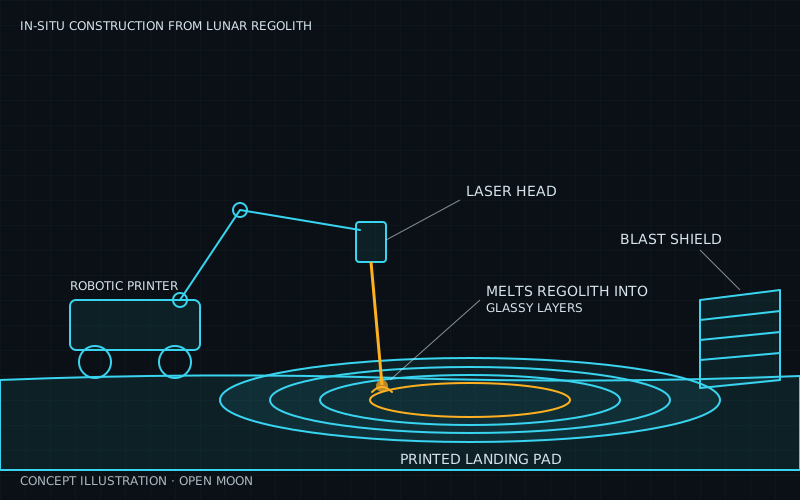
| ICON Project Olympus (laser vitreous transformation) | A robot melts regolith in place with high-power lasers to form a continuous ceramic-like surface. No pavers to make and lay and no binder shipped from Earth, but it needs a lot of power and the process is less mature than simple pavers. | In development under a $57.2M NASA SBIR Phase III contract (2022); regolith experiment flown on a suborbital rocket in Feb 2025 |
| ESA PAVER concentrated-sunlight melting | A large lens focuses sunlight to melt regolith into interlocking glassy tiles on the ground. It uses free solar energy and no imported binder, but it is slow and reheated tracks can crack. | Lab study with a 12 kW laser standing in for sunlight; results published 2023 |
| Masten FAST in-flight alumina spray | The lander sprays alumina pellets through its own engine plume seconds before touchdown, laying a pad without any earlier construction mission. Every landing has to carry hundreds of kilograms of pad material. | NASA NIAC concept study (2020); not flown |
| Anorthosite rock gabions and carbon-fibre blankets | Loose rock in wire cages, or layered carbon-fibre textile, laid on the surface. Simple and quick to place, but blankets wore in tests and regolith-filled fibre bags failed. | Hot-fire tested by NASA KSC with Masten in 2020-2021 alongside pavers |
| Unprepared regolith with distance and berms | Land on bare ground and keep other equipment far away or behind regolith berms. Needs no construction, but does nothing about cratering, surface levelness or ejecta from larger landers. | Current practice for every lunar landing to date |
- official NASA: NASA tests landing pad materials for future lunar missions (Oct 2021)
- paper NASA NTRS: In-situ lunar launch and landing pad construction with regolith-thermoset polymer composite materials (Gelino et al.) (Jan 2022)
- paper NASA NTRS: Advanced materials testing for lunar landing and launch pad construction (Mueller et al.) (Aug 2021)
- paper NASA NTRS: Large vehicle lunar landing surface interaction and in-situ resource based risk mitigation (ASCEND 2021) (Mar 2021)
- paper NASA NTRS: Lunar landing and launch pad construction - concepts and criteria (Gelino et al.) (Sep 2020)
- official PISCES: PISCES launches robotic space construction project (Jun 2015)
- official PISCES: Scientists make headway at lunar landing pad site (Dec 2015)
- official PISCES: Rocket engine firing test - mission complete (Mar 2016)
- official PISCES: Masten Space Systems - preparing for a long-term presence on the Moon (Jun 2020)
- official PISCES: New composite material could make manufacturing on the Moon and Mars more efficient (Dec 2021)
- official ESA: How to make roads on the Moon (PAVER project) (Oct 2023)
- paper Gines-Palomares et al.: Laser melting manufacturing of large elements of lunar regolith simulant for paving on the Moon (Scientific Reports) (Oct 2023)
- official NASA: NASA enables construction technology for Moon and Mars exploration (May 2025)
- wiki Wikipedia: Sintering ()
- press IEEE Spectrum: NASA funds project for spacecraft that make their own landing pads (Masten FAST) (Apr 2020)
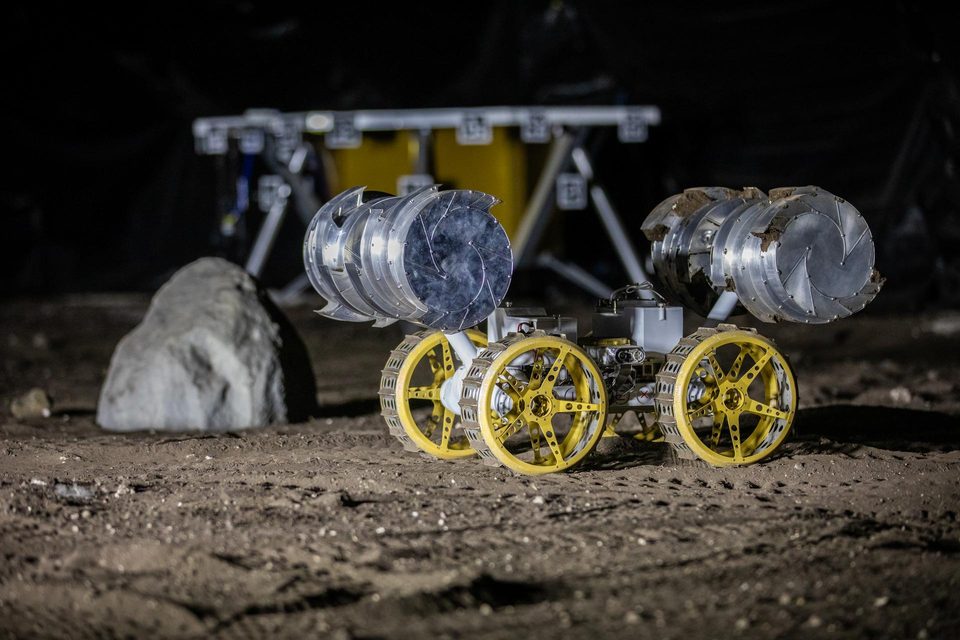
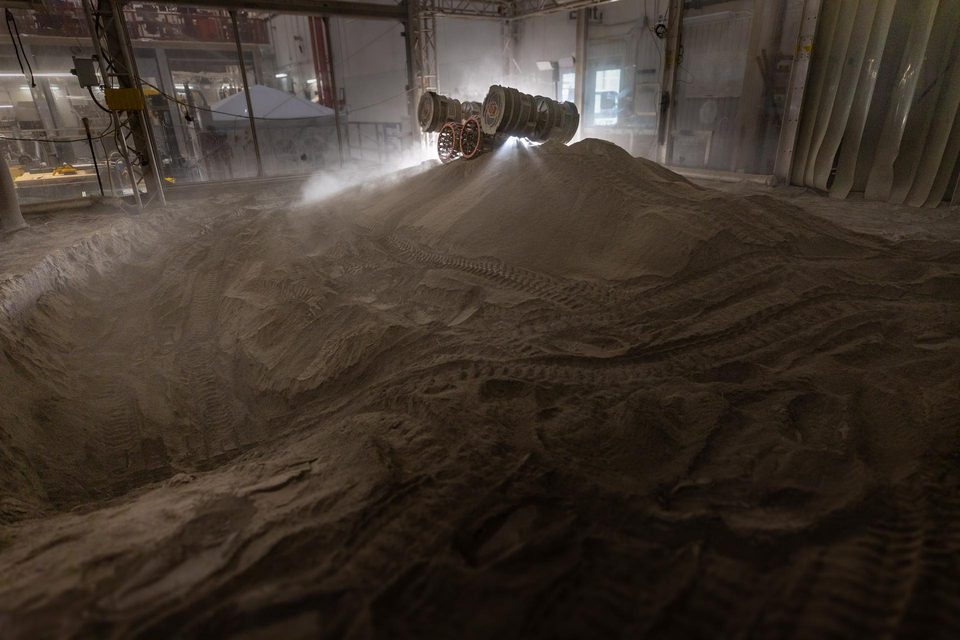
Summary
| System | Construction |
| Phase | 1 |
| Milestones | M05 |
| Readiness | TRL 4 / 9 |
| Plan status | needs development |
Sources
- NASA: NASA tests landing pad materials for future lunar missions (status and facts)
- Reference for the illustration
More sources are on each milestone page that uses this technology.