SSTL Lunar Pathfinder
In final testing; launch NET 2027 on Blue Ghost M2
What it is
Lunar Pathfinder is a communications relay satellite for lunar orbit. It is built by Surrey Satellite Technology Ltd (SSTL) in the UK and is ESA’s first lunar communications relay satellite, developed as a commercial partnership. It will pass data between Earth and spacecraft on and around the Moon. SSTL sells the service under its “SSTL Lunar” brand to both commercial and agency customers (SSTL service guide). It is also the first element of ESA’s Moonlight communications and navigation service.
The project started in April 2018, when ESA, SSTL and Goonhilly Earth Station signed a collaboration agreement for commercial lunar services. By October 2019 it was in a pilot phase. In March 2023 Firefly Aerospace won the NASA CLPS task to carry it to lunar orbit. Under a barter agreement, NASA pays for the ride and gets access to the relay service in return.
The schedule has slipped several times. The 2022 service guide expected launch at the end of Q4 2024, and ESA’s 2024 Moonlight page said operations would begin in 2026. As of October 2026 the satellite was in its final environmental test campaign in the UK, with launch planned for 2027 on a Falcon 9 as part of Blue Ghost Mission 2. ESA says ten international user missions already plan to use it.
Why Open Moon uses it
Milestone M03 (communications and navigation) needs a reliable link to Earth. Open Moon’s approach is to buy relay service rather than build a constellation. Lunar Pathfinder is one of the services on that list, next to NASA’s commercial relay network and ESA Moonlight.
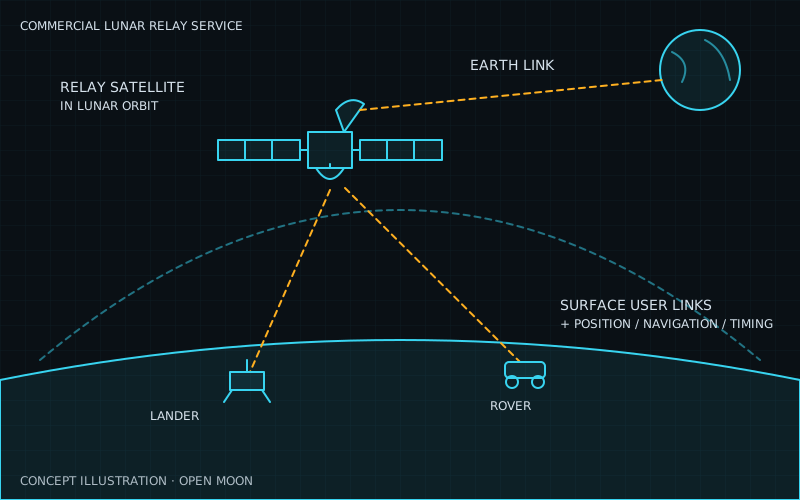
A relay matters because the base will not always see Earth. SSTL notes that far-side assets cannot reach Earth at all without a relay, and polar sites may have only limited direct-to-Earth visibility because of terrain. A relay also lets rovers leave their lander’s line of sight and keep working after the lander dies. Its orbit is designed to favour the lunar south polar region, where Open Moon plans to build.
A relay also eases the load on Earth’s ground stations. NASA’s Deep Space Network already sees demand exceed supply by about 40% at times. Without relays, the early robotic missions would be tied to short direct-to-Earth windows, and far-side or shadowed sites would be out of reach. As the first relay due to arrive, Pathfinder is Open Moon’s earliest chance of a second, independent Earth link.
How it works
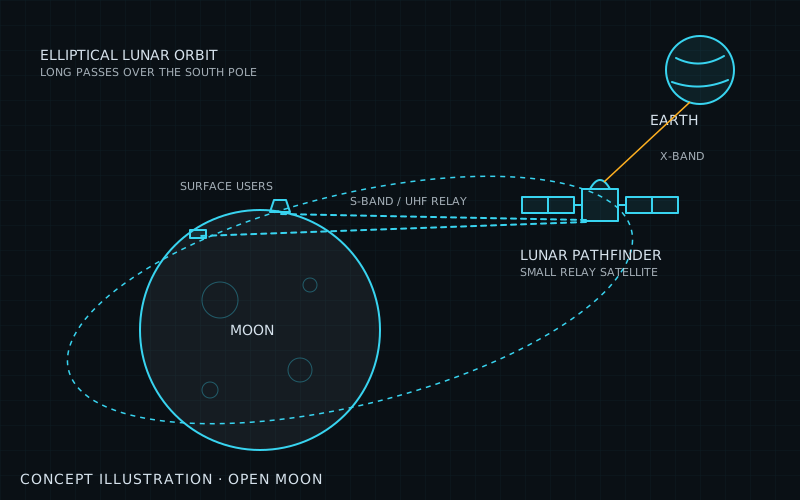
Pathfinder flies in an Elliptical Lunar Frozen Orbit (ELFO). This orbit stays stable over time and gives long daily passes over the southern hemisphere, including the far side. Firefly’s Elytra transfer vehicle will release it into this orbit.
User spacecraft talk to Pathfinder over short-range S-band or UHF links using the CCSDS Proximity-1 protocol. Pathfinder can run one S-band and one UHF channel at the same time, then relays the data to Earth in X-band. Data rate adjusts during a pass as signal strength changes. Ground stations in the guide include Goonhilly, an Indian DSN antenna and Kongsberg Satellite Services. Users can buy an autonomous daily data volume, scheduled contacts, or a priority emergency service.
| Item | Value |
|---|---|
| Orbit (baseline) | 673 x 7,331 km altitude, 54.9° inclination, eccentricity 0.58 |
| Moon links | S-band (2025-2110 MHz up, 2200-2290 MHz down) and UHF (390-405 / 435-450 MHz), 0.5 kbps to 2 Mbps depending on user |
| Earth link | X-band, up to 30 kbps uplink, up to 5 Mbps downlink |
| Design life | About 8 years |
| Power | Two deployable solar arrays and batteries |
| Mass | No current figure published |
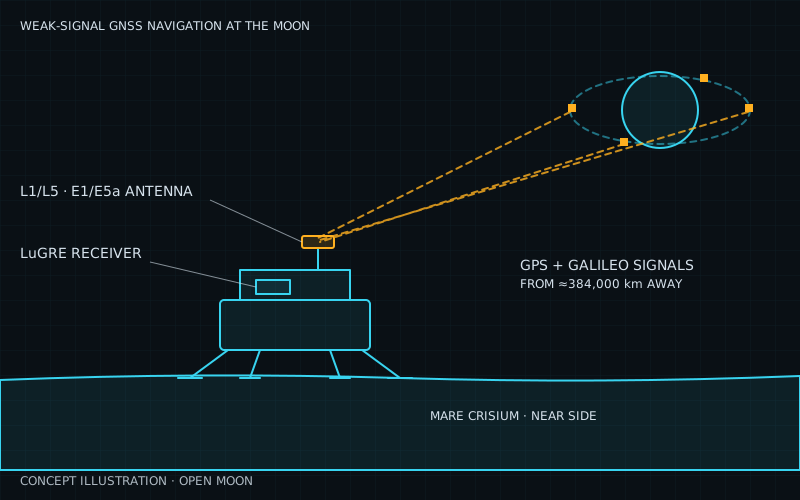
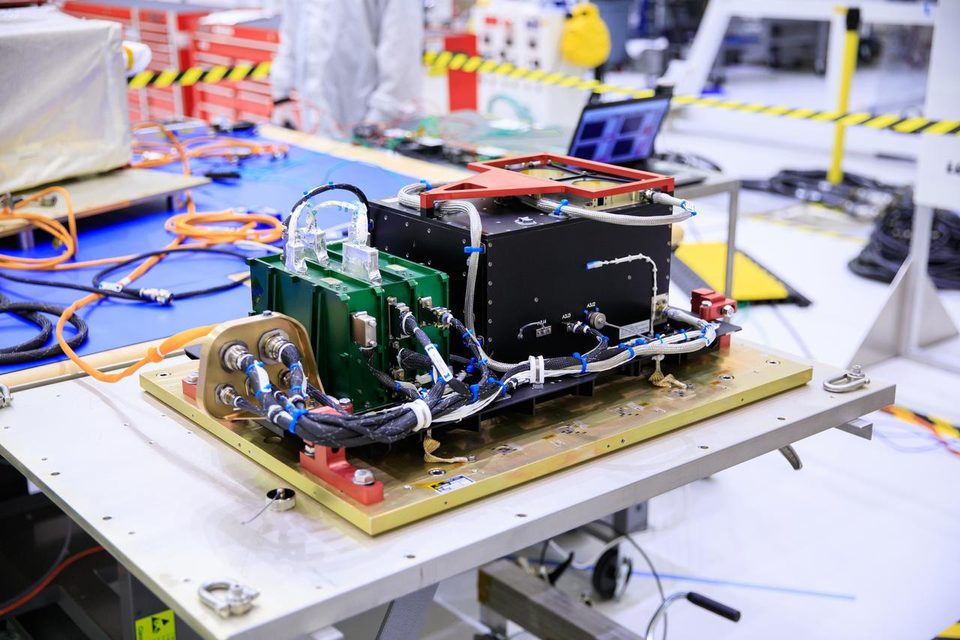
It also carries four experiments: the RADMON radiation monitor, a GNSS receiver to test GPS/Galileo use at the Moon, a NASA laser retroreflector and an X-band ranging transponder. A JPL User Terminal landing on Blue Ghost will be used to commission the relay, and NASA’s LuSEE-Night radio telescope will be one of its first users.
Limitations and open issues
- Not yet flown. It is still in testing. Launch has slipped from late 2024 to 2027, and it now depends on Blue Ghost Mission 2 and the Elytra vehicle working.
- One satellite only. In the northern hemisphere, some sites will see gaps in coverage of several days on a 28-day cycle. There is no spare if it fails.
- Modest capacity. The Earth downlink is at most 5 Mbps and is shared by all users. That is enough for robots, not for live HD video from a crewed base.
- Published figures differ. The 2022 guide lists S-band and UHF links, while an ESA partner page describes two S-band links. The orbit values are marked as indicative. Final numbers should be confirmed with SSTL.
- Pricing is not public. ESA lists the starting price as “upon request”.
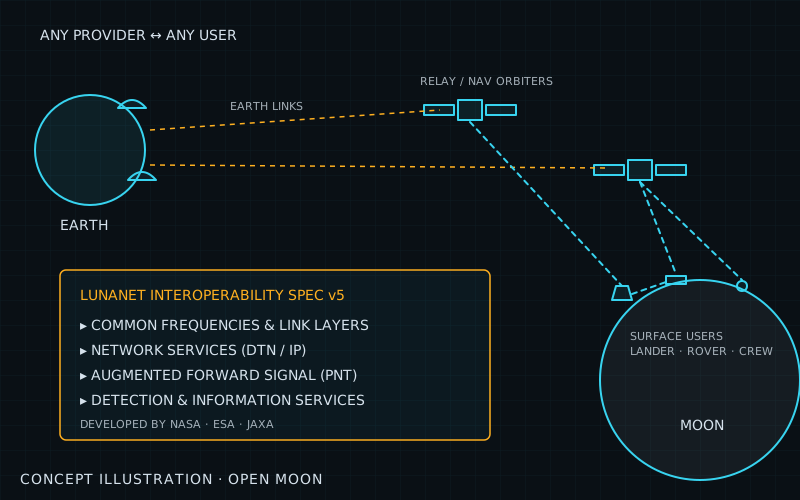
- Interoperability. Open Moon radios must speak Proximity-1 on Pathfinder’s frequencies. How it fits the shared LunaNet standard with Moonlight and NASA relays still has to be shown in orbit.
| Alternative | How it compares | Status |
|---|---|---|
| NASA commercial lunar relay (Intuitive Machines) | A planned network of five relay satellites under a NASA Near Space Network contract, so it should give much more coverage than one Pathfinder. Its [first relay was due to fly with IM-3](https://www.collectspace.com/news/news-040626a-artemis-ii-moon-flyby-video-intuitive-machines-lunar-relays.html), and like Pathfinder it has not yet operated at the Moon. | Contract with a maximum potential value of $4.82B (Sep 2024); first relay planned to launch with IM-3 |
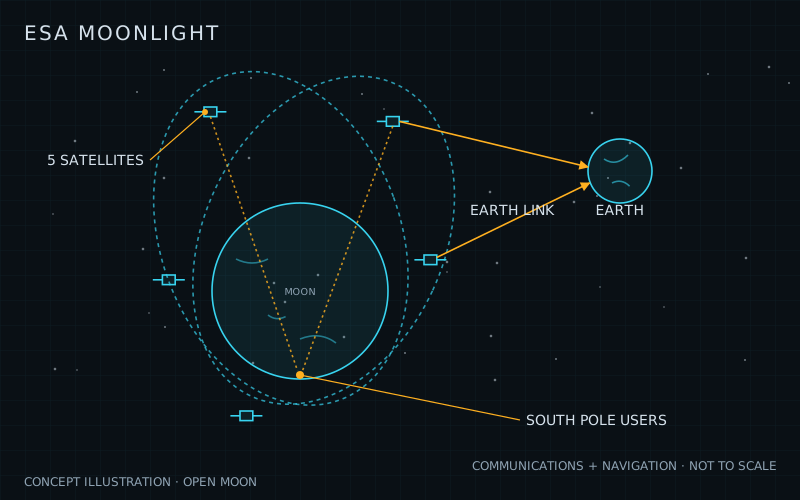
| ESA Moonlight | Pathfinder's successor: five satellites, one for high-rate communications and four for navigation. It adds lunar navigation and more capacity, but arrives later and is still in development. | Initial operations planned by end of 2028, full operations by 2030 |
| Queqiao-2 (CNSA) | A Chinese relay in an elliptical frozen lunar orbit, the same kind of orbit Pathfinder will use. It is already working and much larger (about 1,200 kg dry), but it mainly serves the Chang'e programme and its use by Western missions is not established. | Operating in lunar orbit since March 2024; planned life 8-10 years |
| Direct-to-Earth links via the Deep Space Network or commercial ground stations | No relay needed when Earth is above the horizon, but it does not work on the far side or in terrain that blocks Earth, and NASA's Deep Space Network is already oversubscribed. | Mature; DSN demand exceeds supply by about 40% at times (OIG, 2023) |
- official ESA: Lunar Pathfinder, Europe's first step towards a connected Moon (Oct 2026)
- official SSTL: Lunar Mission Services and Lunar Pathfinder (accessed Nov 2026)
- data SSTL: Lunar Pathfinder Service Guide (user manual, issue V004) (Aug 2022)
- official ESA Business in Space Growth Network: Lunar Pathfinder service (accessed Nov 2026)
- official ESA: Firefly to take Lunar Pathfinder to the Moon (Mar 2023)
- official SSTL: Firefly to take Lunar Pathfinder to the Moon (Mar 2023)
- official ESA: ESA signs collaboration agreement for commercial lunar missions (Apr 2018)
- official ESA: A pathway for communicating at the Moon (Oct 2019)
- official NASA: CLPS flight, Firefly Aerospace's Blue Ghost Mission 2 (Oct 2026)
- official ESA: Moonlight programme (Oct 2024)
- official NASA OIG IG-23-016: NASA's Deep Space Network (Jul 2023)
- press collectSPACE: Intuitive Machines lunar relays and IM-3 (Apr 2026)
- data NASA: LunaNet Interoperability Specification (Feb 2025)
- wiki Lunar Pathfinder, Wikipedia (accessed Nov 2026)
- wiki Blue Ghost Mission 2, Wikipedia (accessed Nov 2026)
- data Gunter's Space Page: Lunar Pathfinder (Jun 2025)
Summary
| System | Communications and navigation |
| Phase | 1 |
| Milestones | M03 |
| Readiness | TRL 7 / 9 |
| Plan status | ready to use |
Sources
- Lunar Pathfinder, Wikipedia (status and facts)
- Reference for the illustration
More sources are on each milestone page that uses this technology.