ESA Moonlight
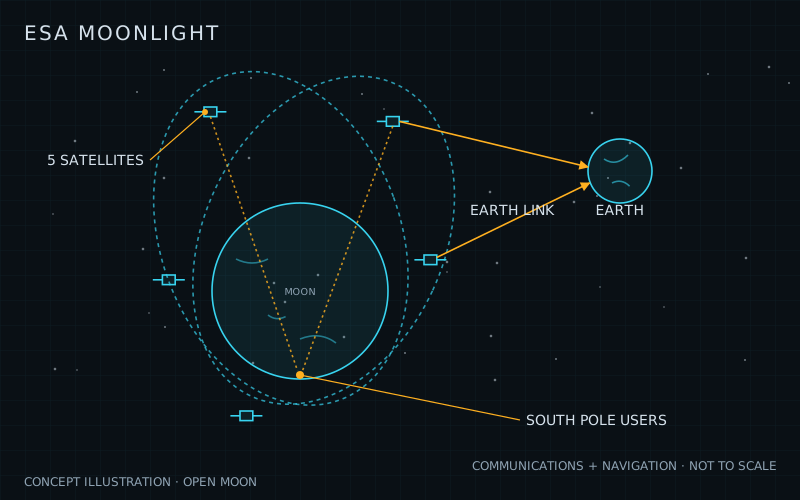
5 satellites; initial operations by end 2028, full operations by 2030
What it is
Moonlight, formally the Lunar Communications and Navigation Services (LCNS) programme, is ESA’s plan for Europe’s first dedicated satellite constellation for communications and navigation at the Moon. It is a partnership between ESA and an industry consortium led by Telespazio, with support from the UK and Italian space agencies (ESA). The constellation will have five satellites: one for high data rate communications and four for navigation, linked to Earth through three dedicated ground stations (ESA).
The idea grew from a 2018 agreement with SSTL and Goonhilly on commercial lunar services, a 2020 call for industry interest and the formal Moonlight initiative announcement in May 2021 (Wikipedia). ESA started the programme on 15 October 2024 at the International Astronautical Congress in Milan, where Telespazio signed a EUR 123 million contract (Telespazio). In March 2025 Viasat was chosen to lead the communications part, including the Earth ground infrastructure and surface user terminals (Viasat). At the November 2025 ministerial council, member states subscribed EUR 176 million to Moonlight (ESA CSC).
ESA’s stated schedule is initial operations by the end of 2028 and full operations by 2030, with the first lunar navigation interoperability tests planned for 2029 (ESA). No Moonlight satellite has launched yet (Wikipedia).
Why Open Moon uses it
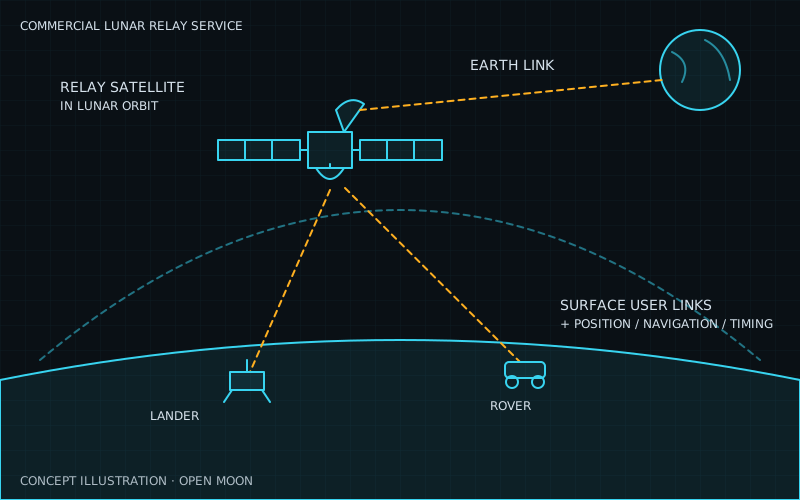
Open Moon’s base sits near the lunar south pole, and Moonlight’s orbits are chosen to give priority coverage to exactly that region (ESA). It serves two jobs in milestone M03 (communications and navigation): a relay link to Earth when Earth is below the horizon, and a local positioning and timing service for landers, rovers and crews. ESA says the service is meant to enable precise autonomous landings and surface mobility (ESA).
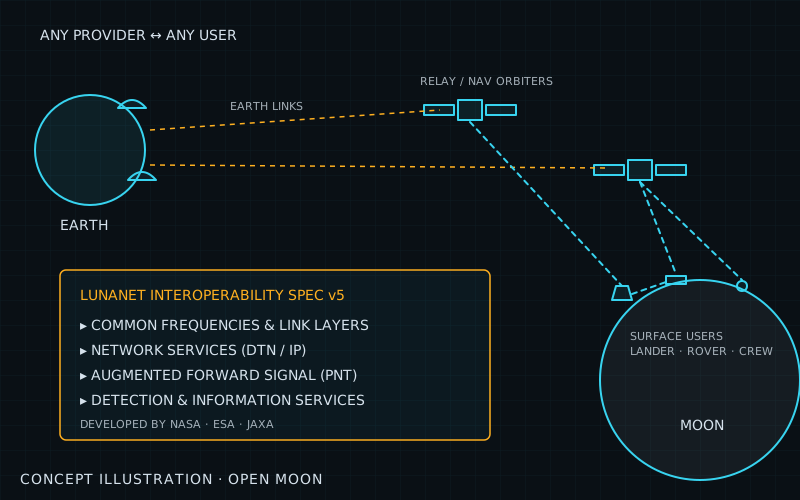
Open Moon buys relay service rather than building its own constellation, and it plans to use at least two networks. Moonlight will follow the LunaNet standards that ESA is developing with NASA and JAXA (ESA; NASA). That means one radio design at the base should work with Moonlight and with NASA’s commercial relay. Without Moonlight, the base would depend on a single relay provider or on direct-to-Earth links, and it would lose an independent navigation service.
How it works
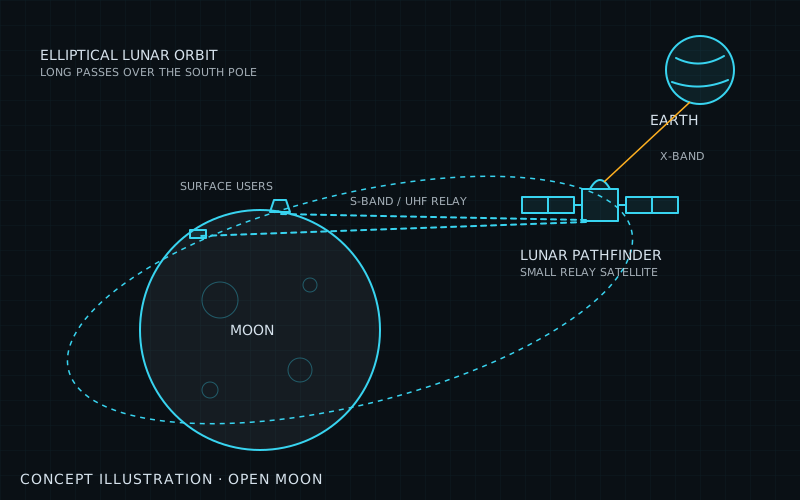
The system has three segments: satellites in lunar orbit providing communication, navigation and time synchronisation; an Earth ground segment of control stations; and a user segment of terminals (Telespazio). The satellites fly in elliptical lunar frozen orbits (ELFOs), which keep their eccentricity, inclination and argument of pericentre constant, so they spend long periods high above the south pole (Telespazio fact sheet). The navigation satellites broadcast GNSS-like ranging signals, much like Galileo does on Earth (ESA ICG-17). Deployment happens in two phases (Telespazio), and ispace may provide transfer to lunar orbit (Telespazio).
| Parameter | Value |
|---|---|
| Satellites | 5 (1 communications, 4 navigation) (ESA) |
| Mass per satellite | 400-600 kg (Telespazio) |
| Orbits | COMSAT ~12 h period, ~6,000 km semi-major axis; NAVSATs ~24 h, ~10,000 km (Wikipedia) |
| Earth ground stations | 3 (ESA) |
| Surface positioning | Up to 3 m precision (ESA CSC) |
| High-rate link (2023 target) | K-band, up to 200 Mbps per user (ESA ICG-17) |
| Low-rate link (2023 target) | S-band, up to 1 Mbps per user (ESA ICG-17) |
| Position accuracy, 95% (2023 target) | Orbiters 100 m, landing 50 m, surface 10 m, 3 m after post-processing (ESA ICG-17) |
| Timing, 95% (2023 target) | 100 ns (ESA ICG-17) |
In a 2023 example design, a four-satellite navigation constellation gave at least 15 hours of continuous navigation service at the south pole every 24 hours (ESA ICG-17). ESA has not published final per-user data rates or coverage figures for the contracted system.
Limitations and open issues
- Not yet built or flown. No Moonlight satellite has launched; the first launch is planned for 2028 (Wikipedia).
- Precursor delay. In 2024 ESA said Lunar Pathfinder would begin operations in 2026 (ESA). It is now set to launch no earlier than 2027 on Blue Ghost Mission 2 (Wikipedia). ESA has not said whether this affects the 2028 date.
- Partial navigation coverage at first. Four navigation satellites in the 2023 example gave about 15 hours of continuous service per day at the south pole, not 24 (ESA ICG-17). How the two-phase deployment splits the satellites, and what coverage exists at initial operations, is not published.
- Funding is staged. The EUR 176 million subscribed at CM25 covers the next phase (ESA CSC); a total programme cost and service prices for users are not published.
- Standards still maturing. Interoperability depends on the LunaNet Interoperability Specification, which ESA and NASA have been updating with industry feedback (ESA), and on an agreed lunar time reference that ESA says still needs to be defined (ESA). The first interoperability tests are not due until 2029 (ESA).
- Launch and transfer not settled. ESA describes delivery by space tug (ESA); the ispace agreement is only a letter of intent (Telespazio).
- More background. ESA’s short explainer video gives an overview of the initiative (ESA video), and the ESA Moonlight page collects news.
| Alternative | How it compares | Status |
|---|---|---|
| NASA commercial lunar relay (Intuitive Machines) | A US relay network bought as a service under NASA's Near Space Network, also aimed at the south pole and also offering navigation support. Larger contract value and Artemis as anchor customer, but no navigation-dedicated constellation like Moonlight's four NAVSATs. | Contract with a maximum potential value of $4.82B, base period Oct 2024 to Sep 2029 |
| SSTL Lunar Pathfinder | A single commercial relay satellite and the precursor to Moonlight. Available sooner and simpler, but one spacecraft gives only part-time coverage and no lunar navigation service of its own. | Final environmental testing in the UK (Oct 2026); launch NET 2027 on Firefly Blue Ghost Mission 2 |
| Queqiao-2 (CNSA) | A Chinese relay in an elliptical frozen lunar orbit that is already working. Proven in service, but it supports China's own lunar programme and is not a LunaNet commercial service open to Open Moon. | Operating in lunar orbit since March 2024 |
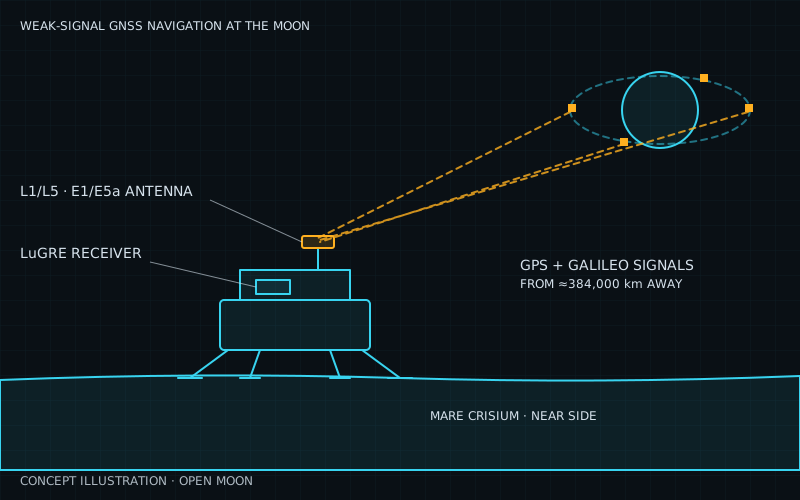
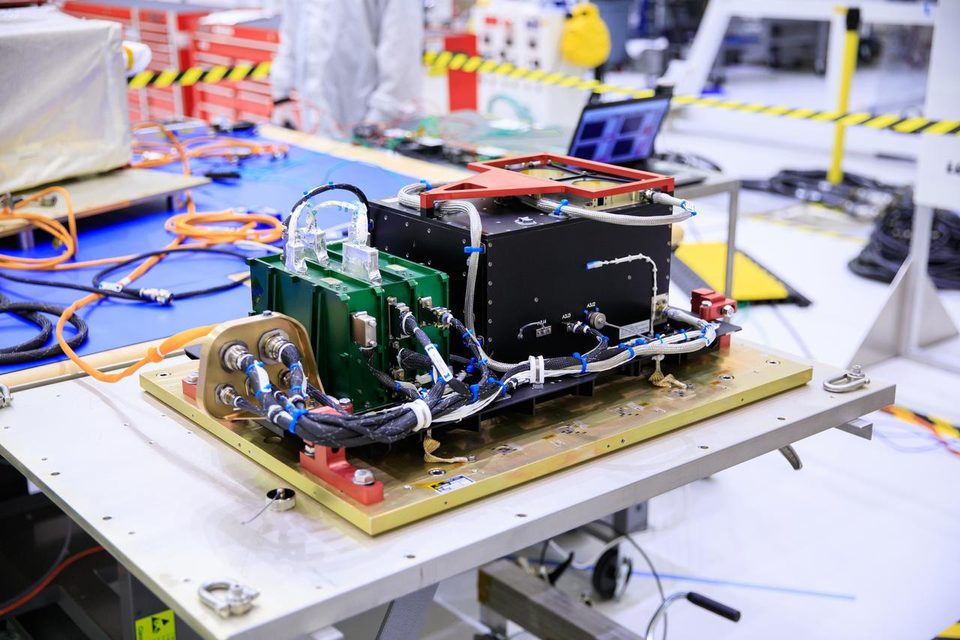
| Weak-signal GPS/Galileo reception (LuGRE-type receiver) | Uses Earth's own navigation satellites from the Moon, so no new constellation is needed. Accuracy and availability are far lower than a dedicated lunar system and it gives no communications. | LuGRE got a navigation fix on the lunar surface on 3 Mar 2025 |
| Direct-to-Earth via ground station networks (ESTRACK/DSN) | The base talks straight to big antennas on Earth. No relay to buy, but NASA notes that south pole landing sites often lack direct contact with Earth ground stations, and it gives no local positioning. | Operational today |
- official ESA: Moonlight programme, pioneering the path for lunar exploration (Oct 2024)
- official ESA: Moonlight programme page (accessed Nov 2026)
- official ESA Connectivity and Secure Communications: Moonlight programme features (accessed Nov 2026)
- official ESA CSC: Programmes receive EUR 2.1 billion at CM25 (Moonlight subscriptions EUR 176 million) (Dec 2025)
- official Telespazio: EUR 123 million contract with ESA for the Moonlight programme (Oct 2024)
- official Telespazio: Moonlight LCNS fact sheet (Sep 2026)
- official Viasat: Viasat selected to design lunar orbiting satellite system alongside Telespazio (Mar 2025)
- official Telespazio: Letter of intent with ispace on lunar transfer for Moonlight (Sep 2025)
- data ESA Moonlight team: Lunar Pathfinder and Moonlight navigation services, UN ICG-17 presentation (Oct 2023)
- data NASA: LunaNet Interoperability Specification (accessed Nov 2026)
- official ESA: Telling time on the Moon (Feb 2023)
- wiki Moonlight Programme, Wikipedia (accessed Nov 2026)
- wiki Lunar Pathfinder, Wikipedia (accessed Nov 2026)
- video ESA video: What is ESA's Moonlight initiative? (Nov 2022)
Summary
| System | Communications and navigation |
| Phase | 1 |
| Milestones | M03 |
| Readiness | TRL 6 / 9 |
| Plan status | ready to use |
Sources
- ESA: Moonlight programme (status and facts)
- Reference for the illustration
More sources are on each milestone page that uses this technology.