LunaNet Interoperability Specification v5
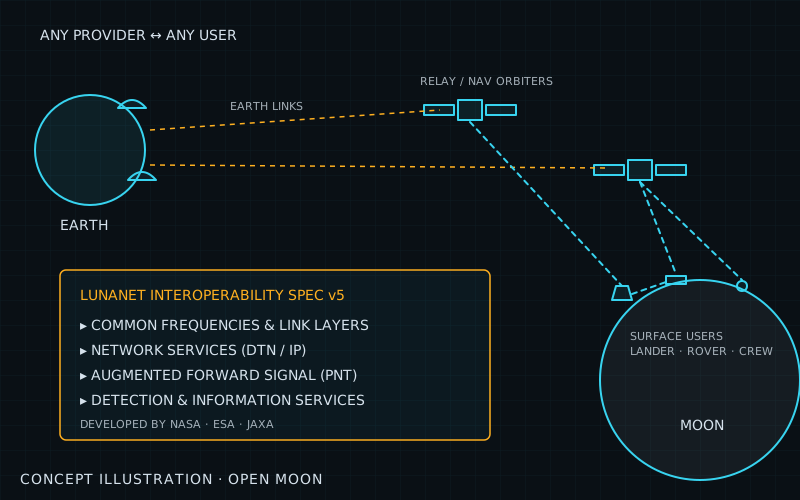
Version 5 published Feb 2025; developed by NASA, ESA, JAXA
What it is
The LunaNet Interoperability Specification (LNIS) is a set of shared rules for radio links, networking and navigation at the Moon. Its goal is a “network of networks”, like the Internet, where many government and commercial providers serve any lunar user (LNIS v5). It covers both direct-with-Earth links and lunar relays, plus position, navigation and timing (PNT) and information such as space weather (NASA). NASA, ESA and JAXA develop it together (NASA).
The LunaNet idea was described publicly by NASA in a 2020 IEEE Aerospace paper. Version 4 was published on 12 September 2022 (NASA). A draft of version 5 went out for public comment on 6 September 2023 (ESA). The version 5 baseline is dated 29 January 2025 and was posted online on 7 February 2025. It came with a companion standard for the navigation broadcast signal, the Augmented Forward Signal (AFS) (NASA, LNIS v5). NASA still lists version 5 as current.
Version 5 cut out sections from earlier versions so that it covers only “LunaNet 1.0”, the services planned for early missions. The focus is low lunar orbit and landers at the south pole and far side (LNIS v5). NASA’s own system built to it is called LCRNS, and JAXA’s is called LNSS (Wikipedia). ESA says its Moonlight service will comply with LunaNet (ESA).
Why Open Moon uses it
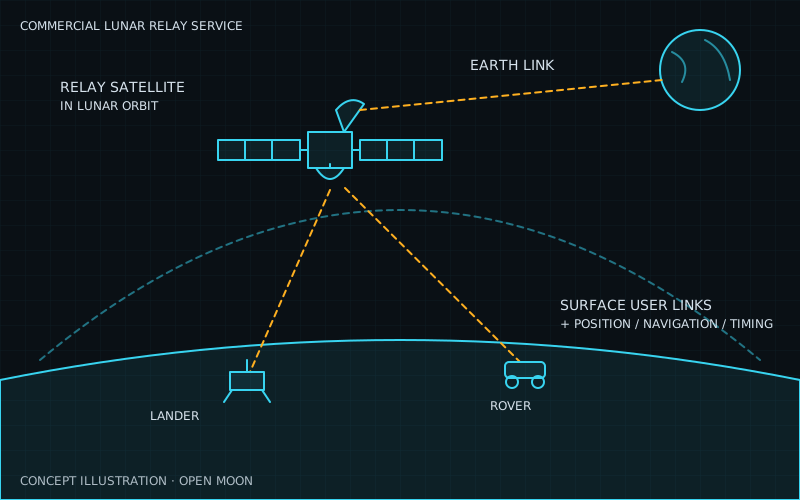
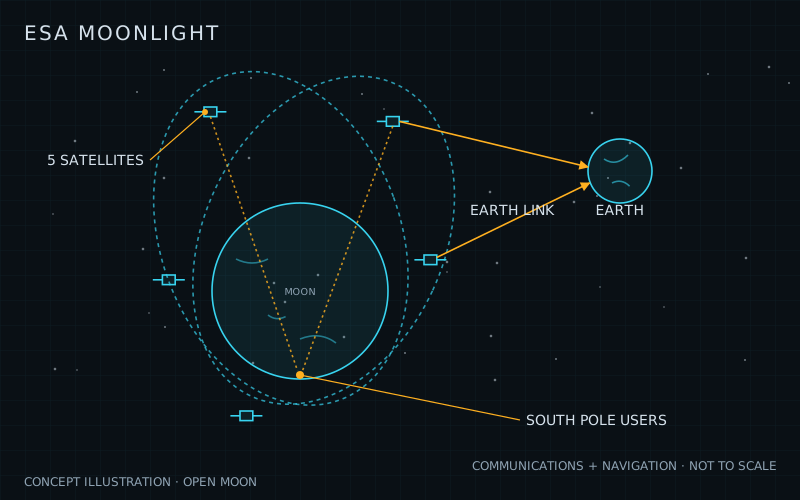
Milestone M03 does not build its own relay constellation. It buys service from several networks: NASA’s commercial relay (Intuitive Machines), ESA Moonlight and others. LunaNet is what makes that work. With one shared standard, a single radio and navigation receiver at the base can use any compliant provider, and a user can design “with the expectation of interoperability with multiple LunaNet 1.0 providers” (LNIS v5). NASA’s relay contract, worth up to $4.82 billion, covers both communications and PNT for the south pole region (NASA). Moonlight plans five satellites, four for navigation and one for communications, with the south pole as its priority (ESA).
Without a common standard, the base would need a different radio and a separate contract for each network. Losing one provider could then cut the link. Rover driving and landings would also lose a shared navigation signal that blends satellites from different agencies.
How it works
LNIS defines providers (LunaNet Service Providers) and the interfaces between providers and users, and between providers (LNIS v5). Its main parts are:
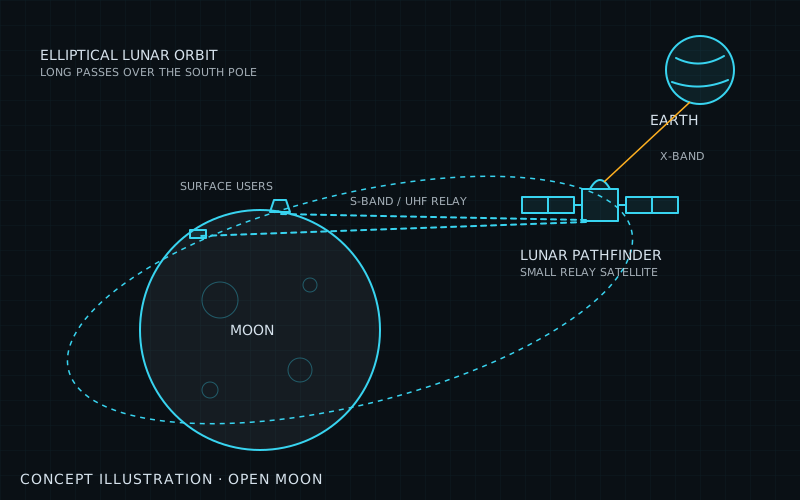
- Communications. Real-time IP services, plus delay-tolerant store-and-forward networking based on Bundle Protocol version 7 (RFC 9171) for when no end-to-end path exists (LNIS v5). To save congested S-band, S-band is used only for links near the Moon and X-band for direct-with-Earth links (same source).
- Navigation (LANS). The Lunar Augmented Navigation Service works like GPS. Satellites from different providers all broadcast the same CDMA signal, the AFS, on one frequency and are synchronised to LunaNet Reference Time. A user who sees four or more of them can work out position, velocity and time (LNIS v5). Because everyone shares one band and waveform, users “see” one virtual network (Schier et al.). LunaNet 1.0 is expected to serve the south pole region first. The full service volume covers the whole Moon up to at least 200 km altitude (LNIS v5).
- Messaging and point-to-point links. Standard messages carry clock, ephemeris, almanac, health and time-offset data, and two-way links can give ranging (LNIS v5).
| Item | Value in v5 |
|---|---|
| AFS centre frequency, bandwidth | 2492.028 MHz, 16.5 MHz (LNIS v5) |
| AFS data channel (I) | 1.023 Mchip/s, 500 symbols/s (AFS Vol-A) |
| AFS pilot channel (Q) | 5.115 Mchip/s, no data (AFS Vol-A) |
| Max signal-in-space error | ≤ 40 m position, ≤ 1 cm/s velocity (95%, both “to be confirmed”) (AFS Vol-A) |
| Proximity S-band | 2025–2110 MHz forward, 2200–2290 MHz return (LNIS v5) |
| Direct-with-Earth X-band | 7190–7235 MHz up, 8450–8500 MHz down (same source) |
| Direct-with-Earth K-band | 22.55–23.15 GHz up, 25.5–27.0 GHz down (same source) |
| Optical links | Not yet specified (same source) |
Limitations and open issues
- Much is still “to be decided”. We counted about 40 open TBD/TBR/TBC items in v5 (LNIS v5). The companion documents are still placeholders, including point-to-point signals, the message definitions, the lunar reference frame and time standard, data services and security (same source).
- No optical standard. Laser links are expected later but are not covered (LNIS v5), so Open Moon’s optical terminal will need provider-specific agreements.
- Interoperability not yet proven in flight. ESA plans the first lunar navigation interoperability tests for 2029 (ESA). A joint NASA–ESA–JAXA LANS demonstration is being studied for 2028–2029 (Gramling et al.).
- Compliance is per service. A provider does not have to offer every service, and extras outside the spec may not interoperate (LNIS v5). The base must check which services each contract actually covers.
- Spectrum not settled. Some lunar bands, including cellular surface bands, are not yet approved by the ITU (LNIS v5), and further decisions are expected at WRC-27 (Schier et al.).
- Not universal. LunaNet 1.0 providers come from NASA, ESA and Japan (LNIS v5). China is building its own Queqiao relay constellation for the ILRS (Planetary Society), so the base cannot count on it as a backup.
- Accuracy is modest at first. A 40 m signal error bound is coarse for landing-pad work. Open Moon will need extra local aids. No published figure gives LANS user accuracy at the south pole with LunaNet 1.0 coverage.
| Alternative | How it compares | Status |
|---|---|---|
| Bilateral agency cross-support using CCSDS standards | Each mission negotiates support agency by agency using existing CCSDS link and protocol standards. Proven for decades and already the base LunaNet builds on, but it covers no shared lunar navigation signal and needs a separate agreement and schedule for every provider. | Operational today for deep-space and lunar missions; CCSDS standards are published and maintained |
| China's Queqiao relay system and planned constellation | A separate national relay and navigation system serving Chang'e missions and the China-led ILRS. It already works at the Moon, but China is not among the LunaNet 1.0 partners (NASA, ESA, Japan), so a LunaNet radio cannot assume it can use it. | Queqiao-2 operating in lunar orbit since 2024; Tiandu-1 and -2 testing constellation technology |
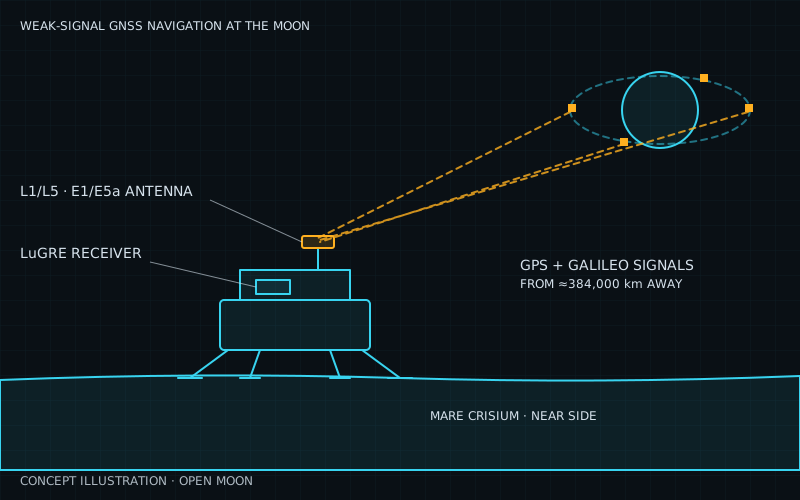
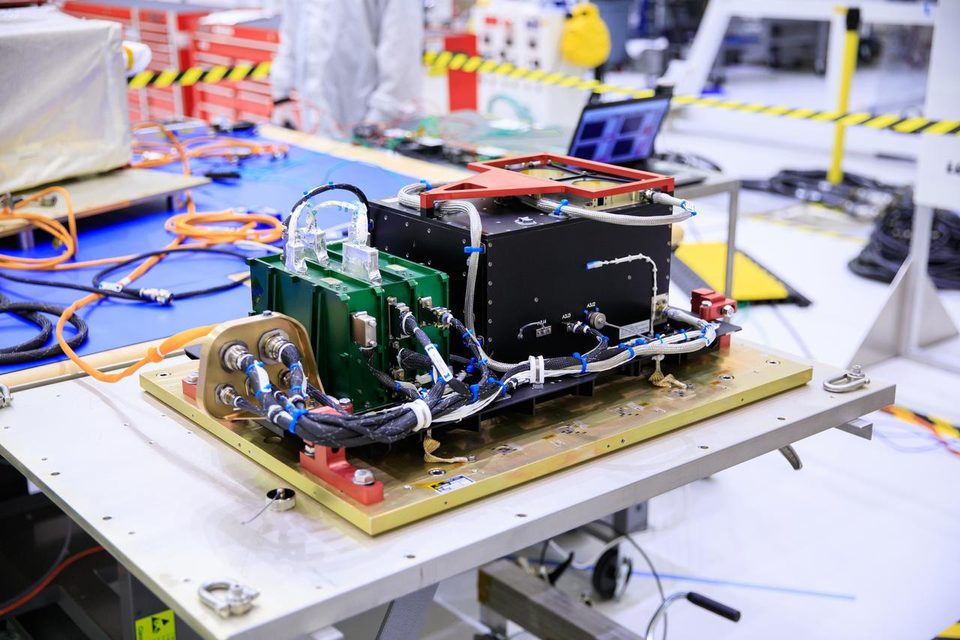
| Weak-signal Earth GNSS reception (LuGRE-type receiver) | Uses existing GPS and Galileo signals from Earth orbit instead of a lunar navigation service. No new satellites are needed, but signals are very weak at the Moon and accuracy is lower than a local service could give. | LuGRE acquired GNSS signals and made a navigation fix on the lunar surface in March 2025 |
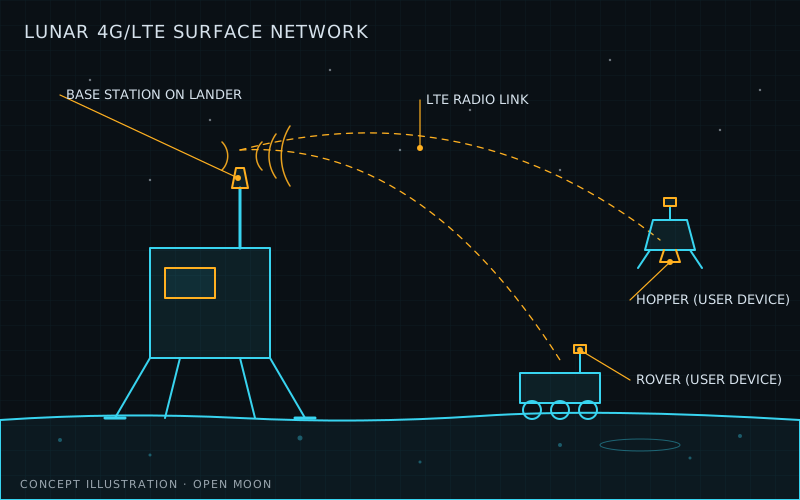
| 3GPP cellular (4G/5G) standards for the surface network | Uses terrestrial mobile standards for local surface links, with mass-market hardware and high data rates. It only covers the surface network, not relays, Earth links or navigation, and its lunar frequency bands are still under investigation. | Nokia completed a NASA systems study of a 3GPP-based lunar surface network for Artemis |
- official NASA: LunaNet Interoperability Specification (all versions) (Feb 2025)
- data LunaNet Interoperability Specification Document, Version 5 (LNIS V005 baseline) (Jan 2025)
- data LunaNet Signal-In-Space Recommended Standard, Augmented Forward Signal, Volume A (AD1 Vol-A) (Jan 2025)
- data LunaNet Interoperability Specification, Version 4 (Sep 2022)
- official ESA: Moonlight services, seeking feedback for updated LunaNet framework (Draft v5) (Sep 2023)
- official ESA: ESA launches Moonlight to establish lunar communications and navigation infrastructure (Oct 2024)
- official NASA: NASA selects lunar relay contractor for Near Space Network services (Sep 2024)
- paper Israel: LunaNet, a flexible and extensible lunar exploration communication and navigation infrastructure (IEEE Aerospace, NTRS) (Mar 2020)
- paper Schier et al.: International coordination and cooperation on LunaNet spectrum (Ka and Broadband Conference, NTRS) (2024)
- paper Gramling et al.: Towards LunaNet LANS interoperability demonstration and monitoring (SpaceOps 2025, NTRS) (2025)
- wiki LunaNet, Wikipedia (accessed Nov 2026)
- official NASA: NASA successfully acquires GPS signals on Moon (LuGRE) (Mar 2025)
Summary
| System | Communications and navigation |
| Phase | 1 |
| Milestones | M03 |
| Readiness | TRL 9 / 9 |
| Plan status | ready to use |
Sources
- NASA: LunaNet Interoperability Specification (status and facts)
- Reference for the illustration
More sources are on each milestone page that uses this technology.