Axiom AxEMU spacesuit
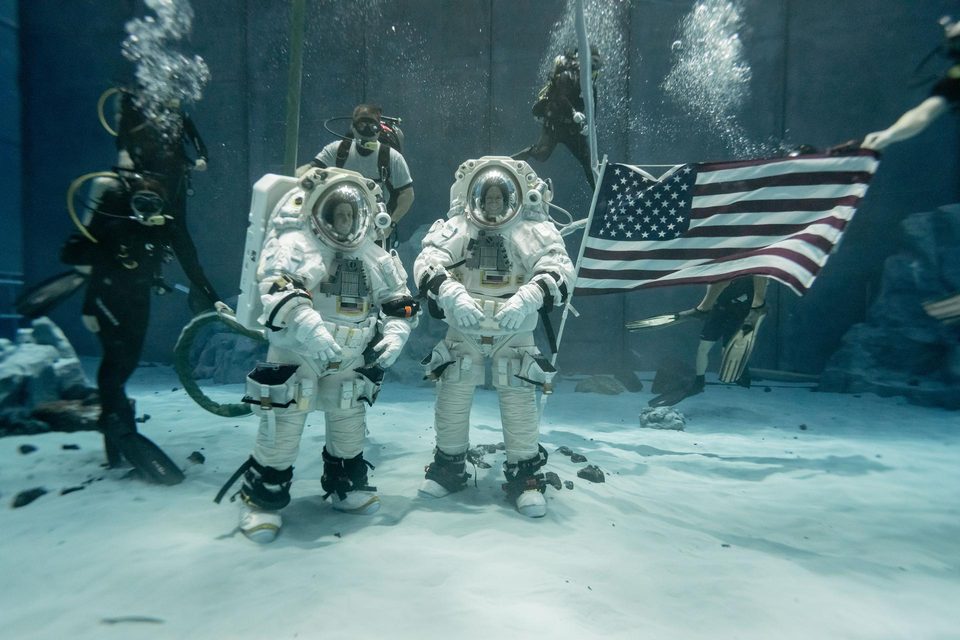
Critical design review closed 13 Nov 2026; qualification next
What it is
The Axiom Extravehicular Mobility Unit (AxEMU) is the spacesuit NASA’s Artemis astronauts will wear to walk on the Moon. It is built by Houston company Axiom Space. It is based on NASA’s own in-house Exploration EMU (xEMU) design, using NASA’s technical designs and data (Axiom). NASA spent over $420 million on the in-house xEMU before switching in April 2021 to buying spacewalks as a service (NASA OIG).
Under the xEVAS contract, NASA will not own the suits. It will rent spacewalking services from the company after a first demonstration. The contracts are worth up to $3.1 billion (NASA OIG). Axiom won the first task order, worth $228 million, in September 2022 to develop and demonstrate the lunar suit (Axiom). A prototype was shown in March 2023 (Axiom). The white flight design, with an outer layer developed with Prada, was shown in October 2024 (Axiom).
The suit closed NASA’s Critical Design Review on 13 November 2026 and now moves into production and qualification testing (Axiom). NASA and Axiom had logged over 850 hours of crewed pressurised testing by February 2026 (NASA). A test on the ISS is planned for 2027, and Artemis IV in 2028 is expected to be the first mission to use it on the lunar surface (Wikipedia).
Why Open Moon uses it
Every job outside the habitat needs a suit: setting up equipment, fixing power lines, driving rovers and collecting samples. Open Moon plans AxEMU-class suits for the crewed sorties of the first habitat (M08). Axiom is the only active provider under NASA’s xEVAS spacesuit contract. Collins Aerospace, the second xEVAS supplier, left the programme in 2024, so NASA now relies on Axiom for both its lunar and ISS suits (NASA OIG).
Without it, crews could not leave the cabin. The old ISS suit and the Apollo suits are not usable on the Moon. Apollo suits were custom-fitted, not built to last, and cannot be reused or refurbished (NASA OIG). A suit that can be maintained and reused is also key to a base that people visit again and again.
How it works
The suit has two main parts: a pressure garment that protects the body and lets it move, and a Portable Life Support System (PLSS) backpack. Axiom plans to finish the pressure garment and assemble the PLSS by early 2027 (Axiom). The PLSS removes carbon dioxide with a regenerable scrubber and removes heat with a cooling system. The suit has redundant systems and onboard diagnostics (Axiom).
Next to the skin is a Liquid Cooling and Ventilation Garment. Cold water flows through tubes over the major muscles and carries body heat to the PLSS, which dumps it to space. A second, fully redundant cooling loop is a backup. A separate gas loop blows oxygen across the face to wash away exhaled carbon dioxide (Axiom). New hip and knee joints let astronauts walk and kneel instead of the “bunny hopping” seen on Apollo (NASA OIG).
| Specification | Value |
|---|---|
| Spacewalk duration | At least 8 hours (Axiom) |
| Time in permanently shadowed regions | At least 2 hours (Axiom) |
| Crew sizing | 1st to 99th percentile, male and female (Axiom) |
| Crewed pressurised test time | Over 850 hours by Feb 2026 (NASA) |
| Mass, operating pressure | Not published |
Axiom builds batteries and valves in-house. Partners include Prada for soft goods, Nokia for lunar communications and Oakley for the visor (NASA OIG). A short-stay version, the AxEMU-S1 “Sortie suit”, shares the same certified parts for early Artemis landings (Axiom).
Limitations and open issues
- Schedule. Axiom first agreed to demonstrate the suit on the Moon in November 2025. As of January 2026 it aimed for demonstration readiness in late 2027. If testing follows historical averages, demonstrations would not happen until 2031 (NASA OIG).
- Testing still ahead. Qualification still needs performance, thermal vacuum, vibration and life-cycle testing before certification (Axiom). The suit has not yet flown in space.
- Single supplier. With Collins gone, there is no backup suit. The OIG warned NASA could be forced to change its spacewalk plans if Axiom cannot deliver (NASA OIG).
- Contract fit. The OIG found firm-fixed-price service contracts poorly suited to development work like spacesuits (NASA OIG).
- Dust. On Apollo, dust caused clogging, abrasion, poor heat rejection and seal failures, and ground tests consistently underestimated it (NASA NTRS). How well the AxEMU holds up over many reuses in dust is not yet shown.
- Service cost. The price per spacewalk for later missions is not public.
| Alternative | How it compares | Status |
|---|---|---|
| Collins Aerospace xEVAS suit | The second suit selected under NASA's xEVAS contract, aimed first at ISS spacewalks. It would have given NASA a second supplier, but Collins and NASA descoped its task orders in June 2024 over schedule, after NASA had spent $37 million. | Cancelled (descoped June 2024); no active lunar suit |
| NASA ISS Extravehicular Mobility Unit (EMU) | Flight-proven since 1983 with 203 ISS spacewalks, but built for microgravity, not walking or kneeling on the Moon. Its design is decades old, it has had helmet water leaks and thermal faults, and spare parts are getting hard to replace. | Operational on the ISS until about 2030; not certified for lunar surface use |
| Russian Orlan-MKS | A rear-entry semi-rigid suit used by cosmonauts on the ISS since 2017, about 110 kg with 7 hours of life support. Proven and easy to don, but designed only for orbital spacewalks, not lunar surface walking or dust. | Operational on the ISS (microgravity only) |
| China's Wangyu lunar suit | China's lunar surface suit for its crewed Moon landing planned before 2030. It is the only other lunar suit in active development, but it is tied to China's own programme and few technical details are published. | In prototype production and testing (named Feb 2025) |
- official Axiom Space: completes NASA's critical design review for next-generation spacesuit (Nov 2026)
- official NASA OIG IG-26-006: NASA's acquisition of next-generation spacesuit services (full report) (Apr 2026)
- official NASA OIG: Spacesuit development delays could impact Artemis timeline and ISS operations (Apr 2026)
- official NASA: Moon mission spacesuit nears milestone (850 hours of crewed pressurised testing) (Feb 2026)
- official Axiom Space, Prada unveil spacesuit design for Moon return (flight design and key capabilities) (Oct 2024)
- official Axiom Space, Prada unveil inner layer (Liquid Cooling and Ventilation Garment) (Jun 2026)
- official Axiom Space, KBR complete first uncrewed thermal vacuum test of AxEMU (Nov 2025)
- official Axiom Space reveals next-generation spacesuit for astronauts returning to lunar surface (Mar 2023)
- official Axiom Space awarded $228M task order under NASA spacesuit contract (Sep 2022)
- official Axiom Space: The next-generation spacesuit (AxEMU product page) (2026)
- wiki Wikipedia: Axiom Extravehicular Mobility Unit (Jun 2026)
- official Gaier, NASA/TM-2005-213610: The effects of lunar dust on EVA systems during the Apollo missions (Mar 2005)
- data NASA Image Library: O'Hara and Love in AxEMU suits, first dual-suit NBL run (Sep 2025)
- press SpaceNews: Axiom Space plans 2027 flight test of spacesuit (Apr 2026)
Summary
| System | Crew and health |
| Phase | 2 |
| Milestones | M08 |
| Readiness | TRL 6 / 9 |
| Plan status | ready to use |
Sources
- Axiom Space: completes NASA's critical design review for next-generation spacesuit (status and facts)
- Image: NASA
More sources are on each milestone page that uses this technology.